The Great Indian Wage Divide: An Autopsy of India’s ₹28,000 Average Salary Reality and the Road to 2047

NEW DELHI, India — The macroeconomic brochures handed to foreign institutional investors scream a breathless narrative of a runaway consumption boom, but the unvarnished payroll ledger tells a radically different, cutthroat story. Behind the glistening corporate glass towers of Gurugram and the venture-funded corridors of Bengaluru lies a stark, structural fault line: the national average monthly wage in India stands frozen at an austere ₹28,000 (approx. $335 USD).
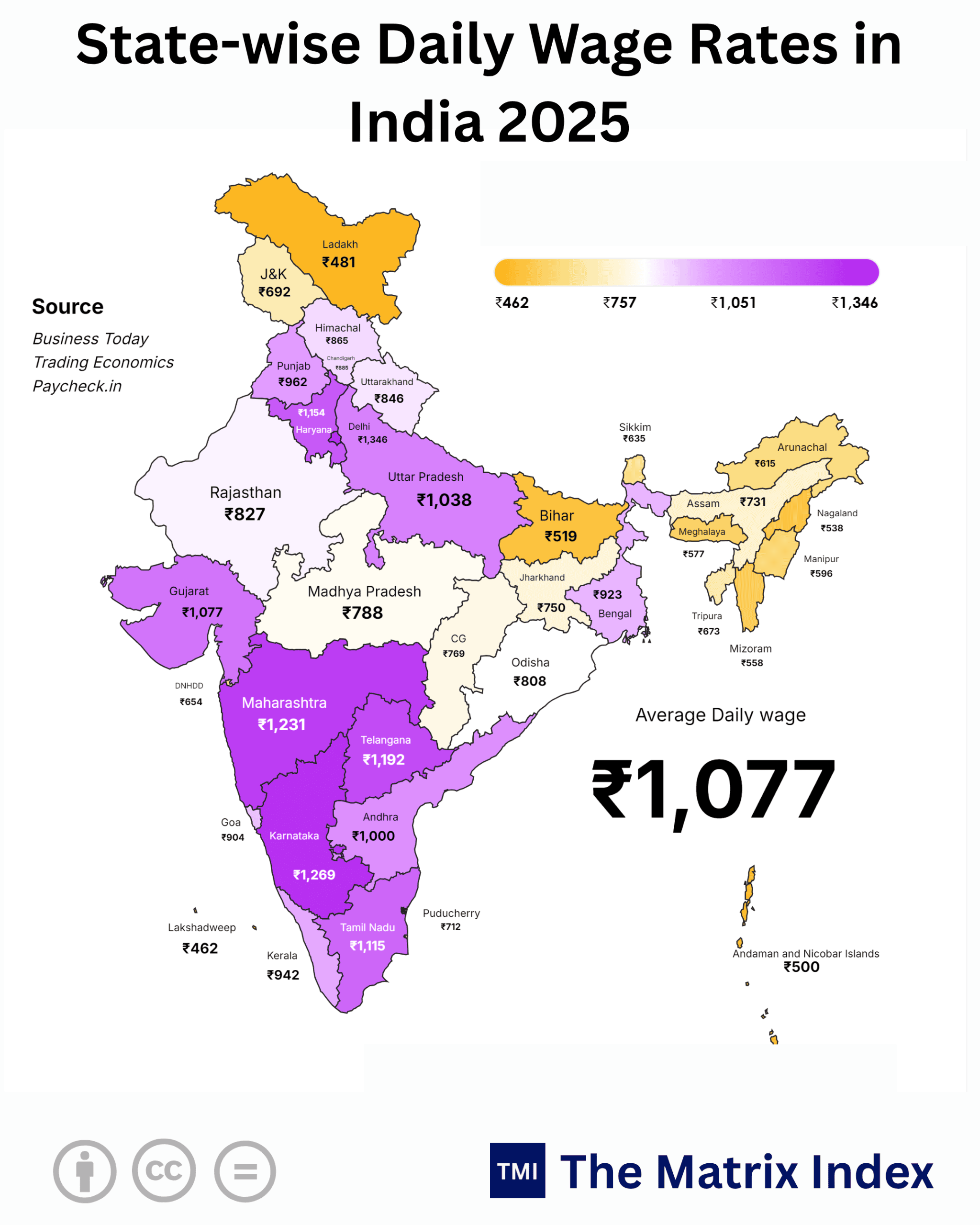
Look across the geographic map of the Republic. The distance between an executive drawing ₹35,000 on average in the national capital of Delhi and an agrarian laborer or contract worker scraping together ₹13,500 in Bihar is not merely a spatial gap of 1,000 kilometers; it is a chasm of two completely separate socio-economic civilizations operating inside a single currency union.
If you believe that aggregate GDP growth figures automatically translate into broad-based household wealth, it is time to wake up from that boardroom slumber. When 60% of an entire nation’s formal-informal blended workforce earns less than the cost of a mid-tier smartphone per month, the rhetoric of becoming a $10 Trillion economy by 2035 collides head-on with the limits of basic human arithmetic.
The Anatomy of the Wage Map: Micro-States, Mega-Gaps, and the ₹35,000 Ceiling
Let us dissect the empirical payroll data with surgical precision. The top tier of the Indian wage pyramid is dominated by five engines: Delhi (₹35,000), Karnataka (₹33,000), Maharashtra (₹32,000), Telangana (₹31,000), and Haryana (₹30,000).
These top five regions represent the epicenters of India’s modern service exports, multinational R&D centers, industrial finance, and centralized corporate administrative overheads. Karnataka’s ₹33,000 and Telangana’s ₹31,000 are direct derivatives of Bengaluru and Hyderabad acting as the back-office and code-engine of the global Fortune 500.
Yet, even in these high-performing states, the ceiling is startlingly low by international benchmarks. In Germany, the statutory minimum monthly wage for a warehouse worker exceeds €2,050 (₹1,85,000). In Japan, an entry-level clerk in Osaka earns upward of ¥240,000 (₹1,35,000). Even in Poland or Mexico, average monthly industrial compensation hovers comfortably between $800 and $1,200 USD (₹67,000 – ₹1,00,000).
The Indian top-tier average of ₹35,000 in Delhi is therefore not an elite figure on the global stage. It is an austerity budget that must absorb hyper-inflated urban rents, out-of-pocket private healthcare bills, and surging private education fees.
At the bottom of the table sits Bihar at ₹13,500, outpaced slightly by Nagaland (₹14,000), Mizoram (₹14,500), and Meghalaya (₹15,000). In Bihar, where over 120 million people reside, the average monthly wage of ₹13,500 translates to roughly $5.40 USD per day. That is barely above the World Bank’s extreme poverty threshold for lower-middle-income nations when accounting for family dependency ratios.
Complete State-by-State Payroll Matrix
The following dataset categorizes all 36 States and Union Territories, measuring their wage structures against economic profiles and output metrics.
(The Bitter Truth): Over 58% of Indian administrative territories sit below the national average benchmark of ₹28,000. More crucially, the Top 5 states generate over 44% of the country’s total formal wage pool, leaving the remaining 31 regions fighting over a stagnant residual economic pie.
The Global Benchmark: How India Compares Against Tier-1 & Tier-2 Powers
To understand why this internal wage compression matters, we must look through an international lens. Let us compare India’s numbers against both Tier-1 industrialized leaders and Tier-2 emerging market peers.
The Tier-1 Comparison: The Productive Automation Gap
In the United States ($4,950/mo) and Australia ($3,850/mo), wages are sustained by deep capital intensity per worker. A single logistics worker in Texas or Melbourne operates automated high-bay racking systems, routing software, and automated machinery that amplifies human labor output by 15x to 20x.
In India, wage formation remains deeply suppressed because businesses frequently substitute capital expenditure with cheap manual labor. When labor is artificially abundant and unorganized, corporate boardrooms choose to deploy ten low-wage contract laborers instead of investing in one high-efficiency automated processing line. The result is a self-reinforcing low-productivity, low-wage equilibrium.
The Tier-2 Comparison: The China and Vietnam Lesson
Consider China ($1,150/mo). In 2000, China’s average industrial wage was roughly on par with India’s, hovering around $60 – $80 USD per month. Over 25 years, China systematically consolidated supply chains, invested heavily in vocational worker certifications, built world-class port infrastructure, and moved up the value curve from cheap textiles to electric vehicle batteries and precision semiconductors.
Today, a factory worker in Shenzhen earns roughly 3.5 times more than a factory worker in Gujarat (₹28,000 / $335) or Tamil Nadu (₹29,000 / $346).
India’s industrial belt has failed to capture that level of wage appreciation because Indian manufacturing remains concentrated in lower-margin assembly rather than high-margin component fabrication and proprietary IP development.
The “So What?” Factor: The Triple Ripple Effect
What happens when the vast majority of a nation’s working population is anchored to an average monthly salary of ₹28,000? Let us trace the ripple effects across three core pillars of the economy.
A. The Common Citizen (The Squeezed Household)
For a family of four living in a Tier-2 city like Lucknow (Uttar Pradesh: ₹27,000) or Bhopal (Madhya Pradesh: ₹20,500), a monthly income of ₹20,000 – ₹27,000 provides zero margin for error:
-
Food and retail inflation absorb roughly 50% to 60% of disposable income.
-
Unregulated private school fees consume another 15% to 20%.
-
Out-of-pocket medical emergencies routinely wipe out lifetime savings, forcing families into the hands of local moneylenders charging 24% to 36% annual interest.
-
The dream of homeownership remains mathematically impossible without 30-year debt structures that eat up 45% of monthly household cash flows.
B. The Investor Community (The Consumption Ceiling)
Equity strategists on Dalal Street frequently celebrate India’s 1.45 billion population as an infinite domestic consumer market. The reality is that the addressable market for premium discretionary goods cars priced above ₹15 Lakh, high-end consumer electronics, luxury apparel, and international vacations is capped at roughly 40 to 60 million individuals.
The remaining 1.38 billion citizens are managing basic daily sustenance. Companies banking on an endless upgrade cycle are hitting a structural ceiling because real wage growth has not matched retail price inflation over the last five years.
C. Industrial Enterprises (The Low-Skill Trap)
Corporate balance sheets benefit from low wage bills in the short term, but they pay for it through chronic skill shortages and high attrition rates in entry-level positions.
When an employee earns ₹18,000 in Jammu & Kashmir or ₹19,500 in Jharkhand, their motivation to upskill or maintain operational loyalty collapses. Workers constantly churn between jobs for incremental raises of ₹500 to ₹1,000, depressing shop-floor productivity across manufacturing hubs.
Seasonality, Distortion, and Anomaly Alerts
Any senior economic strategist looking at this data must immediately flag the structural anomalies baked into these headline numbers.
The Extreme Skew of City-State Hubs
The numbers for Karnataka (₹33,000) and Maharashtra (₹32,000) are heavily distorted by single metropolitan clusters. Strip away the corporate tax bases and salary pools of Bengaluru Urban from Karnataka, and the average salary across the remaining agrarian districts (such as Raichur, Koppal, or Yadgir) drops instantly to ₹17,000 – ₹19,000.
Similarly, Maharashtra’s ₹32,000 average is held up entirely by the Mumbai-Thane-Pune industrial triangle; the agrarian hinterlands of Marathwada and Vidarbha operate on wages that look identical to those in Odisha (₹21,000) or Chhattisgarh (₹20,000).
The Informal Economy Blindspot
Official salary datasets capture primarily formal, EPFO-registered payrolls, organized enterprise declarations, and structured wage surveys. They under-represent the vast, unorganized informal workforce that constitutes nearly 80% to 85% of India’s total labor deployment.
If daily wage laborers, gig-economy delivery riders, contract farm hands, and informal domestic workers are factored into the calculation, the true median national monthly take-home drops from the reported ₹28,000 average down to an estimated ₹15,000 – ₹17,000.
Structural Wage Comparison Across Sectors
To understand the mechanics of this wage stagnation, we must break down where capital is flowing and where it is stagnating across primary, secondary, and tertiary sectors.
(The Golden Opportunity): The massive divergence between IT/BFSI and Textiles/Construction highlights the clear solution: moving 100 million workers from low-yield agriculture (₹8,500) into mid-tier precision manufacturing and industrial assembly (₹24,000 – ₹42,000) can double their real household income within 3 to 5 years.
Two-Sided Risk Assessment: Bull vs. Bear Case
Every forward-looking economic thesis must weigh both scenarios. Can India break through this middle-income salary trap, or will it remain locked in wage stagnation?
The Bull Case: The Global Value Chain Integration (2026–2035)
-
The PLI & Global Supply Chain Relocation: As multinational conglomerates diversify manufacturing operations away from concentrated hubs in East Asia, states like Tamil Nadu (₹29,000), Gujarat (₹28,000), and Uttar Pradesh (₹27,000) capture high-value electronics, aerospace, and green-energy component manufacturing. Factory wages rise by 8% to 10% compounded annually.
-
Infrastructure-Driven Logistics Efficiency: The completion of Dedicated Freight Corridors (DFCs) and high-speed multi-modal logistics parks lowers domestic freight costs from 13% of GDP to under 9%. This margin expansion allows domestic manufacturers to increase worker pay scales.
-
The Tier-2/Tier-3 Knowledge Expansion: Global Capability Centers (GCCs) expand beyond Bengaluru and Hyderabad into cities like Coimbatore, Indore, Bhubaneswar, and Jaipur, elevating local median salaries by 30% to 50%.
The Bear Case: The Premature De-industrialization & AI Headwinds
-
The Generative AI Shock: India’s classic economic elevator the entry-level software testing, IT maintenance, and business process outsourcing (BPO) desk faces direct automation from enterprise AI agents. Entry-level white-collar salaries in Karnataka, Delhi, and Telangana stagnate in real terms.
-
Industrial Automation Bypassing Human Labor: Modern manufacturing plants are deploying industrial robotics far earlier in their growth cycles than Western economies did at comparable development stages. Factory output expands, but factory headcounts remain flat, dampening employment generation.
-
The Demographic Drag: Over 10 million youth enter the labor market annually. If industrial job creation fails to match this supply, the surplus pool of jobseekers will bid down entry-level compensation, locking the national wage average near ₹28,000 in real terms through 2030.
The Alternative Scenario: The Cost of Inaction
What happens if policymakers and industry leaders maintain the status quo?
If industrial policy focuses solely on capital-intensive mega-projects (such as automated refineries and chip fabrication plants) while ignoring labor-intensive apparel, toy, leather, furniture, and light-machinery ecosystems, India risks replicating Latin America’s economic trajectory:
-
A small, highly skilled urban elite earning international salaries in five or six metropolitan pockets.
-
A vast, underemployed hinterland dependent on state welfare, free grains, and informal gig economy platforms.
-
A domestic market incapable of supporting high-value industrial production because the broad public lacks the purchasing power to buy the products they manufacture.
The Strategic Blueprint: 5 Structural Interventions
To shift the national wage curve from an average of ₹28,000 to ₹75,000+ by 2035, economic planners must execute five decisive interventions:
-
Establish Special Manufacturing Zones in Lower-Wage States: Instead of concentrating new investments in high-cost metro regions, direct tax incentives and subsidized power toward Bihar (₹13,500), Jharkhand (₹19,500), and Odisha (₹21,000). Build mega industrial parks directly where labor is abundant, eliminating the social and economic costs of distressed urban migration.
-
Modernize Vocational Apprenticeship Models: Tie college curriculums directly to industrial apprenticeships modeled on the German Dual Education system. Pay standardized stipends co-funded by the state and private enterprises to build real industrial skills.
-
Reduce Direct Payroll Taxes on Entry-Level Hires: Eliminate employer provident fund and state insurance compliance burdens for all new manufacturing hires earning under ₹30,000 for the first three years, encouraging companies to shift workers from cash wages to formal contracts.
-
Build Dedicated Agricultural Processing Hubs: Raw crop exports generate minimal worker value. Transitioning farm output into packaged food processing inside states like Madhya Pradesh and Punjab keeps profit margins and higher wages within rural economies.
-
Decentralize Public Capital Outlays: Allocate national infrastructure funds toward secondary and tertiary municipal connectivity, enabling Tier-3 industrial clusters to access international seaports at low transit cost.
The Verdict: The Road to 2030 and Vision 2047
As India approaches the centenary of its independence in 2047, the standard of success cannot be measured solely by headline GDP rankings or the market capitalization of the Nifty 50. The definitive test of economic development is whether the average citizen in Patna, Ranchi, or Guwahati commands the earning power to live with dignity, build generational wealth, and participate fully in the modern economy.
A national average monthly salary of ₹28,000 is an intermediate milestone, not a final destination. If India is to join the ranks of high-income industrialized nations, this wage base must grow at a real rate of 7% to 9% annually over the next two decades.
That acceleration will not happen through financial engineering or service-sector hubs alone. It requires turning India’s under-industrialized hinterlands into productive manufacturing centers. The talent is present, the demographic window is open, and the data provides a clear roadmap. The only remaining question is whether policymakers and industry leaders have the will to build a high-wage economy.
Data Source:
- Ministry of Statistics and Programme Implementation (MoSPI)
- Periodic Labour Force Survey (PLFS)
- Forbes Advisor India
- World Bank Development Indicators.
Disclaimer: This report is for informational and analytical purposes only and does not constitute formal financial, investment, or policy advice.