The MBA Factory Mirage: How 5,800 Business Schools Are Distorting India’s Demographic Dividend and Global Capital Efficiency

NEW DELHI, India — India is operating the largest management credentialing assembly line on planet Earth, yet over 75% of its management graduates remain structurally unemployable for high-tier analytical, strategic, or corporate finance roles.
Official Ministry of Education census figures reveal a staggering national infrastructure of 5,800 Business Schools distributed across the subcontinent. On paper, this colossal network promises a steady stream of elite corporate leaders ready to power India’s charge toward a $10 Trillion economy by 2035 and a developed Viksit Bharat by 2047.
Look past the brochures and high-rise glass campuses, however, and the reality is stark: India has engineered an educational real estate bubble that monetizes middle-class anxiety while flooding the market with unspecialized generalists.
The Geographic Skew: Industrial Corridors vs. Educational Deserts
The spatial distribution of management education across India defies basic economic logic. It does not reflect a balanced, long-term human capital strategy. Instead, it mirrors real-estate speculation and state-level licensing deregulations that peaked over the last two decades.
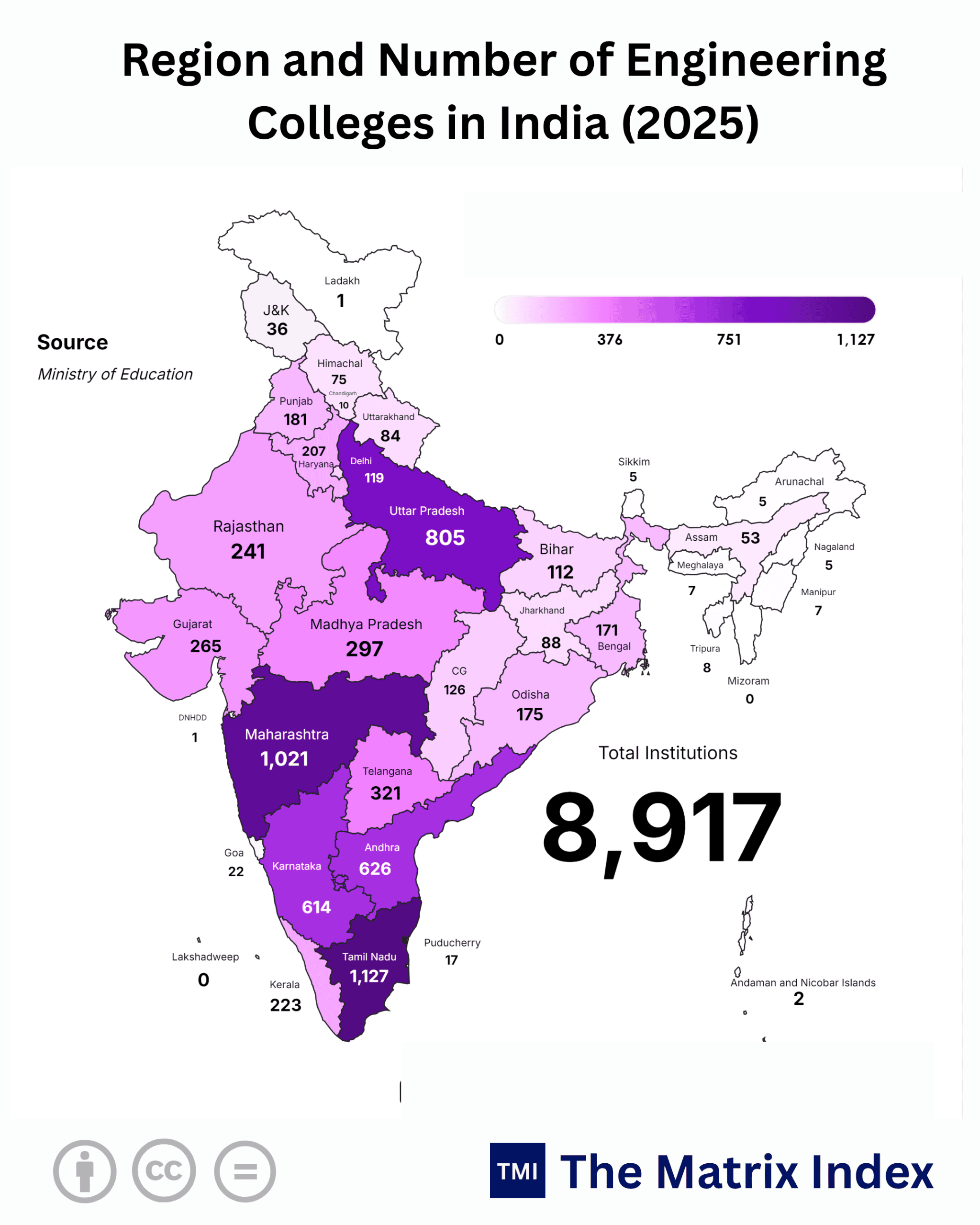
A concentrated pocket of just five states Maharashtra (1,015), Uttar Pradesh (885), Tamil Nadu (612), Karnataka (558), and Andhra Pradesh (432) warehouses 3,508 business schools. That accounts for 60.48% of the entire country’s management education capacity.
The Western Industrial Conglomerate
Maharashtra sits at the apex with 1,015 institutions (17.50% of the national share). The state leverages the financial gravity of Mumbai and the manufacturing-IT corridor of Pune. However, this hyper-concentration creates severe hyper-competition.
Dozens of mid-tier and low-tier private universities build campuses adjacent to sugar cooperatives and peripheral industrial zones, charging premium tuitions for sub-par training in generic administrative workflows.
The Northern Demographic Cauldron
Uttar Pradesh ranks second with 885 institutions (15.26%). Unlike Maharashtra, UP’s expansion is not driven by corporate absorptive capacity; it is driven by sheer demographic mass and high youth underemployment.
Private institutions across Greater Noida, Lucknow, and Kanpur absorb hundreds of thousands of graduates each year who are attempting to escape agrarian underemployment or dead-end civil service exam cycles. They trade two years of family savings for an accreditation that yields starting corporate salaries barely above minimum wage.
The Southern Technology Hubs
The southern belt Tamil Nadu (612), Karnataka (558), Andhra Pradesh (432), and Telangana (287) collectively accounts for 1,889 institutions (32.57% of the national total).
While Bengaluru and Hyderabad serve as genuine innovation engines absorbing product managers and data analysts, the vast majority of institutes in Tier-2 and Tier-3 towns (such as Coimbatore, Belagavi, Guntur, and Warangal) operate as low-grade training centers feeding lower-tier IT back-offices, customer operations, and outsourced business services.
Complete State-Wise Density & Structural Footprint
Below is the definitive national audit of India’s 5,800 Business Schools based on 2025–2026 Ministry of Education institutional records.
Complete National Distribution of Business Schools (Census Year 2025–2026)
More than 70% of these 5,800 institutions lack verified corporate hiring pipelines. They operate primarily as fee-collection engines rather than catalysts for economic transformation.
The Global Human Capital Architecture: India vs. Tier-1 & Tier-2 Economies
To understand the scale of institutional bloat in India, we must benchmark these figures against global economies. The discrepancy is not merely numerical; it is structural.
Global Structural Comparison: Institutional Density vs. Value Creation
If India restructures its bottom 4,000 institutions to follow the German dual-study model (integrating them directly into factory floors and tech stacks), it could create the world’s most formidable applied operational workforce.
The United States: Capital Specialization
The United States maintains roughly 600 AACSB-accredited business schools. These programs focus heavily on capital markets, venture ecosystems, scalable product management, and corporate law.
US business schools act as gatekeepers to the world’s most liquid private capital pools. Conversely, the vast majority of India’s 5,800 institutions operate without meaningful research funding or access to early-stage venture ecosystems.
Germany: The Dual-Study Precision Engine
Germany avoids generic business training altogether. Its 120 business faculties and Fachhochschulen run integrated dual-study models. Students spend 50% of their academic calendar inside manufacturing firms, engineering houses, and supply chain hubs.
In India, a management student can complete an entire two-year MBA without spending a single week on an operational factory floor or examining an enterprise ERP system.
China: State Industrial Alignment
China restructured its management education pipeline over the past decade, capping generic business programs at roughly 300 elite institutions.
The Chinese Ministry of Education directly aligned curriculum outcomes with national strategic priorities: battery supply chains, semiconductor manufacturing, robotics logistics, and high-frequency international trade corridors across Southeast Asia and Africa.
The “So What?” Factor: Real-World Economic Fallout
What happens when an economy produces over 600,000 management graduates every year without matching industrial demand? The repercussions ripple across three critical pillars of the national economy:
The Household Ripple: Middle-Class Capital Destruction
The average Indian middle-class family spends between ₹6,00,000 and ₹18,00,000 ($7,200 to $21,600) on a private Tier-2 or Tier-3 MBA program. This investment is frequently financed through personal loans, gold pledges, or liquidated family land.
When the graduate secures a job paying just ₹22,000 to ₹35,000 per month in business development or insurance sales, the loan payoff period stretches beyond 7 to 10 years. The return on investment turns negative in real terms once inflation is accounted for.
The Corporate Ripple: The Retraining Tax
India Inc. incurs massive hidden operational costs to retrain new hires. Large IT services firms, retail banks, and FMCG conglomerates spend 3 to 6 months putting incoming MBAs through internal basic training academies.
Companies are forced to spend resources teaching basic corporate accounting, Python automation, enterprise SQL, and business writing. This dynamic acts as a private corporate tax on human capital development, suppressing median corporate wages across the board.
The Industrial Ripple: The Generalist Trap
While global industries demand specialized talent in supply chain forecasting, semiconductor logistics, clinical trial management, and clean-tech project finance, Indian business schools continue to churn out generic “Marketing & HR” administrators.
The resulting skills mismatch starves emerging sectors of operational leadership, forcing multinationals to import foreign talent or offshore core strategic roles to Singapore, London, and Dubai.
Seasonality & Anomaly Alert: Growth Engine or Real Estate Bubble?
Is the rapid rise of private business schools over the past two decades a genuine response to economic demand, or an institutional bubble driven by favorable real estate dynamics?
1. Land-Banking Arbitrage
Between 2004 and 2018, establishing an educational trust offered a reliable path to converting agricultural land on the outskirts of Tier-1 and Tier-2 cities into tax-exempt institutional real estate.
Promoters capitalized on this regulatory opening to build large, under-utilized physical campuses. The business school was often treated as an operational cash cow designed to service debt on the underlying real estate asset.
2. The Placement Metric Illusion
The headline placement statistics published by many private business schools obscure low-quality employment outcomes.
Graduates placed in contract-based business development (such as cold-calling for consumer tech and insurance distribution) are frequently counted as “Fully Placed.“
Within 90 to 180 days, attrition rates in these roles regularly exceed 40%, returning underemployed youth to the job market with unserviceable education loans.
3. The Artificial Intelligence Margin Squeeze
The global shift toward generative AI workflows, automated financial modeling, and AI-driven CRM systems is rapidly eliminating the manual reporting and administrative jobs that historically absorbed low-tier Indian MBAs.
Institutions that fail to teach automated data pipelines, direct API integrations, and specialized supply chain architecture face sharp drops in placement volume over the next three to five years.
Two-Sided Risk Assessment: Bull vs. Bear Case (2026–2035)
The Bull Case: The Global Capability Center (GCC) Supercycle
-
GCC Expansion Engine: India currently hosts over 1,600 Global Capability Centers, with projections pointing to 2,500+ by 2030. These centers are transitioning from back-office support to core operational hubs for multinational firms.
-
Tier-2 Talent Integration: As top-tier metros face escalating commercial real estate and talent costs, GCCs are expanding into Tier-2 hubs like Pune, Jaipur, Coimbatore, and Bhubaneswar.
-
Industrial Specialization: Programs that pivot quickly toward defense manufacturing management, renewable energy economics, and high-tech supply chain administration will see strong wage premiums and high placement demand.
-
Market-Driven Consolidation: The natural closure of low-quality business schools will allow well-capitalized institutions to acquire distressed assets, standardizing curriculum quality nationwide.
The Bear Case: Structural Devaluation of the Generic MBA
-
Automation of Entry-Level White-Collar Work: AI agents and automated enterprise software are directly replacing entry-level analysts, digital marketers, and baseline recruiters, removing the traditional safety net for average graduates.
-
Debt Deficits in the Middle Class: Rising default rates on unsecured education loans could trigger credit tightening among private non-banking financial companies (NBFCs), cutting off tuition flows to non-accredited private colleges.
-
Severe Wage Stagnation: If annual B-school output remains disconnected from industrial demand, real entry-level wages for graduates outside the top 100 institutions will continue to lag headline inflation.
-
Institutional Closures: Over 1,500 sub-scale business schools could face financial unviability before 2030, leaving behind stranded assets, unpaid faculty, and localized real-estate distress.
The Alternative Scenario: The Policy Shift Playbook
What happens if the Union Government, AICTE, and state higher education boards aggressively reform management education over the next 24 to 36 months?
The Decoupling from UGC/AICTE Legacy Frameworks
If policymakers replace antiquated classroom attendance rules with mandatory 50% industrial apprenticeships, the standard MBA structure will split into two distinct tracks:
-
Strategic Research & Venture Leadership: A small tier of 100 to 150 elite institutions focused on high-stakes corporate strategy, deep tech commercialization, and venture capital management.
-
Applied Industrial Operations (AIO): The remaining thousands of regional institutions restructured into technical operations centers, training plant managers, warehouse logistics controllers, healthcare administrators, and global trade coordinators.
The “Sponsor-Or-Shutter” Mandate
Under this alternative framework, private business schools would be legally required to secure direct corporate co-sponsorship for at least 40% of their operational seat capacity.
Institutions unable to establish verified corporate hiring consortiums within three consecutive academic cycles would lose accreditation. This mechanism would quickly eliminate low-quality operators, reallocating human capital toward practical technical vocations.
Strategic Roadmap: Transforming India’s Management Ecosystem
Transforming 5,800 fragmented business schools into a globally competitive asset requires targeted structural reforms across institutional tiers.
Priority Reforms for Institutional Leaders & Regulators
-
Enforce Independent Placement Audits: Mandate that all business schools submit audited tax-return-verified placement data (via the Indian Placement Reporting Standards) before publishing annual marketing material.
-
Tie Curriculums to Industry Operations: Replace generalist textbooks with live business simulations, SQL/Python data processing, industrial ERP environments, and cross-border customs mechanics.
-
Incentivize Regional Mergers: Offer tax-efficient frameworks for smaller colleges (sub-120 seat capacities) to merge into larger regional polytechnic universities with unified corporate placement offices.
-
Integrate Applied Faculty: Require that at least 35% of all core management credits be taught by active corporate executives, entrepreneurs, and industrial engineers rather than career academics.
My Verdict: 2026–2030–2047 Horizon
India’s demographic dividend is not an infinite resource. It is a time-sensitive demographic window that will begin closing by 2040.
Having 5,800 business schools across the country could become a powerful demographic asset or remain a costly economic liability.
If this vast infrastructure continues to operate as an unregulated, generalist credentialing system, it will keep producing underemployed graduates burdened by personal debt, dampening domestic productivity and straining the middle class.
Projections for the Next Two Decades:
-
By 2028–2030: The market will force a wave of consolidation. Up to 25% of unaccredited, sub-scale institutions will close or convert into specialized vocational colleges as parents demand transparent, verified placement outcomes.
-
By 2035: The successful institutions will be those that aligned with India’s manufacturing, GCC, and infrastructure expansions. The generic “MBA” will largely be replaced by specialized degrees: Supply Chain Engineering, Health Systems Management, and FinTech Architecture.
-
By 2047: To power a $30+ Trillion globalized Indian economy, the nation will require top-tier management institutions capable of competing directly with Harvard, INSEAD, and London Business School, while its broader network of institutes supplies specialized operational talent across Asia, Africa, and the Middle East.
The Immediate Call-to-Action:
-
For Students & Parents: Stop buying the “MBA” label on prestige alone. Demand audited median salary data, inspect faculty publication and consulting records, and refuse to take on high-interest personal debt for non-accredited generalist programs.
-
For Business School Founders: Liquidate outdated administrative curriculums immediately. Rebuild your syllabus around deep industry partnerships, operational technology stacks, and enterprise data fluency.
-
For Policymakers: End the era of rubber-stamp approvals. Mandate transparency, audit placement claims through tax-verified databases, and align institutional licensing with India’s real industrial goals.
The era of the frictionless credential mill is over. The era of verifiable economic value has begun.
GOOGLE ‘PEOPLE ALSO ASK’ FAQs
Q1. How many business schools currently operate across India?
5,800 institutions currently operate across India, with Maharashtra leading at 1,015 and Uttar Pradesh holding 885. Just five states house over 60.48% of the country’s entire management education infrastructure.
Q2. What is the real employability rate of Indian MBA graduates?
Less than 22% of graduates from non-tier-1 business schools meet tier-1 corporate hiring criteria. Over 75% enter low-wage contract sales or customer operations roles that fail to beat domestic inflation rates.
Q3. Why does India have an oversupply of MBA institutions compared to the US and Germany?
India’s 5,800 institutions far exceed the US (600) and Germany (120) due to historical educational real-estate speculation. This commercial model expanded generic classroom capacity without integrating enterprise tech stacks or dual-study industrial apprenticeships.
Q4. How will artificial intelligence impact low-tier business school placements by 2030?
Over 40% of entry-level business analytics, basic finance, and digital marketing roles will be displaced by automated enterprise agents before 2030. Unaccredited generic programs face imminent closure without advanced technical curriculum pivots.
Q5. What is the average ROI timeline for a middle-class Indian MBA investment?
Between 7 and 10 years is the standard repayment timeline for a ₹6,00,000 to ₹18,00,000 degree outside elite hubs. Starting corporate salaries of ₹22,000 to ₹35,000 monthly produce negative net yields under inflation.
Data Source:
- Ministry of Education (India)
- AICTE Institutional Census Records
- AACSB International Benchmarks
Disclaimer: This report is for informational and analytical purposes only and does not constitute formal financial, investment, or policy advice.