The Fragile Union: Sub-National Fiscal Insolvency, Deceptive Liquidity, and the Anatomy of India’s 2026–2047 Economic Fracture
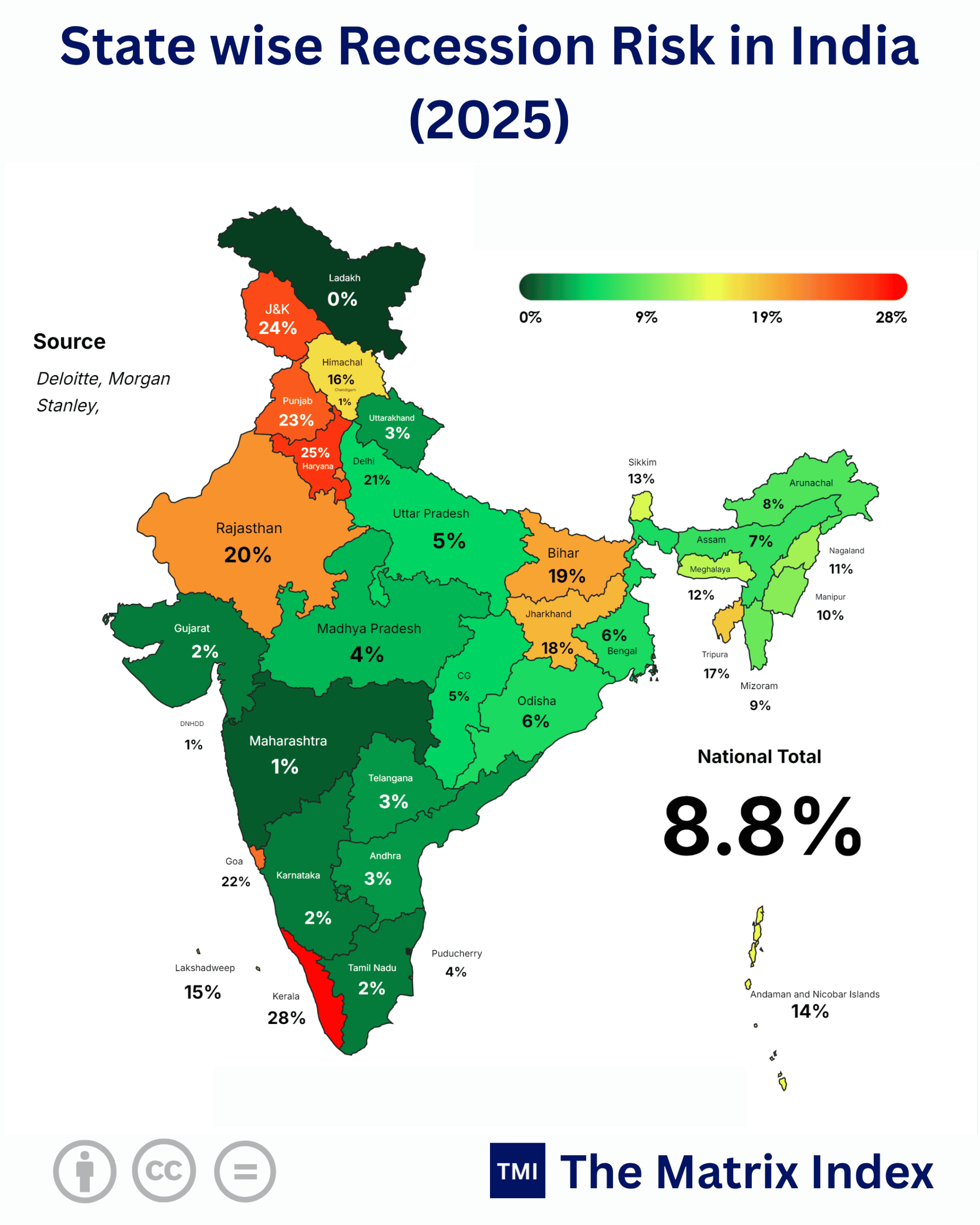
NEW DELHI, India — Headline GDP metrics tell a comforting lie, and global investment desks have swallowed it whole. While macro-level talking heads obsess over national-level expansions and boast of an 8.8% national recession probability benchmark, a predatory insolvency cycle is quietly eroding the structural foundations of the Indian union. Economic health is never uniform. Money is cowardly; it runs from systemic rot long before governments print revised balance sheets.
Behind the triumphant central aggregate lies an unvarnished economic reality: sub-national economic stress is decoupling state balance sheets from sovereign narratives. Several flagship state economies are sleepwalking directly toward local liquidity crunches. When a state stumbles, sovereign central banks cannot simply wave away the debris without devaluing currency, gutting capital projects, or forcing austerity directly down citizen throats.
The Deceptive National Mean vs. Sub-National Freefall
Look at the divergence. An aggregate national average of 8.8% suggests relative macroeconomic resilience to an institutional fund manager sitting in New York, London, or Tokyo. But look closer. That number is an intellectual sedative. It conceals an internal spread spanning 28% in Kerala to a rock-bottom 1% in Maharashtra, with Ladakh anchoring the bottom of the table at 0%.
Think of this disparity like the eurozone debt drama of 2010. The headline European aggregate masked the fact that Greece, Spain, and Italy were drowning in debt while Germany exported its way into trade windfalls. In India, fiscal imbalances are reaching a similar boiling point. Wealth generation in Gujarat (2%), Karnataka (2%), and Tamil Nadu (2%) subsidizes unsustainable, politically driven consumption models across the north and extreme south.
Strip away accounting tricks, delayed pension disbursements, and off-budget liabilities, and sovereign guarantees look worryingly hollow. The old adage rings true: “A chain is only as strong as its weakest link.” By treating the republic as a monolith, institutional capital ignores ticking balance-sheet time bombs across several regional capitals.
The Anatomy of Vulnerability: High-Risk States and Structural Decay
The alarm bells are ringing loudest at the top of the risk index. Kerala (28%) and Punjab (23%) represent two distinct varieties of structural decay: demographic exhaustion alongside long-term systemic erosion.
Kerala’s revenue apparatus is hitting a wall. It behaves like an economy running on credit-fueled consumption, financed by Gulf remittances and state borrowing. When middle-eastern labor markets tighten or global inflation bites into those remittances, the state machine strains to pay basic salaries and pensions. The debt-to-Gross State Domestic Product (GSDP) ratio here hovers near 38%, starving capital investments of needed funds.
Punjab presents an even starker fiscal picture. A breadbasket economy trapped in an unsustainable cycle of groundwater exhaustion, debt rollover, and agricultural handouts, its debt-to-GSDP ratio has breached 48%. The state functions less as an engine of wealth creation and more as a debt-servicing pipeline. Almost its entire net borrowing goes toward servicing legacy obligations. This dynamic mirrors the rust-belt collapse of Detroit, USA, or the de-industrialized valleys of northern England, where fixed costs crowd out any chance for future modernization.
Then consider the institutional blind spots: Haryana (25%), Jammu & Kashmir (24%), Goa (22%), and Delhi (21%).
Haryana’s vulnerability exposes its extreme internal economic divide. Strip away the corporate tax revenues of Gurugram, and you are left with an agrarian belt burdened by land misallocation, soaring youth unemployment, and ballooning state-backed liabilities.
Delhi’s 21% vulnerability reveals the limits of a model that leans heavily on subsidizing household utilities without expanding its physical industrial base. As the capital, its tax engine is cushioned by retail density and services. Yet its balance sheet is running out of headroom as operating expenditures edge out productive municipal investment.
The Industrial Shock-Absorbers: Sub-5% Fiscal Bastions
At the other end of the ledger, a tight cluster of industrialized powerhouses operates almost like an entirely different national economy. Maharashtra (1%), Gujarat (2%), Karnataka (2%), and Tamil Nadu (2%) remain firmly shielded from serious recessionary threats.
These states have built diversified economic bases that mirror the industrial ecosystems of Baden-Württemberg, Germany, or Guangdong, China. They run active manufacturing clusters, handle deep institutional export flows, capture primary technology investments, and attract steady domestic corporate liquidity.
These four states alone generate roughly one-third of India’s total economic output. Because their local tax engines run on commercial transactions, corporate investments, and property gains rather than short-term consumption debt, they absorb external shocks far better than their peers.
Telangana (3%) and Andhra Pradesh (3%) have largely managed to contain their downside exposure by securing strong services and infrastructure footprints. Meanwhile, Uttar Pradesh (5%) reflects an ongoing, balance-sheet-heavy transformation. By directing considerable state resources and central allocations into roads, freight corridors, and industrial hubs, Uttar Pradesh is shifting its fiscal trajectory from consumption subsidies toward asset generation.
There are no shortcuts in economic development. A state that builds hard infrastructure today creates the tax base of tomorrow; a state that spends on short-term consumption mortgages its own future.
Comprehensive Sub-National Fiscal Risk Assessment
The table below breaks down the vulnerabilities, sovereign debt levels, capital outlays, and primary risk drivers across all evaluated states and territories.
(The Bitter Truth): Seven states with a combined population exceeding 250 million people are operating with Debt-to-GSDP ratios that blow past 35%, while allocating less than 10% of their total annual budgets to capital formation. In plain language: these regional balance sheets are burning debt on day-to-day administrative overhead rather than building productivity drivers for the future.
The “So What?” Factor: Main Street, Corporate Boardrooms, and Household Wealth
Macroeconomic analyses often read like exercises in abstract accounting. But balance sheets ultimately settle on real people. When a state sits at a 28% (Kerala) or 23% (Punjab) recession risk, the fallout cascades straight down to workers, investors, and local businesses.
For the local entrepreneur operating out of Kochi, Patiala, or Rohtak, high fiscal vulnerability is not an academic observation. It hits directly at cash flow:
-
State government payments to infrastructure contractors and vendors routinely stall by six to eighteen months, freezing working capital.
-
State municipal corporations quietly raise stamp duties, hike commercial electricity tariffs, and tack on local transport cess charges to patch widening deficits.
-
Infrastructure maintenance falls behind. Potholed arterial roads, uncollected municipal waste, and water delivery shortfalls become private out-of-pocket costs for businesses trying to operate.
For households, this dynamic translates into a silent tax on everyday life:
-
In high-risk states, young graduates struggle to find formal corporate opportunities. Many end up forced into seasonal retail work or underemployment, draining local purchasing power.
-
Property markets feel the chill. Residential and commercial real estate across underperforming tier-2 towns in high-risk zones sees price stagnation or real-terms depreciation (15% to 25% adjusted for inflation), as capital heads toward Pune, Bengaluru, or Ahmedabad.
-
When basic state infrastructure decays, parents turn to private alternatives, spending larger shares of household income on private power backups, private schooling, and out-of-pocket healthcare.
For corporate boardrooms, this data should directly shape operational strategy. Building a high-capital logistics terminal or factory in a state carrying a recession risk above 20% exposes operations to unpredictable regulatory hurdles, sudden utility tariff hikes, and recurring municipal cash grabs.
Conversely, expanding within states boasting sub-3% risk profiles (Gujarat, Karnataka, Tamil Nadu, Maharashtra) offers regulatory consistency and deep industrial infrastructure, even if real estate and initial setup costs run higher up front.
Global Parallels: What Historical Precedents Teach Us
The current Indian state risk divergence is not historically unique. We have seen these balance sheet distortions unfold across major global economies before.
The United States faced a similar internal fragmentation throughout the late 1970s and 1980s. While the Sun Belt (Texas, Arizona, Florida) boomed on the back of flexible labor regulations, energy production, and tax incentives, the Rust Belt (Pennsylvania, Ohio, Michigan) watched its industrial base hollow out. The culprits: entrenched operational rigidities, heavy legacy commitments, and an inability to pivot away from sunset industries.
Punjab’s economic path today bears an unsettling resemblance to the American Rust Belt of that era. Its policy focus remains heavily anchored in protecting legacy farming subsidies, even as soil health, groundwater reserves, and local enterprise stagnate.
Consider Europe in 2010. The PIIGS economies (Portugal, Italy, Ireland, Greece, Spain) operated under a shared monetary framework managed by the European Central Bank (ECB), but pursued wildly divergent local fiscal policies. While Germany ran disciplined spending plans and focused on export competitiveness, peripheral European economies took advantage of low borrowing costs to finance public-sector expansion and consumption outlays.
When the macroeconomic cycle turned, these states were hit with severe liquidity squeezes. Today, Kerala behaves in much the same way under the Reserve Bank of India’s umbrella: relying on national monetary stability while running a state balance sheet heavily dependent on external remittances and borrowed consumption funds.
Similarly, Brazil’s sub-national debt crisis of the late 1990s offers another cautionary tale. Brazilian states such as Minas Gerais and São Paulo accumulated massive debts by borrowing against future revenues and keeping inefficient state programs alive. The federal government in Brasília was eventually forced to intervene with sweeping debt-rescheduling packages. Those bailouts came at a heavy cost: years of enforced austerity, stalled regional investments, and stubborn inflation across the broader economy. Rajasthan and Bihar run the risk of drifting down a comparable path if operational expenditures continue to crowd out basic capital development.
Seasonality & Anomaly Alert: Genuine Shifts or Temporary Spikes?
Financial markets frequently mistake seasonal fluctuations for permanent structural changes. It is critical to separate transient macroeconomic friction from deep balance-sheet decay.
Take Goa (22%). Its elevated recession risk is not an indicator of systemic sovereign bankruptcy. Instead, it highlights an undiversified economic model. Goa’s balance sheet remains heavily tethered to foreign tourism cycles, charter arrivals, and discretionary hospitality spending.
When global travel hits inflation headwinds or regional regulations disrupt local iron-ore logistics, Goa’s quarterly collections take immediate hits. That is a seasonal and cyclical vulnerability, not necessarily a sign of long-term insolvency. A single strong winter tourism run or a rebound in international charter flights can swing this figure downward by 600 to 800 basis points in a few quarters.
Conversely, Punjab (23%), Kerala (28%), and Himachal Pradesh (16%) are battling deep, long-term structural decay. Their vulnerability numbers are not mere holiday blips or monsoon distortions:
-
Committed Expenditures: Across these states, non-negotiable outlays namely government salaries, legacy pensions, and interest payments on old debt consistently swallow between 65% and 75% of their total revenue receipts.
-
Capex Starvation: In Punjab, capital expenditure has dropped to roughly 4.2% of total state outlays. That means practically nothing is being plowed back into revenue-generating economic assets.
-
Pension Liabilities: Reverting to or maintaining defined-benefit pension setups without dedicated, invested funding pools is not a temporary anomaly. It is an unfunded commitment that leaves future budgets exposed.
These structural shortfalls will not clear up on their own with a good monsoon or an uptick in GST collections. They point to systemic balance-sheet imbalances that demand difficult, structural reforms.
Two-Sided Risk Assessment: The Bull Case vs. The Bear Case
Any rigorous economic analysis must pressure-test its own thesis. Below is a stress-tested assessment of how sub-national fiscal dynamics could play out through 2030.
The Bull Case: The Federal Discipline Dividend
-
Central Fiscal Enforcement Works: The Ministry of Finance holds a firm line on borrowing caps under the Fiscal Responsibility and Budget Management (FRBM) Act, effectively shutting down off-budget borrowing maneuvers by regional administrations.
-
Capital Spending Incentives Pay Off: The central government’s fifty-year interest-free capital loans successfully nudge high-risk states to redirect funds away from short-term subsidies and toward productive infrastructure projects.
-
Global Supply Chain Tailwinds: Broad multinational manufacturing shifts, driven by “China Plus One” strategies, spread beyond primary industrial centers into secondary hubs across Uttar Pradesh, Odisha, and Assam. This expansion widens their direct corporate and commercial tax bases.
-
Formalization of the Economy: Sustained growth in electronic payments and national GST tracking pulls unorganized businesses into the formal tax system, producing consistent 12% to 14% annual revenue growth that slowly stabilizes struggling state budgets.
The Bear Case: The Sub-National Domino Collapse
-
A Populist Spending Race: Approaching election cycles spur competitive populist handouts, leading several vulnerable states to adopt unhedged income schemes, broad utility waivers, and underfunded pension promises.
-
A Wider Municipal Spread: International credit rating agencies begin pricing sub-national fiscal risks directly into debt appraisals. While sovereign bonds stay anchored, the yield spread demanded by institutional investors for off-budget state entities widens dramatically.
-
A Real Capex Freeze: Faced with rising interest payments on old debts, stressed states cut their infrastructure and maintenance budgets down to bare minimums. Roads, power infrastructure, and urban utilities run down, accelerating an exodus of manufacturing capital toward the stable southern and western industrial belts.
-
A Forced Central Liquidity Bailout: A sudden liquidity squeeze in a major northern or southern state leaves it struggling to clear market treasury bills without emergency liquidity support from the Reserve Bank of India, triggering currency volatility and national-level sovereign rating reviews.
The Alternative Scenario: The Disruption Wildcard
What if the fundamental assumptions underpinning these models change overnight? The baseline projections assume a steady, gradual transition in the current economic landscape. But economic history rarely follows a straight line.
Consider three realistic wildcards that could upend these state balance sheets:
A Shock to Central Tax Devolution
Imagine a scenario where the Finance Commission fundamentally rebalances the revenue-sharing formula between the Union and the States.
If the central framework cuts back on tax redistribution to historically underperforming states and instead ties fiscal disbursements directly to local revenue generation, states like Bihar (19%) and Jharkhand (18%) would face immediate fiscal crunches. Conversely, if redistribution leans even harder into subsidizing distressed balance sheets, productive industrial powerhouses like Tamil Nadu (2%), Karnataka (2%), and Maharashtra (1%) would see their own infrastructure pipelines starved of funding, dragging down the national growth engine.
Generative AI Shakes Up the IT Services Corridor
An unexpected, aggressive disruption to the traditional IT services model could alter this dynamic.
If generative artificial intelligence and enterprise automation shrink headcounts and compress high-margin consulting work, the services-heavy tax engines of Bengaluru (Karnataka) and Hyderabad (Telangana) would feel the pinch. A drop in high-bracket income taxes, commercial real estate demand, and local consumer spending would quickly test the fiscal buffers of these modern low-risk centers.
Climate Shocks Across Northern Farming Belts
A run of severe climate disruptions such as unseasonal heatwaves hitting the northern grain belts followed by erratic monsoon rains could quickly break the agricultural models of Punjab (23%) and Haryana (25%).
Hit with widespread crop damage, the central and state governments would face immediate pressure to release emergency relief packages, extend loan waivers, and fund farm-support checks. That would blow open regional deficits and accelerate the shift toward unsustainable debt levels.
The Strategic Roadmap: Vision 2030 to 2047
To steer the federation away from an internal fiscal fracture, policy cannot rely on short-term fixes. State balance sheets need structural modernization.
The path to India’s centenary of independence in 2047 requires actionable structural pivots:
Phase 1 (2026–2028): Fiscal Transparency and Hard Budget Discipline
-
Mandatory State Debt Audits: Require every state administration to publish a fully reconciled balance sheet that accounts for all off-budget borrowings, power utility debts, and state-backed corporate loan guarantees. Sunlight is the best disinfectant.
-
Zero-Based Infrastructure Budgeting: Make capital expenditure grants contingent on verifiable asset completion rather than initial project announcements.
-
Firm Borrowing Ceilings: The central government must maintain strict limits on market borrowings, rejecting requests to raise debt caps to fund day-to-day administrative overhead.
Phase 2 (2028–2035): Structural Tax and Spending Modernization
-
Fully Funded Pension Mechanisms: Phase out all unfunded, pay-as-you-go retirement systems. All state pension promises must be tied directly to independent, actuarially sound market funds.
-
Cost-Reflective Public Utility Tariffs: Strip regional electricity regulatory commissions of political interference. Power tariffs should reflect the actual cost of generation and transmission, cutting down the massive losses currently bleeding state budgets.
-
Building Secondary Industrial Corridors: Use targeted infrastructure tax zones to help secondary cities like Kanpur, Indore, Coimbatore, and Bhubaneswar attract industrial manufacturing clusters, reducing over-reliance on a handful of tier-1 hubs.
Phase 3 (2035–2047): Modern Sub-National Insolvency Frameworks
-
Establish a Municipal Insolvency Framework: India needs a formal, legal mechanism for dealing with sub-national bankruptcies, similar to Chapter 9 structures in the United States. Local administrative bodies must be able to restructure unsustainable debts without triggering federal-level bailouts.
-
Independent Credit Ratings for State Bond Issues: Transition state market borrowings away from uniform central guarantees. Let individual states issue bonds based on their own fiscal standing. When a disciplined state can borrow cheaper than a profligate neighbor, market discipline will force structural fiscal reform far faster than central regulations ever could.
My Verdict: 2026–2030–2047
The comfortable myth of uniform, monolithic national growth has run its course. Through 2030, the gap between India’s disciplined industrial engines and its debt-burdened regional economies will widen, rather than narrow.
We are watching an economic split unfold. Maharashtra, Gujarat, Karnataka, and Tamil Nadu will pull further ahead, operating as dynamic production hubs plugged into international value chains. Meanwhile, states that continue to lean on consumption debt, unfunded welfare programs, and delayed infrastructure maintenance risk sliding into localized, persistent economic stagnation.
The old proverb says it best: “A house divided against itself cannot stand.” Sovereign stability cannot survive indefinitely on the shoulders of just four or five industrial state balance sheets while others run up unsustainable liabilities.
For institutional allocators, chief investment officers, and corporate boards, the mandate is clear: look past the aggregate national headline numbers. Stop allocating capital to the map as if it were a single, uniform market. Build your exposure around the self-funding, capex-heavy, and balance-sheet-disciplined states that drive real value, and demand a clear risk premium before committing capital to heavily indebted jurisdictions.
To the policymakers in New Delhi and regional administrative secretariats: the countdown is ticking. The road to 2047 cannot be built on borrowed consumption funds, off-budget debt tricks, and short-term political handouts. Modernize these balance sheets, direct capital into productive infrastructure, enforce genuine budget discipline or prepare to manage an economy fractured from the inside out.
GOOGLE ‘PEOPLE ALSO ASK’ FAQs
Q1: Which Indian states face the highest recession risk in 2025–2026?
A: Kerala (28%), Haryana (25%), Jammu & Kashmir (24%), and Punjab (23%) lead the national vulnerability index. These high risk levels stem from elevated debt-to-GSDP ratios exceeding 38% to 48%, severe committed pension liabilities, and stagnant capital expenditures.
Q2: Why does the national average recession risk mask regional economic distress?
A: 8.8% is merely the aggregate national mean, which obscures acute fiscal divergence between manufacturing and consumption states. High-performing industrial engines like Maharashtra (1%) and Gujarat (2%) statistically offset acute structural solvency crises in northern and southern consumer states.
Q3: How do sub-national fiscal deficits impact local real estate and businesses?
A: Stressed states defer vendor payments by 6 to 18 months, freeze capital allocations, and hike commercial utility tariffs. This liquidity drainage leads to inflation-adjusted commercial property depreciations of 15% to 25% across distressed secondary cities.
Q4: Which Indian states are most resilient against global economic downturns?
A: Maharashtra (1%), Gujarat (2%), Karnataka (2%), and Tamil Nadu (2%) maintain the lowest recession probabilities. Their resilience is anchored by diversified corporate tax revenues, foreign direct investment, and capital allocations exceeding 14% to 21% of total state budgets.
Q5: What structural reforms are required to avert sub-national defaults by 2030?
A: Mandatory audits of off-budget borrowings and a hard transition to fully funded pension schemes are immediately required. Enforcing strict statutory debt caps alongside user-fee utility models will protect sovereign stability ahead of the 2047 centenary roadmap.
Data Source:
- Reserve Bank of India (RBI) State Finances Reports
- Comptroller and Auditor General of India (CAG)
- Ministry of Statistics and Programme Implementation (MoSPI).
Disclaimer: This report is for informational and analytical purposes only and does not constitute formal financial, investment, or policy advice.