The Great Fuel Arbitrage: How India’s Internal Diesel Borders Are Distorting a $4 Trillion Economy
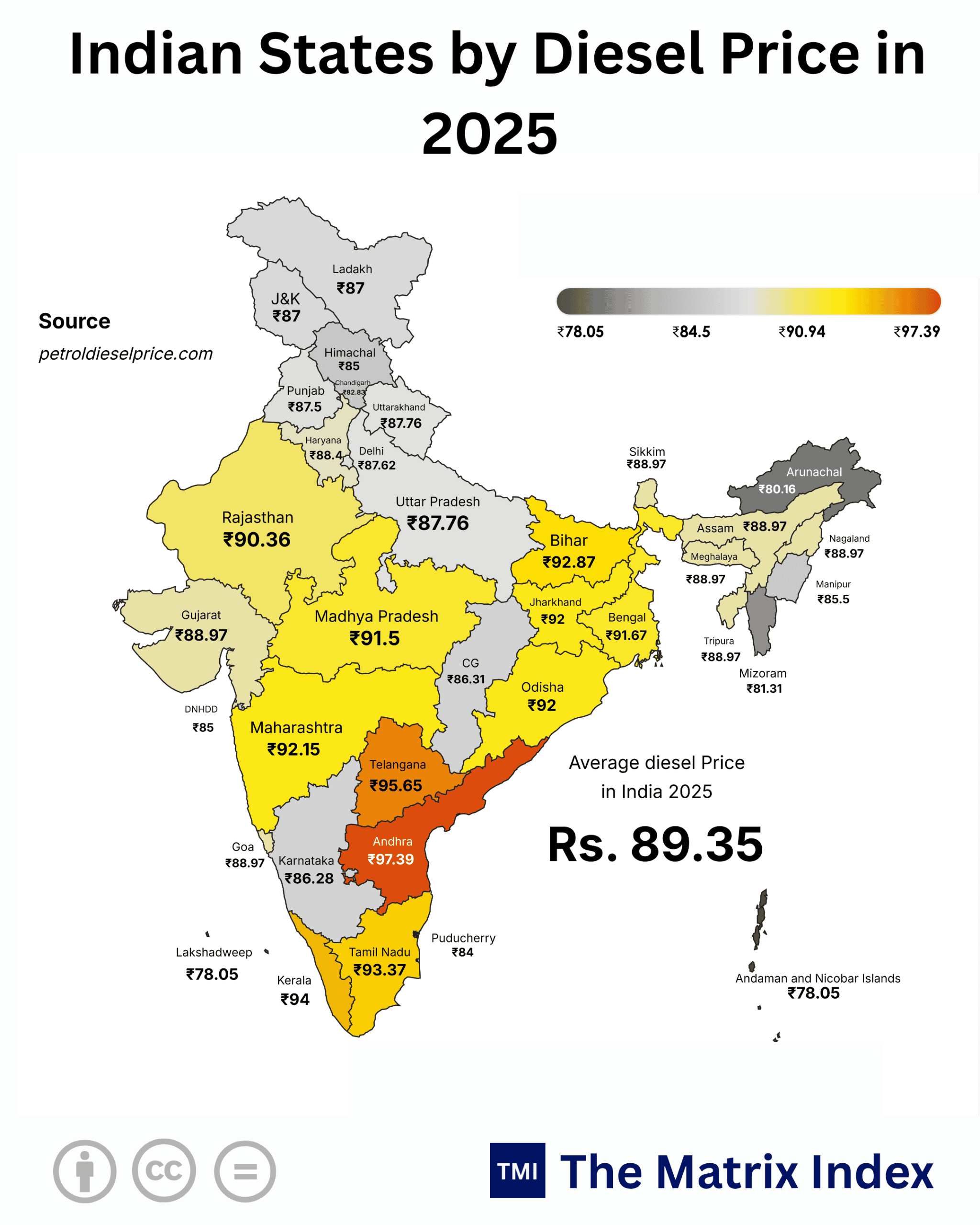
NEW DELHI, India — Look closely at the southern border of Andhra Pradesh where it kisses Tamil Nadu, and you will not see a boundary between sovereign cultures; you will see an invisible, government-mandated financial tollbooth siphoning wealth straight out of the productive economy. A commercial trucker hauling forty metric tons of industrial machinery from Visakhapatnam to Chennai pays ₹97.39 per litre the moment the heavy nozzle clanks into his tank in Andhra Pradesh. Drive a few hours across the state line, and the identical fluid refined from the same crude, processed through identical pipelines by the very same state-run oil marketing companies drops to ₹93.37 in Tamil Nadu, crashes to ₹87.62 in Delhi, and bottoms out at ₹78.05 in the Andaman and Nicobar Islands.
That is not a pricing discrepancy. That is a state-sponsored market failure of seismic proportions.
We are witnessing a ₹19.34 per litre chasm within a single constitutional union that claims to operate under the doctrine of “One Nation, One Market.” While political manifestos herald the historic unifications engineered by digital payments and the Goods and Services Tax (GST), the lifeblood of physical commerce diesel remains trapped in an archaic, predatory labyrinth of regional value-added tax (VAT) extraction. This is not mere administrative friction; it is an economic drag coefficient that directly alters corporate balance sheets, warps supply chains, fuels an illicit borderlands black market, and extracts an unseen, regressive tariff from the wallet of every consumer between Kashmir and Kanyakumari.
The political class will tell you this is federalism in action. Do not believe them. It is an addiction to fiscal convenience at the direct expense of sovereign logistics efficiency.
The Sovereign Smokescreen: Dissecting the Pan-India Pricing Fracture
To understand how a country running high-speed freight corridors can tolerate a near 25% structural price divergence on industrial fuel, you have to peel back the layer of fiscal deceit that separates retail pricing from real economic cost. The national average baseline of ₹89.35 per litre reported across the territory is a mathematical abstraction. It obscures the predatory fiscal behavior of states that treat motor spirit and high-speed diesel as emergency cash registers whenever regional deficits run amok.
At the top of the pyramid sit Andhra Pradesh (₹97.39), Telangana (₹95.65), and Kerala (₹94.00). These states do not operate under fundamentally higher international shipping costs; crude lands at Visakhapatnam, Kochi, and Chennai refineries at parity with or even cheaper than inland ports like Mathura or Panipat. What drives these figures into the stratosphere is an unholy cocktail of ad-valorem VAT, regional entry surcharges, social welfare cesses, and fiscal indiscipline disguised as decentralized autonomy.
Move toward the middle tier West Bengal at ₹91.67, Madhya Pradesh at ₹91.50, and Rajasthan at ₹90.36 and you observe industrialized states attempting to balance consumer revolt against cavernous fiscal gaps. Then descend into the manufacturing and transit hubs: Gujarat (₹88.97), Uttar Pradesh (₹87.76), Haryana (₹88.40), and Delhi (₹87.62). Here, tax policy is weaponized to pull logistics volume, capture refinery throughput, and insulate the manufacturing base from the ruinous input inflation choking the south.
Why does a logistics fleet owner in Vijayawada operate under a ₹9.77 per litre handicap compared to an identical fleet operator parked in Ghaziabad? Why does a farmer running a localized irrigation pump in Telangana bleed capital at ₹95.65 per litre while an agricultural enterprise in the Punjab plains accesses diesel at ₹87.50?
There is no logistical justification for this. It is an institutionalized penalty on geography.
Global Parallels: How the World Structures the Energy Chassis
No modern Tier-1 economic power permits this degree of uncalibrated, fragmented internal fuel arbitrage. The comparative models reveal how badly the domestic architecture is lagging behind global realities.
The United States: Uniform Baselines and Ring-Fenced Gas Taxes
In the United States, the federal excise tax sits flat at 24.4 cents per gallon for diesel. While individual states impose their own fuel taxes (from Pennsylvania’s high rates to Texas’s conservative stance), the variance is strictly tied to dedicated Highway Trust Funds. The money extracted from the diesel pump is legally bound to the physical asset the truck drives on.
More crucially, the International Fuel Tax Agreement (IFTA) completely eliminates predatory retail pump shopping. An interstate carrier based in California pays diesel tax based on where the fuel is consumed, not where it was pumped into the tank. If an eighteen-wheeler fills up on cheap Nevada diesel and burns it on California interstates, the company pays the tax differential back to California on a quarterly filing. The retail pump price differential does not distort logistics routes. India has no such mechanism, turning interstate borders into chaotic games of logistical hide-and-seek.
Germany and the European Union: The Harmonized Energy Tax Directive
Turn to Germany and the broader European Union. Under the EU Energy Tax Directive (2003/96/EC), member states must respect rigid minimum excise duty floors. Germany applies its Energiesteuer uniformly across all sixteen federal states (Bundesländer).
A litre of commercial diesel pumped outside Munich costs precisely the same in base excise and environmental levies as a litre pumped outside Hamburg or Berlin. Price variations exist exclusively due to micro-market terminal competition and minor private retail margin adjustments. The state does not fragment the single market to plug municipal balance-sheet blunders.
Japan and Australia: Single-Market Neutrality
In Japan, the Diesel Oil Delivery Tax (Keiyuka Zei) is collected at a flat statutory rate across prefectures. There is zero tolerance for internal tariff barriers that could degrade the hyper-optimized Just-In-Time (JIT) supply chains powering the automotive corridors of Aichi or Kanagawa.
Similarly, Australia utilizes a singular federal Fuel Tax Credit system via the Australian Taxation Office (ATO), ensuring that businesses running heavy vehicles off-road or on public highways receive uniform input credits regardless of whether they operate in New South Wales or Western Australia.
The Chinese Model: Sovereign Price Ceilings and State Optimization
Even looking at Tier-2 emerging leaders, China’s National Development and Reform Commission (NDRC) sets definitive ceiling and floor retail guidance prices for fuel across provinces every ten working days, pegging them to global crude movements. While provincial adjustments exist based on localized refining hubs, Beijing strictly prohibits sub-national administrations from slapping autonomous ad-valorem surcharges that undermine the export competitiveness of the primary manufacturing apparatus.
India stands alone among the world’s major economies: an aspiring manufacturing powerhouse that permits its individual federated states to treat commercial energy as an unregulated, captive tax farm.
The Complete Sub-National Diesel Ledger: 2026
The following audit lays bare the extreme price dispersion currently governing commercial transport and industrial activity across India’s states and territories.
A commercial fleet routing 500 trucks across Andhra Pradesh rather than Karnataka or the Union Territories bleeds up to ₹5,50,000 extra per day purely on fuel tax differentials, transforming state borders into engines of operational destruction.
The “So What?” Factor: The Brutal Ripple Effect on the Ground
Data in isolation is sterile. To grasp why this matters, you must calculate its violent transmission through the real economy. Diesel is not merely a fuel. In an economy where over 70% of domestic freight moves by road, diesel is a structural tax on reality.
Take a standard thirty-two-foot multi-axle container truck running from Hyderabad to Delhi, covering roughly 1,500 kilometers. The truck consumes approximately 3.5 kilometres per litre. That single journey burns roughly 428 litres of diesel.
Fill the entire run inside Telangana at ₹95.65, and the fuel bill is ₹40,938. Fill the same volume in Uttar Pradesh at ₹87.76, and the bill lands at ₹37,561.
That single, mundane choice creates a ₹3,377 cash delta on one trip for one truck.
Now multiply that delta by a mid-sized national logistics operator running a fleet of 2,500 assets making four such long-haul runs a month. We are talking about a ₹33.77 crore ($4 million) operational cost differential every single year determined entirely by the geographical coordinates of where the fuel nozzles meet the tanks.
Who pays this bill? The logistics firm does not absorb it; their operating margins sit at a razor-thin 4% to 6%. They pass it forward.
The freight forwarder passes it to the fast-moving consumer goods (FMCG) enterprise. The FMCG enterprise passes it to the distributor. The distributor slaps it onto the retail price of cooking oil, cement, wheat flour, and pharmaceuticals.
The ultimate payer is not the corporate board; it is the daily wage worker in Guntur or Visakhapatnam who finds their real wages silently burned away at the local kirana store. This is the definition of a regressive tax: an invisible burden placed squarely on the shoulders least equipped to bear it.
Furthermore, this pricing chasm has spawned an entire parasitic industry: The Cross-Border Diesel Arbitrage Syndicate. Along the border zones of Andhra Pradesh and Tamil Nadu, or Rajasthan and Haryana, fuel stations on the high-tax side sit desolate, their forecourts echoing with silence and their owners heading toward bankruptcy.
Two kilometers away, across the border line, low-tax pumps operate twenty-four hours a day, surrounded by idling rigs, modified tankers, and dangerous underground storage networks designed to bypass state transit monitoring. It is a direct drain of tax revenue away from the very states desperate to maximize it.
Seasonality and Anomaly Alert: Structural Trap, Not a Temporary Spike
Wall Street analysts and domestic equity brokerages often make the mistake of classifying these sub-national price divergences as transient shocks driven by global geopolitical heat the Strait of Hormuz, pipeline outages in the Caucasus, or OPEC+ production games.
Do not fall for that lazy thesis.
What the data reveals is an entrenched, path-dependent fiscal trap. When global benchmark Brent crude plummeted historically during global demand contractions, did the retail prices in Hyderabad, Vijayawada, or Kolkata tumble in tandem? Absolutely not.
Central and state finance ministries immediately stepped into the breach, jacking up Special Additional Excise Duties and regional VAT to capture the consumer surplus and shore up their sagging balance sheets.
This dynamic represents an Asymmetric Upward Ratchet. The ad-valorem structure of state VAT guarantees this distortion. Because many states levy their tax as a direct percentage on top of the base cost plus central excise, whenever underlying prices drift higher, the state’s absolute rupee take increases automatically without any new legislation.
It is inflation capitalizing on inflation. The divergence we see today is not an anomalous summer demand spike or a temporary pre-election sop; it is an institutional addiction to non-shareable, easily collectible cash receipts.
The Strategic Balance Sheet: Two-Sided Risk Assessment
Analyzing this fiscal gridlock requires looking at the ledger from both sides. There is no simple, consequence-free policy button to press. Every choice redistributes pain across the union.
Bull Case: The Industrial Acceleration Catalyst
The economic argument for blowing up this state-level fuel architecture and dragging diesel screaming into the GST regime is overwhelming.
-
Radical Logistics De-escalation: Moving to a unified, dual-GST rate structure with full input tax credit (ITC) mechanisms would slash India’s logistics costs from an abysmal 13-14% of GDP down to sub-9% levels, matching US and European supply chain efficiencies overnight.
-
Capital Expenditure Unlocking: If national heavy transport operates on a single fuel pricing baseline, commercial fleet operators can stop engineering artificial routes to chase cheap fuel and instead invest tens of billions of dollars into fleet modernization, cold-chain refrigeration, and predictive telemetry.
-
Elimination of the Border Dead-Zone: Eradicating the ₹19.34 maximum internal spread wipes out cross-border smuggling syndicates, freeing up enforcement capital and restoring profitability to thousands of shuttered highway retail petroleum outlets.
-
Direct CPI Disinflation: A permanent, unified reduction in diesel volatility cuts food and consumer goods transportation overheads by a structural 150 to 220 basis points, giving the Reserve Bank of India room to operate a looser, growth-supportive monetary stance.
Bear Case: The Fiscal Insolvency Shock
The pushback against unification is not born of sheer malice; it stems from cold, terrifying fiscal panic inside regional finance ministries.
-
State Balance-Sheet Implosion: Fuel and alcohol are the twin pillars of independent state revenue generation. Stripping states of their autonomous fuel VAT authority eliminates roughly 25% to 35% of their own-source tax revenue (OSTR), turning them into completely dependent wards of the central government.
-
The “Shortfall Crisis” Redux: Following the bitter political battles over GST compensation cess delays in earlier cycles, states do not trust the Centre to make them whole through timely, formulaic statutory transfers.
-
Sudden Upstream Capital Freezes: If oil marketing companies and upstream refiners find their margins capped by rigid national GST slabs, capital expenditure for refining upgrades, green hydrogen co-processing, and pipeline maintenance could freeze, compromising long-term domestic energy security.
-
Severe Regressive Replacement Taxes: Deprived of the easy-money diesel tap, desperate regional governments will inevitably hike property transaction stamp duties, electricity tariffs, and municipal levies, choking the urban middle class through alternative avenues.
Macro Scenarios: How the Next Decade Unfolds
The future of India’s commercial transport infrastructure hinges on which of three distinct structural scenarios takes hold over the coming decade:
Scenario 1: The Status Quo Gridlock (Base Case — 55% Probability)
The GST Council remains locked in partisan trench warfare. States like Andhra Pradesh, Telangana, Kerala, and West Bengal reject any surrender of their sovereign petroleum taxing powers. The national average continues to drift higher, but the internal spread widens past ₹25.00 per litre as heavily indebted states ramp up special welfare cesses to finance non-productive populist budgets.
National logistics operators pivot aggressively toward route bypass models, establishing private refueling terminals along friendly corridors like Uttar Pradesh, Gujarat, and dedicated Union Territories, starving high-tax states of commercial activity.
Scenario 2: The Partial Grand Bargain (Compromise Track — 35% Probability)
Facing mounting pressure from international manufacturing consortiums setting up shop under production-linked incentive (PLI) schemes, the Central Government forces an executive compromise. Diesel is brought under a nominal GST umbrella at a 28% peak slab, but states are granted explicit statutory dispensation to levy an additional, floating “Regional Decarbonization and Infrastructure Cess” within a strictly enforced corridor capped at ₹5.00 to ₹7.00 per litre.
The nationwide spread contracts from ₹19.34 down to under ₹4.50. Smuggling routes collapse, and the playing field levels out enough to drive supply-chain optimization, though the complete disinflationary dividend remains elusive.
Scenario 3: Complete GST Absorption and Open Input Credits (Radical Reform — 10% Probability)
A profound economic crisis or overwhelming political consolidation forces the complete absorption of all motor spirits into the GST architecture with fully operational, cross-sectoral Input Tax Credits (ITC). Transport companies offset their fuel tax liabilities directly against downstream invoicing.
Diesel drops to an effective post-credit industrial cost of under ₹65.00 per litre for registered corporate enterprises nationwide. India’s logistics cost-to-GDP ratio plummets to 8.5%, rivaling the United States and Germany, unlocking a sustained 120-150 basis point acceleration in annual industrial gross value added (GVA). The internal trade barriers that have haunted the republic since independence are finally dissolved.
Comparative Matrix: Global Diesel Taxation and Logistics Drag
Understanding the structural damage of the Indian pricing model requires mapping it against regional peers and global competitors across freight efficiency, fiscal extraction, and supply-chain drag.
Slashing sub-national variance to under 3% via a unified national framework would inject an estimated $38 Billion directly into domestic corporate capital expenditure budgets over a thirty-six-month horizon.
The Alternative Scenario: The Electrification Bypass
What happens if policy remains completely paralyzed? Markets do not wait forever for finance ministers to find their courage. If the high-VAT southern bloc (Andhra Pradesh, Telangana, Kerala, Tamil Nadu) insists on running diesel at near-triple-digit territory (₹93 to ₹97+), they will not protect their fuel revenues over the long haul.
They will inadvertently engineer their own obsolescence.
At ₹97.39 per litre, the Total Cost of Ownership (TCO) parity between a legacy 55-ton internal combustion prime mover and a heavy commercial Electric Vehicle (EV) paired with battery-swapping or megawatt-level flash-charging drops sharply from the year 2031 straight into late 2027.
Fleet operators working high-frequency, closed-loop industrial routes such as transporting iron ore and steel coils between Bellary, Visakhapatnam, and Chennai are already drawing up plans to deploy heavy commercial EV platforms years ahead of schedule.
If the private sector bypasses the liquid fuel infrastructure altogether, these debt-burdened state governments will face a sudden structural collapse in their fuel tax base. They will be left holding empty nozzles, surrounded by a decarbonized private sector that moved on while the politicians were still bickering over revenue shares.
Strategic Playbook: Navigating the Fuel Minefield
For industrial leaders, supply-chain chiefs, and private equity allocators navigating this fragmented terrain today, relying on national averages is an invitation to margin destruction. Surviving and exploiting this asymmetric landscape demands immediate, clinical action.
For Supply Chain Directors and Procurement Chiefs:
-
Eradicate National Fuel Surcharges: Never sign an industrial distribution contract pegged to an aggregated national fuel baseline. Insist on corridor-specific, origin-destination fuel pass-through indexing. If your cargo is originating out of western or northern manufacturing belts (Gujarat at ₹88.97, Haryana at ₹88.40), do not let third-party logistics partners bill you surcharges rooted in southern peak rates.
-
Redesign Distribution Nodes: If your distribution network currently warehouses heavily inside Andhra Pradesh or Telangana solely for regional fulfillment, run the numbers on migrating primary storage across the border into Karnataka (₹86.28) or strategically near low-tax logistics corridors. The real estate lease differentials can often be funded entirely by the fuel arbitrage savings.
For Fleet Operators and Logistics C-Suites:
-
Institutionalize Telematics-Driven Fuel Bunkering: Equip every long-haul asset with geofenced route-optimization software that bars drivers from taking on anything more than splash-fuel in states running prices above ₹92.00. Mandate that master tanks are completely filled within jurisdictions like Uttar Pradesh (₹87.76), Delhi (₹87.62), or Karnataka (₹86.28).
-
Direct Private Bulk Procurement: Stop exposing your operations to the retail forecourt lottery. Partner directly with primary oil marketing companies to construct your own automated inland consumer fuel depots inside lower-VAT border zones, capturing wholesale volume discounts that widen your margin spread over sub-scale competitors.
For Institutional Investors and Capital Allocators:
-
Stress-Test Portfolio Margins: Audit the cash-flow models of portfolio logistics and transportation firms against an extreme-spread environment. Downgrade operators that lack dedicated terminal infrastructure and remain completely exposed to high-tax retail pump volatility.
-
Accelerate Industrial Infrastructure Bets: Pour expansion capital into non-discretionary alternative freight ecosystems. Focus on the Western and Eastern Dedicated Freight Corridors (rail freight), short-sea coastal shipping networks, and dedicated electric commercial fleet networks that step right over this internal tax maze entirely.
The Verdict: 2026, 2030, and the Road to 2047
Look past the public relations releases and the surface-level economic rhetoric. You cannot run a credible $4 Trillion economy that aspires to cross $7 Trillion by 2030 and achieve developed status under Viksit Bharat 2047 while treating your primary industrial energy supply like an unregulated illicit gambling den.
The current system is untenable. By saddling commercial transport with a ₹19.34 internal price spread, we are effectively running an internal protectionist regime. We are penalizing regional manufacturing hubs, driving up the cost of everyday groceries, and encouraging predatory fiscal behavior that starves productive industry to bankroll short-term government balance sheets.
If the Central Government and the state leadership do not summon the political resolve to fold petroleum into a transparent GST framework with accessible Input Tax Credits by 2028, modern private capital will simply deploy its own solutions. The transition to commercial electric mobility and dedicated private rail corridors will not happen out of environmental idealism; it will happen as an act of raw corporate survival against state-level economic extraction.
The old proverb reminds us that a cart cannot run on broken axles. Today, the broken axle is an archaic, predatory fuel tax architecture that carves the country into dozens of competing, zero-sum jurisdictions.
It is time to dismantle these invisible internal borders. Unify the fuel architecture under a singular national standard, or resign your manufacturing ambitions to the status of an unrealized promise. The clock is ticking, and the real economy is tired of paying the tab.
GOOGLE ‘PEOPLE ALSO ASK’ FAQs
Q1: Why does the diesel price vary significantly across Indian states?
A: A ₹19.34 per litre retail price gap exists because states levy autonomous ad-valorem VAT and surcharges outside the GST regime. These localized cesses create an unhedged 24.7% cost disparity between coastal and inland industrial transit corridors.
Q2: Which state currently has the highest diesel price in India?
A: Andhra Pradesh records the highest price at ₹97.39 per litre, sitting 8.99% above the national baseline. Telangana follows at ₹95.65 per litre due to compounding state welfare cesses and non-creditable transit fuel surcharges.
Q3: Which state or territory offers the lowest diesel price in India?
A: Andaman and Nicobar Islands and Lakshadweep offer the lowest price at ₹78.05 per litre, cushioned by central maritime subventions. On mainland India, Arunachal Pradesh posts the lowest figure at ₹80.16 per litre.
Q4: How does state-level fuel taxation impact India’s logistics costs?
A: Road logistics swallow 13.5% to 14.0% of GDP, nearly double the 7.5% United States benchmark. The absence of input tax credits inflates operational freight overheads, adding an unhedged ₹33.77 crore annual fuel penalty per 2,500-truck fleet.
Q5: Will diesel be brought under the national GST Council framework?
A: A 35% probability exists for an executive compromise establishing a 28% GST ceiling with capped local cesses before 2028. Failure to reform will accelerate commercial heavy-EV fleet parity, forcing migration away from liquid fuel by 2027.
Data Source:
- Ministry of Petroleum and Natural Gas (PPAC)
- Goods and Services Tax Council
- International Energy Agency (IEA)
Disclaimer: This report is for informational and analytical purposes only and does not constitute formal financial, investment, or policy advice.