The Shadow Tax on Modernity: Deconstructing India’s Acid Violence Ledger, Retail Regulation Failures, and the Human Capital Erosion Threatening Vision 2047
| State / Union Territory | Acid Attack Cases (2025) |
|---|---|
| Bengal (West Bengal) |
31 |
| Uttar Pradesh |
25 |
| Madhya Pradesh |
11 |
| Delhi |
8 |
| Karnataka |
6 |
| Maharashtra |
5 |
| Rajasthan |
4 |
| Bihar |
4 |
| Haryana |
3 |
| Gujarat |
3 |
| Punjab |
2 |
| Jharkhand |
2 |
| Chhattisgarh (CG) |
2 |
| Odisha |
2 |
| Telangana |
2 |
| Andhra Pradesh |
2 |
| Tamil Nadu |
2 |
| Jammu & Kashmir (J&K) |
1 |
| Chandigarh |
1 |
| Uttarakhand |
1 |
| Assam |
1 |
| Kerala |
1 |
| Ladakh |
0 |
| Himachal Pradesh |
0 |
| Sikkim |
0 |
| Arunachal Pradesh |
0 |
| Nagaland |
0 |
| Manipur |
0 |
| Meghalaya |
0 |
| Tripura |
0 |
| Mizoram |
0 |
| Goa |
0 |
| DNHDD (DNH and DD) |
0 |
| Puducherry |
0 |
| Lakshadweep |
0 |
| Andaman and Nicobar Islands |
0 |
| Total Reported |
106 |
NEW DELHI, India — You cannot build a $10 trillion modern economy on top of a retail chemical wild west where industrial-grade corrosives retail cheaper than clean drinking water and cost less than a liter of pasteurized milk.
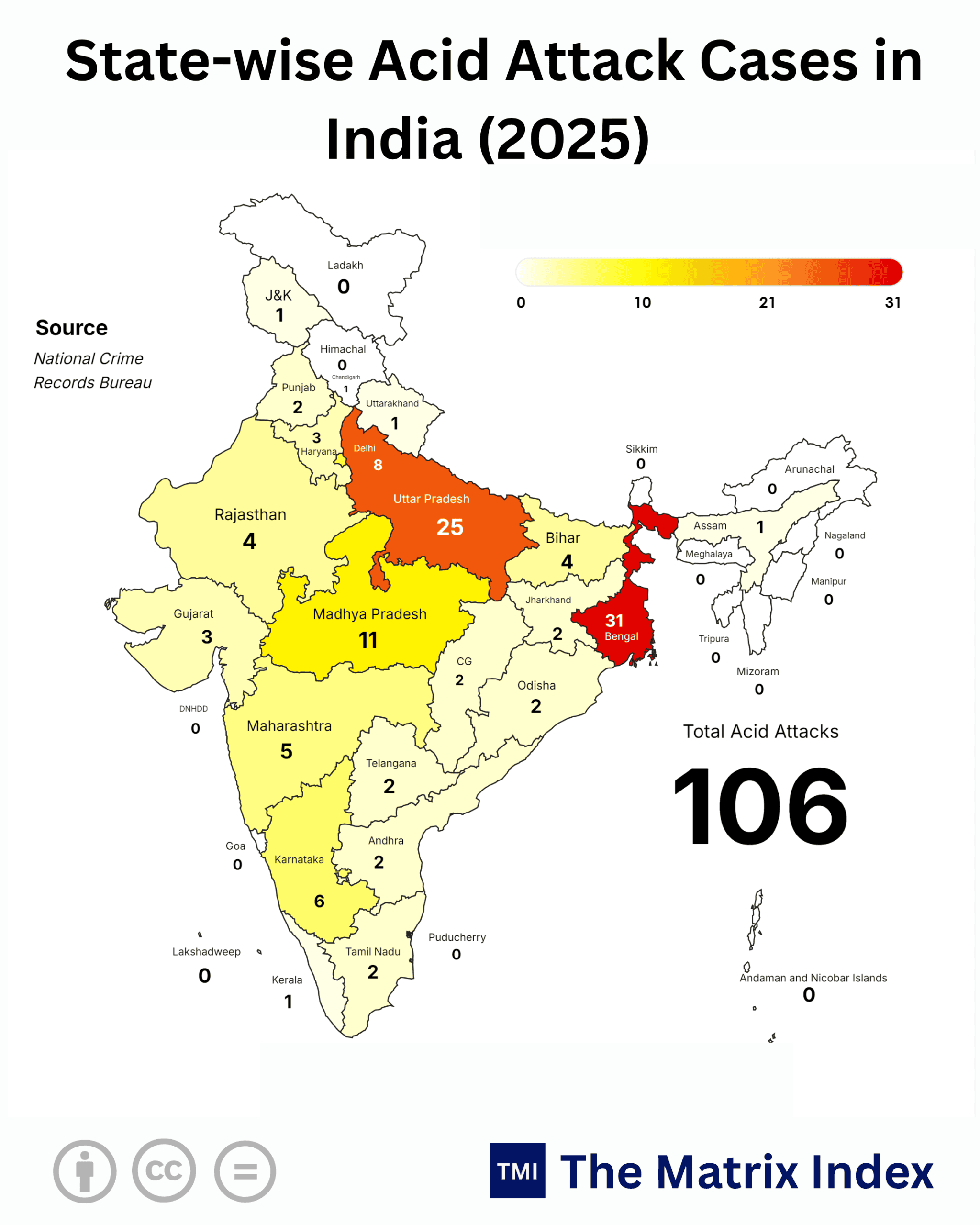
While policy analysts celebrate headline manufacturing indices and foreign direct investment inflows, state-level law enforcement dockets quietly recorded 106 reported cases of catastrophic acid assaults across the country in 2025.
That number is not merely a dark criminal metric; it is an indictment of systemic market surveillance failure, an unquantified liability on India’s labor participation rates, and an institutional blind spot threatening our long-term economic credibility.
Acid attacks are commonly analyzed through the lens of gender-based violence or isolated criminal pathology. That framing is incomplete and frankly intellectually lazy.
Look at it as an economic strategist: an acid attack is an unmitigated market failure resulting from unregulated retail access to dangerous commercial inputs, leading to an immediate, permanent destruction of human productivity, astronomical downstream medical costs, and severe systemic deterrence against female labor force participation.
When a society permits lethal corrosive agents principally concentrated sulfuric and hydrochloric acid to be bought over-the-counter for ₹30 to ₹50 without identity verification, it is subsidizing violent crime and undermining its own productive foundations.
Dissecting the 2025 Ledger: A Cartography of Regulatory Failure
The geography of corrosive assaults in India reveals an unmistakable concentration of risk. The data from 2025 is not evenly distributed across the republic’s federal map; it clusters along specific industrial corridors, unregulated informal retail markets, and states crippled by inconsistent law enforcement oversight.
West Bengal stands out with 31 documented attacks in 2025, accounting for nearly 29.25% of all attacks nationwide.
Why? It is not an inexplicable cultural anomaly; it is an economic supply chain issue. The lower Gangetic belt houses dense clusters of informal leather tanning, unorganized battery recycling, metal finishing units, and small-scale textile processing workshops.
In these informal micro-enterprises, concentrated acids are treated as routine, fungible processing chemicals. The transition from industrial vat to street-level weapon requires zero clearance, minimal friction, and zero paper trails.
Uttar Pradesh follows closely with 25 cases (23.58% of the total volume).
Here, the sheer scale of the population intersects with a massive informal manufacturing sector running from Kanpur’s leather hubs to Western UP’s brass and electroplating workshops. The state’s administrative apparatus has clamped down on organized gang syndicates, but it has completely failed to plug the retail sieve through which dangerous precursors flow into domestic spaces.
Combined, West Bengal and Uttar Pradesh generate 52.83% of India’s documented corrosive trauma.
When you layer in Madhya Pradesh with 11 cases and the national capital territory of Delhi with 8 incidents, these top four territories comprise 70.75% of the entire national incident footprint.
The fact that the national capital, operating under direct federal security oversight and intense judicial scrutiny, registers 8 attacks in a single calendar year tells you everything you need to know about the disconnect between supreme court directives on paper and back-alley reality.
The Comprehensive 2025 State-by-State Exposure Index
The following table provides an exhaustive breakdown of corrosive attacks recorded across all Indian States and Union Territories in 2025, mapping their economic concentration and regulatory enforcement postures.
कड़वा सच: The real issue isn’t that acid violence is ubiquitous; it’s that it clusters heavily where state enforcement is weak. Over 70% of these horrific crimes happen in just four jurisdictions, proving that our regulatory failures are local, structural, and entirely fixable if administrators actually care to enforce existing rules.
3. The Broken Machinery of Deterrence: Why Judicial Directives Stall
In 2013, the Supreme Court of India handed down landmark guidelines in the Laxmi v. Union of India ruling. The bench mandated clear administrative controls:
-
Acid sales were declared non-bailable offences under regulatory review.
-
Retailers were mandated to log buyer identities via government-issued photo identity cards.
-
Stock registers had to be declared to local Sub-Divisional Magistrates (SDMs) within 15 days of acquisition.
-
Unregulated over-the-counter cash transactions were explicitly banned.
Thirteen years later, walking into a neighborhood hardware shop or sanitation depot in outer Delhi, suburban Kolkata, or rural Meerut tells a completely different story.
You can acquire a liter of high-concentration acid in under two minutes. No identity card requested. No digital register opened. Cash changes hands, and the transaction vanishes into the shadow economy.
Why has the judicial framework collapsed on the ground?
First, the enforcement mechanism is tied to the desk of the local SDM. Sub-divisional magistrates in developing Indian districts manage elections, land revenue disputes, disaster management protocols, infrastructure rights-of-way, and protocol visits.
Expecting an overburdened revenue officer to conduct surprise monthly physical inventory reconciliations of 4,500 mom-and-pop paint and hardware shops across their sub-division is pure administrative fantasy.
Second, the supply side has evolved faster than the regulatory framework. While physical stores face sporadic police checks, chemical intermediaries migrated seamlessly to online e-commerce platforms and informal digital courier networks.
Industrial cleaning supplies, toilet-cleaning formulations containing unbuffered hydrochloric concentrations exceeding 10%, and direct jewelry-cleaning solutions are routinely shipped in plain cardboard packaging across state borders. The law looks for a merchant behind a counter; the modern market delivers the weapon directly to the doorstep via an algorithm.
Third, our criminal justice machinery moves at a painfully slow pace. An assault occurs in 2025; the trial begins in 2027; forensic chemical profiling languishes in backlogged state laboratories for months; bail is secured via defense technicalities; and the eventual conviction, if secured at all, arrives after a decade.
Deterrence is not a function of the severity of the theoretical punishment written in the Indian Penal Code or the Bharatiya Nyaya Sanhita; it is a direct function of the certainty and speed of apprehension and punishment. When conviction rates linger at abysmal levels and trials stretch across life stages, the economic and social cost of committing the crime approaches zero for the perpetrator.
The Macroeconomic Domino Effect: Human Capital Destruction
Let us step outside the courtroom and sit at the desk of the macroeconomist. What does an acid assault actually do to an economy?
Economists like to discuss India’s demographic dividend the fact that hundreds of millions of young people will power consumption and production toward 2047.
Yet India’s Female Labor Force Participation Rate (FLFPR) hovers at roughly 32% to 37% (depending on whether you use urban-exclusive or combined periodic labor surveys). This stands well behind Vietnam (over 70%), China (over 60%), and even regional peers like Bangladesh.
When high-profile acid attacks occur in urban public spaces bus stops, market thoroughfares, outside educational institutions the ripple effect is immediate, pervasive, and economically destructive.
It does not simply destroy the life of the individual victim; it acts as a severe structural tax on all women navigating public infrastructure.
Parents restrict mobility. Women refuse overtime shifts that finish after dark. Families pull daughters out of higher-tier educational institutions requiring public transit commutes, pushing them into low-productivity local options.
The economic freedom and geographic mobility of millions of potential productive workers are crushed by the perceived risk of catastrophic public violence.
Then comes the direct healthcare and productivity balance sheet:
-
Direct Capital Destruction: An acid attack survivor typically requires between 15 and 45 surgical interventions over a decade skin grafting, contracture releases, ocular reconstructions, and respiratory interventions. The direct financial cost ranges from ₹15,00,000 to over ₹50,00,000 ($18,000 to $60,000 USD). In a country where out-of-pocket healthcare expenses still cause widespread personal bankruptcies, this completely liquidates household savings, plunges extended families into intergenerational debt, and pulls capital away from productive investments.
-
Workplace Erasure: Survivors face debilitating physical disfigurement, chronic pain syndromes, partial or total blindness, and severe social stigma. Their formal workforce participation is usually reduced to zero. An individual who could have contributed 35 to 40 years of compounding productivity, paid income taxes, and accumulated consumer assets is transformed by systemic negligence into a state-dependent economic casualty.
Multiply this across thousands of lifetime survivors carrying this trauma across India, and you are looking at tens of billions of rupees in lost economic output, wasted human potential, and avoidable emergency healthcare spending.
Global Benchmarks: How the World Closed the Corrosive Sieve
This crisis is not an inevitable consequence of emerging market dynamics. Other economies faced epidemic-level corrosive violence, confronted the raw reality, and crushed the problem through clear, decisive market interventions.
The Bangladesh Playbook (The Gold Standard)
In the late 1990s and early 2000s, Bangladesh was the undisputed global epicenter of acid violence, recording over 400 documented cases annually. Attacks were frequent, destructive, and carried out with cheap agricultural chemicals.
The state did not issue soft administrative circulars; it declared legislative war. In 2002, Bangladesh enacted two comprehensive laws: the Acid Crime Control Act and the Acid Control Act.
The response rested on three structural pillars:
-
Capital punishment and accelerated fast-track specialized courts concluding trials in weeks, not decades.
-
Complete institutional licensing of all acid importers, wholesalers, transport logistics firms, and industrial end-users. Unlicensed possession of corrosive chemicals was treated with the same legal gravity as unlicensed possession of military munitions.
-
Nationwide retail sales bans for domestic cleaning, substituted immediately by chemically buffered alternatives.
The result? Acid attacks in Bangladesh plummeted by more than 85% to 90% over the subsequent decade and a half. The country transformed its international standing and eliminated a horrifying domestic threat by treating corrosive substances as lethal commercial weapons rather than everyday commodities.
The United Kingdom: Modern Urban Adaptations
Faced with a sudden, violent surge in corrosive fluid attacks across London and other metropolitan centers between 2015 and 2018 largely driven by street gangs using household drain cleaners as unregulated alternatives to knives and firearms the United Kingdom passed the Offensive Weapons Act 2019.
The British framework established two crucial principles:
-
It criminalized the possession of concentrated corrosive substances in a public place without a verified, legitimate operational excuse, placing the legal burden of proof squarely on the carrier.
-
It prohibited the sale and delivery of products containing elevated concentrations of sulfuric, hydrochloric, or nitric acids to anyone under the age of 18, mandating physical face-to-face identity and age verification at the point of residential courier delivery. Platforms like Amazon and local couriers were held directly and financially liable for supply-chain compliance breaches.
The European Union: Strict Precursor Controls
Under the EU REACH regulations and dedicated regulations on explosives precursors (Regulation EU 2019/1148), the European bloc strictly limits the sale of concentrated acids to the general public.
Sulfuric acid above a 15% concentration cannot be legally sold to an ordinary retail consumer without a formal precursor license issued by a national regulatory authority. The transaction requires a documented commercial tax identification number, a legitimate operational business rationale, and automated tracking through a centralized digital registry.
If a commercial operator cannot balance their chemical inputs against verifiable end-product outputs, their operating license is suspended.
India, by contrast, operates an antiquated, fragmented, paper-bound framework where local bureaucrats are tasked with tracking bulk hazardous materials using manual paper registers. It is an analog patch on a modern industrial machine, and it fails basic stress tests every single day.
Seasonality, Anomalies, and Market Realities
The 106 cases reported in 2025 require objective statistical interpretation. Is this an absolute decline, an administrative plateau, or a statistical artifact masking deeper systemic failures?
On paper, a drop from historical highs of 200+ annual cases to 106 indicates positive directional momentum. But every seasoned investigative reporter and forensic accountant knows you do not accept topline numbers at face value.
-
The Problem of Underreporting: In rural stretches of Bihar, Uttar Pradesh, and West Bengal, severe domestic assaults involving chemical burns are frequently settled out-of-court under intense familial and community pressure. In many instances, they are formally registered under general domestic violence provisions, dowry harassment sections, or grievous hurt statutes without invoking specialized chemical attack clauses. This artificially suppresses the primary statistical headline.
-
The Transmutation Anomaly: Corrosive substances have changed. While traditional industrial acids face sporadic scrutiny, violent actors frequently deploy unregulated low-grade industrial toilet cleaners, concentrated battery electrolytes, and bleaching compounds. Many of these chemicals inflict severe permanent disfigurement, yet fall outside the strict legal threshold of scheduled corrosive agents during preliminary police intake. The victim is scarred for life, but the docket records an ordinary physical assault.
-
The Seasonality Vector: Spikes in attacks consistently correlate with specific economic and calendar windows. Peak incident velocity regularly clusters around harvest and crop-liquidation periods in agrarian belts when domestic and property conflicts peak as well as the high-heat pre-monsoon months, when localized labor tensions in informal manufacturing clusters reach seasonal highs. This is a predictable operational reality, not a collection of random lightning strikes.
The Institutional Divergence: Why Some States Succeeded
While the northern and eastern industrial belts recorded persistent failures in 2025, several Indian jurisdictions maintained zero or near-zero incident footprints. Understanding this divergence is critical for effective national policy.
Look closely at the data: Gujarat registered 3 cases; Tamil Nadu registered 2.
Both are heavy manufacturing states with massive chemical synthesis complexes, vast dye manufacturing units, and extensive industrial leather clusters. Why did they register a combined total of only 5 cases, while West Bengal alone generated 31?
The difference lies in industrial formalization and supply-chain governance.
In Gujarat, chemical transport is heavily dominated by formal corporate operators integrated into centralized logistics monitoring systems. Bulk corrosive agents are delivered via trackable industrial manifests directly to licensed commercial facilities.
The leak into neighborhood cash-and-carry retail stalls is substantially lower because the industrial ecosystem is institutionalized and strictly audited by state pollution control boards and industrial safety directorates.
In Tamil Nadu, the leather clusters of Ambur and Ranipet and the textile hubs of Tirupur have faced decades of intensive environmental litigation, forcing high degrees of traceability on input chemicals and effluent discharges.
The presence of strong institutional scrutiny sharply limits casual, untracked secondary sales.
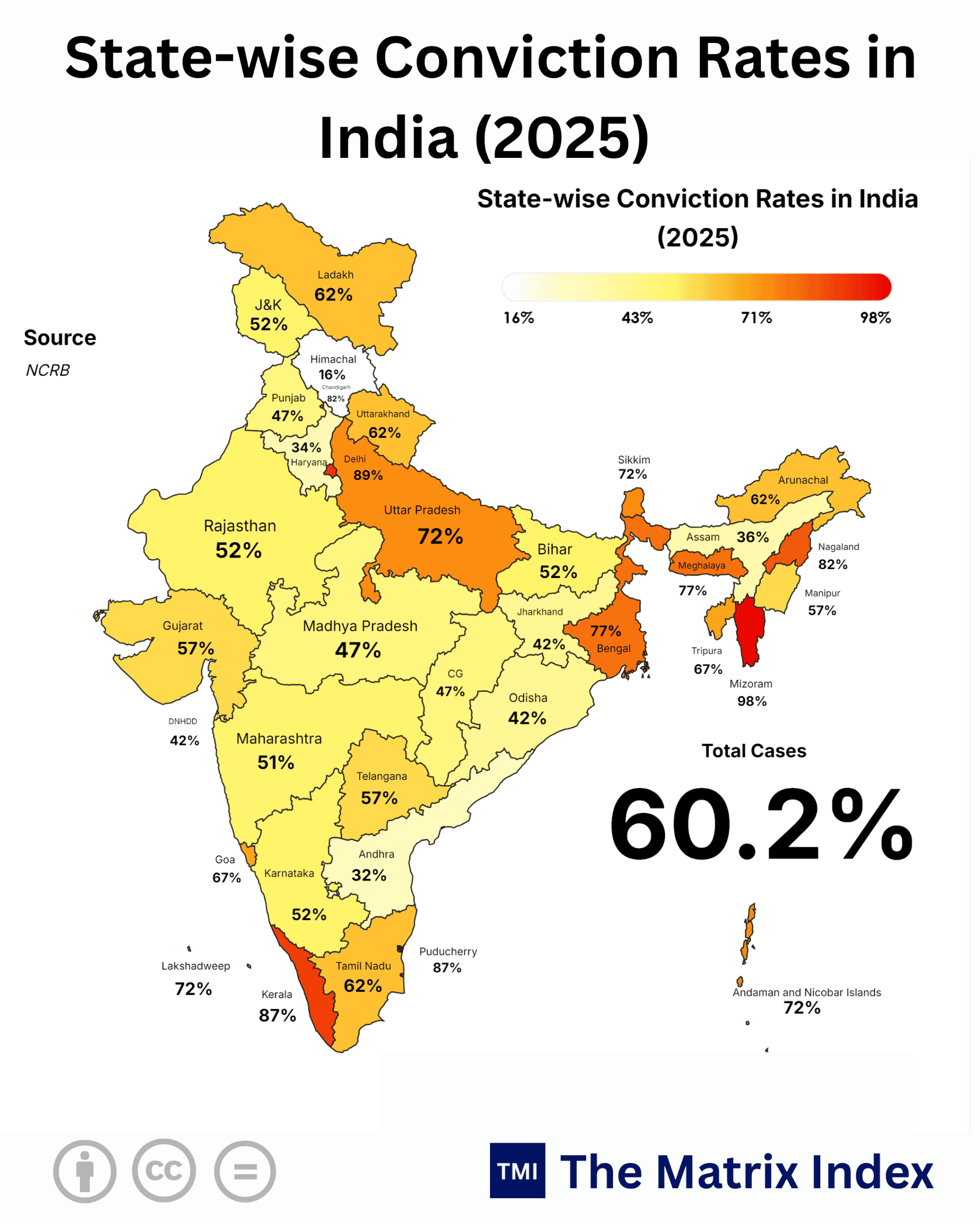
When you add northeastern states like Sikkim, Nagaland, and Mizoram which report zero incidents thanks to natural logistics choke points, low informal industrial chemical demand, and robust community oversight it becomes undeniable: acid violence is not an unavoidable fact of life; it is an entirely avoidable symptom of administrative complacency.
Structural Risk Assessment: The Dual Trajectory
India stands at a regulatory crossroads. How we choose to govern corrosive domestic markets over the coming five years will trigger one of two clear economic trajectories.
The Bull Case: The Regulated, Safe Economic Model
-
Aggressive Supply-Side Formalization: The union government institutes a national unified chemical tracking portal, integrating chemical manufacturers, distributors, and bulk purchasers via unique QR-coded batch identifiers tied directly to GST invoices. No GST invoice, no chemical movement.
-
Mandatory Consumer Chemical Substitution: A complete statutory ban on the retail consumer sale of unbuffered inorganic acids with concentrations exceeding 5%. Household cleaning markets transition entirely to enzymatically buffered, non-corrosive chemical alternatives a sector that represents an open $1.8 billion domestic specialty chemicals modernization opportunity.
-
Accelerated Fast-Track Specialized Benches: Establishment of dedicated criminal benches concluding chemical assault trials within 90 days, backed by mandatory minimum sentences and state-guaranteed, upfront medical restitution reserves funded by automated fines levied on non-compliant chemical merchants.
-
Macro Impact: A marked reduction in fear-driven public transit avoidance by female workers, contributing to an estimated 150 to 300 basis points increase in urban female workforce participation by 2035, adding billions to national GDP while removing a catastrophic human rights stain from India’s investment profile.
The Bear Case: Administrative Complacency and Fragmented Enforcement
-
Paper-Registry Continuity: Enforcement remains permanently tethered to the manual logbooks of overburdened local revenue officers. Chemical merchants continue to sell high-concentration corrosives under the table to anonymous cash buyers.
-
Digital Marketplace Evasion: Illicit retail distributions shift deeper into encrypted communications channels, decentralized dark-store courier delivery, and gray-market micro-distribution networks, continually outrunning police capabilities.
-
Deepening Labor Footprint Scars: Persistent high-profile assaults in metropolitan centers continue to suppress female labor market fluidity. International human rights monitors consistently downgrade India’s workplace safety indices, weaponizing urban safety metrics during bilateral trade and investment dialogues.
-
Macro Impact: India continues to waste human capital, burning billions of rupees annually in lifetime medical trauma management and squandered productivity, permanently compromising the ambitious societal targets set for the 2047 centenary of independence.
The Alternative Scenario: What Happens If We Disrupt the Retail Model?
What if the policy response bypasses criminal penalties altogether and attacks the problem purely through industrial and economic design?
Consider a comprehensive, state-mandated market pivot: The Total Decoupling Strategy.
In this scenario, the Ministry of Chemicals and Fertilizers, combined with the Ministry of Commerce and Industry, enacts an immediate industrial phase-out of consumer-accessible raw acids.
Instead of policing hundreds of thousands of retail shops, the state alters the product landscape at the point of manufacture.
If an industrial unit requires sulfuric acid for electroplating, that chemical must be delivered in tamper-evident, trackable containers mixed with unmistakable biological markers and color agents that make covert retail distribution unviable.
Concurrently, the domestic consumer market is flooded with safe, bio-enzymatic cleaning alternatives backed by localized Production Linked Incentive (PLI) schemes.
If you eliminate the consumer chemical supply chain, you eliminate the weapon.
Perpetrators do not synthesize sulfuric acid in home kitchens; they buy it because it is cheap, untracked, and sits in an unlabelled glass bottle next to laundry soap in the neighborhood stall.
Close the tap at the factory gate, and the street-level violence stops overnight.
Investigative Verdict: 2026, 2030, and the Road to Vision 2047
As an investigative economic strategist looking at this 2025 ledger, I refuse to accept that 106 shattered lives are merely an unavoidable statistical baseline in an emerging superpower of 1.4 billion people.
The presence of 31 cases in West Bengal and 25 in Uttar Pradesh is proof of institutional complacency.
We are telling global capital that we can build sophisticated space exploration frameworks, operate modern unified digital payment backbones processing billions of real-time transactions, and deploy complex semiconductor manufacturing incentives yet we somehow cannot track a bottle of lethal corrosive acid moving between a wholesale warehouse and a suburban retail counter.
This contradiction is unacceptable for a serious global economy.
If the Indian republic is to genuinely achieve its Vision 2047 milestone of Viksit Bharat a fully developed, high-income, equitable economy it must realize that human safety, physical bodily integrity, and the rule of law are absolute macroeconomic prerequisites, not downstream luxuries.
We must stop treating acid violence as an emotional human interest sidebar. It is a critical supply-chain security failure and a direct drag on national economic productivity.
The policy mandate for 2026 and beyond is non-negotiable:
-
Strip the Sub-Divisional Magistrates of an enforcement responsibility they do not have the bandwidth to execute, and place hazardous chemical tracking within a digitally unified, GST-integrated enforcement matrix monitored by state environmental and police directorates.
-
Criminalize the unlogged, cash-based sale of industrial-grade chemical corrosives with catastrophic financial penalties for commercial proprietors, treating unauthorized chemical retail identically to the unauthorized distribution of commercial explosives.
-
Establish a permanent, fully funded National Corrosive Violence Restitution Fund, financed by dedicated industrial excise surcharges levied across the heavy chemical synthesis industry.
When a survivor is wheeled into an emergency burn ward, their immediate reconstructive surgeries, ocular treatments, psychological rehabilitation, and lifetime economic pensions must be paid automatically by the state, with the administrative machinery aggressively seizing the assets of the perpetrator and the non-compliant chemical merchant to balance the ledger.
The time for soft judicial appeals and paper registers ended a decade ago.
Either we build an industrial supply chain that protects our citizens, or we continue to pay a heavy, hidden tax on our national ambition. The data is clear, the solutions are proven, and the window for comprehensive structural reform is wide open.
GOOGLE ‘PEOPLE ALSO ASK’ FAQs
Q1: Which Indian state recorded the highest number of acid attacks in 2025?
A1: 31 cases were recorded in West Bengal during 2025, accounting for 29.25% of the national total. Unregulated informal tanning and textile clusters enable high-concentration corrosive leakages straight into unmonitored retail channels.
Q2: What percentage of total acid attacks occurred in the top-ranking states?
A2: 70.75% of all national attacks in 2025 occurred across just four regions: West Bengal (31), Uttar Pradesh (25), Madhya Pradesh (11), and Delhi (8). This extreme spatial clustering highlights local retail enforcement deficits over ubiquitous occurrence.
Q3: What are the primary legal regulations governing acid sales in India?
A3: 2013 Supreme Court mandates under Laxmi v. Union of India require retail buyer photo-ID logs, minor sales bans, and stock declarations to Sub-Divisional Magistrates. Section 124 of the Bharatiya Nyaya Sanhita imposes minimum 10-year prison terms.
Q4: How do acid attack rates impact India’s female labor force participation?
A4: 32% to 37% female labor force participation is further suppressed when public corrosive violence creates structural mobility deterrence. Perceived public space risks force women out of night shifts, public transit, and high-productivity urban employment centers.
Q5: What lifetime economic costs are associated with surviving an acid attack?
A5: ₹1.5 million to ₹5.0 million ($18,000–$60,000) is expended on average per survivor across 15 to 45 reconstructive procedures. This wipes out household generational wealth while removing decades of productive workforce participation and taxable economic output.
Data Source:
- National Crime Records Bureau (NCRB)
- Ministry of Home Affairs (MHA)
- Supreme Court of India Casework Records.
Disclaimer: This report is for informational and analytical purposes only and does not constitute formal financial, investment, or policy advice.