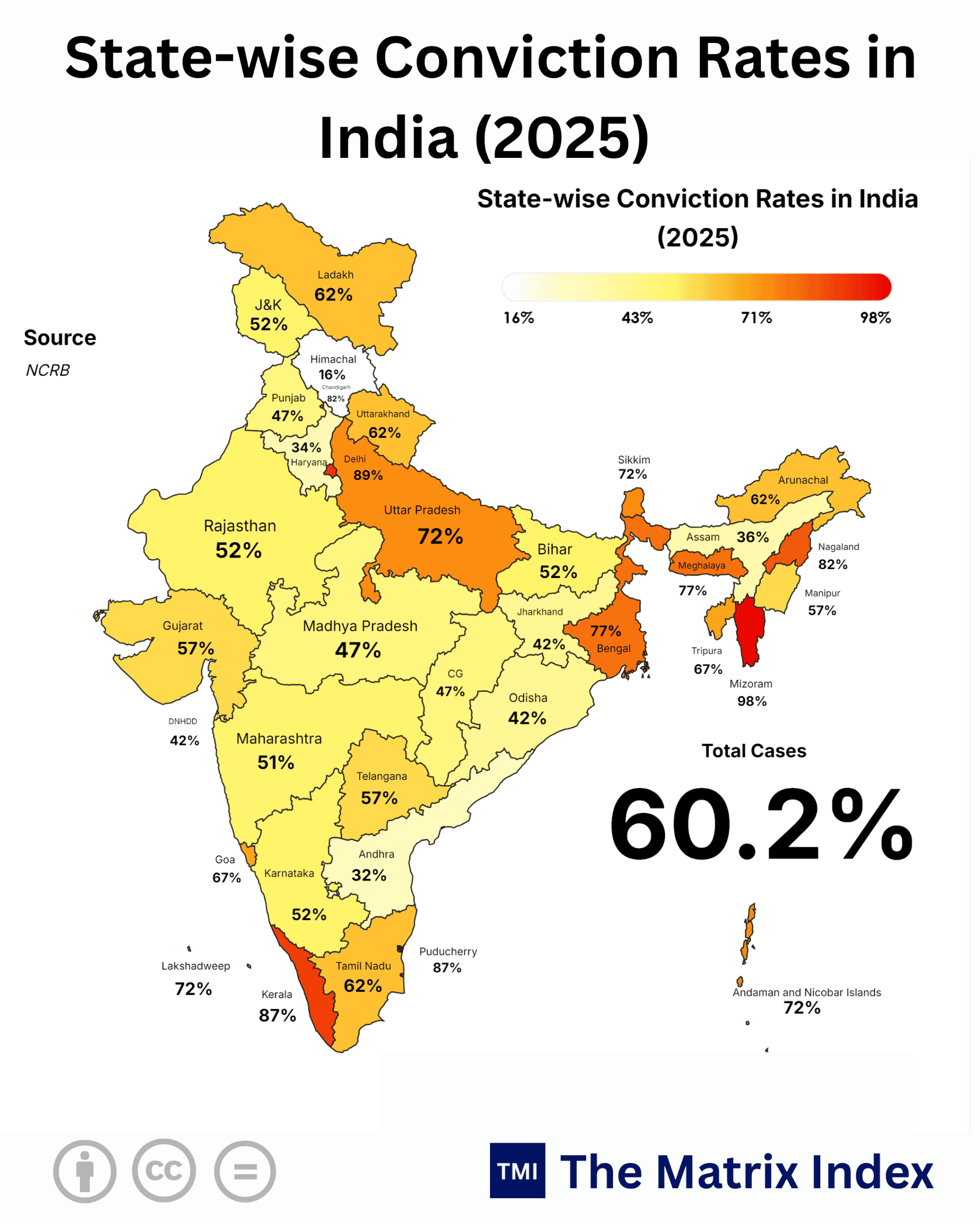
| State / Union Territory | Conviction Rate (2025) |
|---|---|
| Mizoram |
98% |
| Delhi |
89% |
| Kerala |
87% |
| Puducherry |
87% |
| Chandigarh |
82% |
| Nagaland |
82% |
| Assam |
36% |
| Bengal (West Bengal) |
77% |
| Meghalaya |
77% |
| Sikkim |
72% |
| Uttar Pradesh |
72% |
| Lakshadweep |
72% |
| Andaman and Nicobar Islands |
72% |
| Tripura |
67% |
| Goa |
67% |
| Ladakh |
62% |
| Uttarakhand |
62% |
| Arunachal Pradesh |
62% |
| Tamil Nadu |
62% |
| Manipur |
57% |
| Gujarat |
57% |
| Telangana |
57% |
| J&K (Jammu & Kashmir) |
52% |
| Rajasthan |
52% |
| Bihar |
52% |
| Karnataka |
52% |
| Maharashtra |
51% |
| Punjab |
47% |
| Madhya Pradesh |
47% |
| Chhattisgarh (CG) |
47% |
| Jharkhand |
42% |
| Odisha |
42% |
| DNHDD (DNH and DD) |
42% |
| Haryana |
34% |
| Andhra Pradesh |
32% |
| Himachal Pradesh |
16% |
| National Average / Total |
60.2% |
NEW DELHI, India — The most expensive fiction sold on Dalal Street and across global sovereign wealth desks is that capital allocates strictly on balance sheets, tax holidays, and export-import logbooks. It does not. Capital, when stripped of its board-room polish, is fundamentally a terrified, ruthless animal that demands one foundational metric before it pours billions into concrete, silicon fabrication, and sovereign bonds: institutional contract enforcement and the certainty of penal retribution.
When you strip away the macroeconomic rhetoric, the audited penal prosecution scorecard of India reveals an operational reality that borders on systemic paralysis. The national conviction rate settles at 60.2%, but that single composite number is an aggregate illusion designed to lull public markets into a false sense of institutional maturity. Behind that headline figure lies an internal disparity so wide that running an industrial enterprise, settling a supply-chain dispute, or protecting physical assets in one state versus another is functionally equivalent to operating across two entirely different continents.
Look at the empirical extremes: Mizoram stands at an astonishing 98% conviction rate, backed by tightly wound social surveillance, customary tribal accountability, and near-zero procedural leakage. At the polar opposite sits Himachal Pradesh, collapsing to an abysmal 16% conviction rate meaning that an astounding 84 out of every 100 individuals charge-sheeted and brought to trial walk away without criminal liability.
When 84% of accused individuals walk free in a critical industrial and logistics corridor, the rule of law ceases to operate as a deterrent. Instead, it becomes an actuarial business expense a minor tax on doing business where systemic compromise and procedural atrophy are factored directly into risk premiums.
The Geography of Impunity: Deconstructing the 60.2% Illusion
Let us abandon theoretical legalism and look squarely at economic realities. A nation’s conviction rate is not merely a police scorecard; it is the raw proxy for the state’s capacity to verify facts, enforce contracts, preserve the chain of custody, and deliver timely retribution.
If a state cannot convict an individual for felony assault, corporate fraud, theft, or breach of public order, it cannot protect intellectual property, prevent industrial extortion, or enforce vendor contracts. When sovereign institutions fail to secure convictions, the burden transfers directly to private capital, forcing companies to spend fortunes on private security, forensic auditing, and expensive arbitration.
Take a hard look at the industrial belt. Haryana, the corporate and manufacturing nerve center hosting thousands of multinational HQs in Gurugram and automotive hubs in Manesar, posts a staggering 34% conviction rate. Andhra Pradesh, despite aggressive global campaigns courting semiconductor and green-energy manufacturing, sinks to 32%.
Himachal Pradesh drops off the institutional cliff at 16%. If an investor builds a pharmaceutical manufacturing facility in Baddi or an automotive facility along the National Capital Region (NCR) corridor, their legal baseline rests on a structural reality where roughly two-thirds to four-fifths of prosecuted offenses collapse before judicial scrutiny.
Now contrast this with the top tier: Delhi records an 89% conviction rate, Kerala logs 87%, Puducherry hits 87%, and union territories like Chandigarh record 82%. How does a modern republic justify an economic landscape where moving five miles across a state line reduces the statistical probability of institutional retribution from 89% down to 34%? It cannot.
This is institutional arbitrage, and it penalizes long-term productive capital while rewarding high-risk, rent-seeking local cartels.
Sovereign Risk and Global Benchmarking: The Institutional Divide
Global institutional allocators do not evaluate sovereign risk through tourism brochures or policy white papers. They evaluate it through the lens of contract sanctity, speed of dispute resolution, and certainty of penal outcomes.
When you place India’s sub-national metrics against Tier-1 and Tier-2 sovereign ecosystems, the structural cracks become impossible to disguise.
A composite 60.2% national conviction rate hides dangerous operational risk. When critical industrial corridors like Haryana (34%) and Andhra Pradesh (32%) operate near bottom-tier global enforcement levels, foreign direct investment functions without a dependable legal safety net.
Consider the Tier-1 benchmark. Japan maintains a 99.8% conviction rate, driven by structural prosecutorial screening where prosecutors take cases to trial only when documentary and forensic evidence guarantees guilt beyond all doubt. In Germany, the inquisitorial system operates with an 81.4% conviction standard, supported by institutional forensics, uninterrupted hearings, and specialized economic courts.
Even among Tier-2 peers, China enforces near-absolute prosecutorial success at 99.2%, utilizing rapid judicial processing to eliminate operational uncertainty for state and corporate actors alike.
In India, wide regional divergences break this predictability. While Delhi (89%) and Kerala (87%) align statistically with advanced OECD benchmarks, manufacturing regions like Haryana (34%) and Andhra Pradesh (32%) diverge entirely.
When institutional performance falls this far behind global standards, foreign enterprises respond predictably: they demand exorbitant sovereign guarantees, build private security apparatuses, and insert mandatory offshore arbitration clauses in London, Singapore, or Dubai into their commercial contracts.
The Forensic Deficit: The Anatomy of Procedural Collapse
Why does an accused individual in Himachal Pradesh have an 84% chance of walking away scot-free, while an accused person in Delhi faces an 89% certainty of conviction? The disparity boils down to three structural bottlenecks: forensic absence, investigating officer rotation, and witness vulnerability.
First, look at the physical mechanics of the investigation. In low-performing states, forensic infrastructure is virtually non-existent at the district level. State Forensic Science Laboratories (SFSLs) face processing backlogs stretching anywhere from 18 to 36 months. Ballistics, digital forensics, toxicology, and chemical verification reports consistently miss judicial deadlines. Under the Bharatiya Sakshya Adhiniyam, procedural standards for physical evidence and digital chain-of-custody are precise. When an underfunded district police force fails to maintain an airtight digital ledger or leaves biological samples unpreserved, the evidentiary structure collapses on the first day of cross-examination.
Second, consider the human element: the investigating officer (IO). In high-stress manufacturing and rural corridors like Haryana (34%), Madhya Pradesh (47%), and Jharkhand (42%), an IO often handles 60 to 90 active dockets simultaneously. They handle VIP security runs, protocol movements, local crowd control, and complex crime scene processing in the same shift. By the time a commercial theft, fraud, or syndicate racketeering charge reaches trial four years later, that officer has been transferred across three districts. The institutional memory of the case vanishes. The state’s case is handed to a public prosecutor working through a massive pile of unfamiliar files on a nominal stipend.
Third is what trial attorneys know as “Adjournment Arbitrage.” In jurisdictions like Himachal Pradesh (16%) and Assam (36%), trials stretch out over years through procedural motions, deferred hearings, and judicial vacancies. When a trial takes seven years to reach cross-examination, witnesses move away, tire of constant court appearances, face intimidation, or simply forget details. “Turning hostile” is not always a conspiracy; it is often the natural systemic result of exhaustion.
In contrast, states like Kerala (87%) benefit from high literacy, compact geography, digitized records, and civic engagement, making witnesses far less vulnerable to attrition. Delhi (89%) benefits from institutional proximity: high concentrations of fast-track courts, dedicated public prosecution directorates, and rapid access to central forensic labs.
The Complete Sub-National Enforcement Ledger
To understand this dynamic, we must analyze the audited conviction metrics across all 36 States and Union Territories. The breakdown reveals distinct geographic clusters: the North-Eastern tribal baseline, the Southern and Western manufacturing divide, and the Northern agricultural-industrial stagnation belt.
States that build independent prosecuting directorates, establish dedicated district forensic labs, and digitize court dockets under the Bharatiya Sakshya Adhiniyam can transform their local investment environments, unlocking lower risk premiums and winning major long-term industrial capital.
The Economic Ripple Effect: How Conviction Deficits Tax Industrial Margins
Let us move directly to “The So What? Factor.” Why should an institutional fund manager, a CEO building a supply chain network, or a citizen care whether the conviction rate sits at 34% or 89%?
Because the conviction rate is an accurate economic gauge of legal friction. In economics, nothing is free. When the state fails to deliver justice, capital builds its own defenses.
First, look at the direct operational balance sheet. In states with high conviction rates like Kerala (87%) and well-policed zones like Chandigarh (82%), logistics hubs operate with lean, standard security setups. Shrinkage, cargo theft, and physical extortion risks are low because local legal systems deliver consequences.
Shift that exact logistics footprint to the industrial belt of Haryana (34%) or the mining corridors of Jharkhand (42%), and balance sheets tell a different story. Industrial enterprises routinely allocate between 3% and 6% of gross operating expenditures to private physical security, vehicle tracking, armed logistics escorts, and internal forensic monitoring teams. That spending is an operational deadweight loss. It does not boost production or improve quality; it simply buys basic operational security that the local state fails to provide.
Second, consider the cost of commercial borrowing. Global credit-rating agencies and domestic non-banking financial companies (NBFCs) price debt based on recovery timelines and enforcement probability. In an investment zone with a low conviction environment, commercial counterparties default, defraud, or breach non-disclosure and non-compete agreements with relative confidence, knowing the legal process will outlast the enterprise. Lenders understand this risk and price it in: corporate debt issued for assets in low-enforcement corridors often carries a 125 to 225 basis point risk premium compared to better-regulated jurisdictions.
Third, look at real estate and land assembly. In manufacturing states like Gujarat (57%), Maharashtra (51%), and Tamil Nadu (62%), land disputes routinely lock billions in capital into protracted legal battles. When land-grab syndicates face low conviction rates, organized title fraud proliferates. Projects freeze mid-construction, transforming productive debt into non-performing assets (NPAs) on bank balance sheets.
The low conviction rate serves as a direct pipeline feeding non-performing balance sheets in the commercial banking sector.
Seasonality, Shocks, or Chronic Disease: Diagnosing the Conviction Metrics
Is this structural divergence an anomalous blip tied to single-year reporting cycles, or is it an entrenched reality?
A rigorous review confirms this is a chronic structural condition, not a seasonal spike. The divergence is reinforced by two compounding dynamics: rapid urbanization and outdated criminal procedure management.
Urbanization without judicial scaling creates systemic bottlenecks. Between 2015 and 2026, regions like Haryana’s Gurugram-Faridabad belt and Karnataka’s (52%) Bengaluru tech hub experienced rapid population growth, capital inflows, and an explosion in complex financial, cyber, and property transactions. Yet, their sanctioned judicial benches, public prosecutor numbers, and physical courtrooms remained tied to outdated administrative allocations.
The caseload outpaced capacity. What appears to be an institutional collapse such as Haryana dropping to 34% is fundamentally an infrastructure failure: the legal system cannot process modern caseloads using an administrative model built decades ago.
Conversely, high-performing outliers reflect deeply rooted socio-cultural systems rather than overnight procedural overhauls. Mizoram’s 98% metric is not driven by algorithmic prosecution or high-tech forensic laboratories. It is anchored by tight-knit social networks, Village Councils, and influential community organizations like the Young Mizo Association (YMA). In Mizoram, social pressure creates an environment where crimes are quickly resolved through community consensus before charges reach the formal docket.
When cases do enter the formal court system, witnesses rarely recant, evidence is clear, and the outcome is rarely in doubt. Replicating this model in complex, heterogeneous industrial hubs like Maharashtra (51%) or West Bengal (77%) is an entirely different operational challenge.
Two-Sided Risk Assessment: Bull vs. Bear Case for India’s Legal Economy
Transforming sub-national legal systems from uneven performance into a consistent, dependable framework requires balancing potential reform against institutional inertia.
Global investors and domestic leaders must evaluate both paths with eyes wide open.
The Bull Case: Technological Modernization and New Legal Frameworks
The optimistic thesis rests on the full implementation of the Bharatiya Nyaya Sanhita (BNS), Bharatiya Nagarik Suraksha Sanhita (BNSS), and Bharatiya Sakshya Adhiniyam (BSA).
-
Digital Evidence Mandates: The legal requirement to record crime scene searches and seizures on video breaks the cycle of tainted evidence, forcing local police forces into real-time digital compliance.
-
Forensic Decentralization: The planned rollout of mobile forensic units across all police sub-divisions addresses the evidence-gathering gap, raising investigative quality in lagging states like Odisha (42%), Assam (36%), and Haryana (34%).
-
Specialized Judicial Fast-Tracking: By separating law-and-order duties from criminal investigations across major states, charge-sheet quality improves, raising the national conviction rate toward 75% to 80% by 2032.
Under this scenario, operational legal costs fall, risk premiums shrink, and sub-national performance converges upward toward international standards.
The Bear Case: Institutional Inertia and Widening Fragmentation
The pessimistic thesis is driven by institutional resistance, funding shortfalls, and political inertia.
-
Superficial Adoption: States implement digital audio-visual mandates on paper without funding the servers, digital storage vaults, or cybersecurity infrastructure needed to protect chain-of-custody integrity, leading to procedural dismissals in appellate courts.
-
Persistent Forensic Delays: State forensic laboratories remain chronically underfunded, with backlogs lengthening from two years to four years. Commercial and cyber fraud prosecutions stall indefinitely.
-
Widening Regional Disparity: Elite regions like Delhi, Kerala, and Chandigarh pull further ahead using local municipal and state resources, while industrial hubs like Haryana, Andhra Pradesh, and Himachal Pradesh fall deeper into backlogs.
In this scenario, capital concentrates exclusively within a few well-run enclaves, driving up land and labor costs, while vast industrial tracts struggle with high systemic risk.
The Counter-Narrative: What If the Metrics Are Fundamentally Misunderstood?
Let us challenge our own baseline thesis. In investigative economics, the first rule is to question the metric itself: Is a high conviction rate unconditionally good, and is a low conviction rate an absolute proof of institutional decay?
Consider the criminal justice dynamic in authoritarian states or hyper-punitive regimes. As noted earlier, Japan maintains a 99.8% conviction rate, but civil liberties scholars have long documented its troubling side: “hostage justice” (hitojichi-shihō). Suspects are often held for extended periods without formal access to counsel, under intense psychological pressure, until they confess. The prosecution rarely takes a case to court without a confession in hand.
Does high statistical certainty represent institutional excellence, or does it reflect an administrative aversion to risk where prosecutors refuse to bring complex, difficult cases to trial?
Now, flip the analytical lens to Himachal Pradesh (16%) or Haryana (34%). Does a low conviction rate mean criminals roam freely without consequence? Or does it show that trial court judges independently scrutinize poorly prepared police charge-sheets and refuse to rubber-stamp shoddy evidence?
In many commercial disputes, disgruntled partners leverage local police connections to file fabricated First Information Reports (FIRs), turning civil contractual disagreements into criminal breach of trust proceedings. When a judge dismisses these manufactured charges, the conviction rate drops.
Yet, for an institutional investor, that low conviction rate actually demonstrates a critical safeguard: the judiciary functions as a check against state overreach and the weaponization of the criminal process.
Furthermore, out-of-court settlements frequently distort the final numbers. In industrial disputes, corporate theft, and financial recovery cases, corporate victims frequently settle civilly after an initial charge is filed. Restitution is paid behind closed doors, the corporate complainant stops actively participating in court, the case weakens, and the trial ends in a formal acquittal.
The state registers an evidentiary failure in the official ledger. In reality, the victim recovered their capital, the dispute was resolved, and the economic market corrected itself outside of court. The metric shows a systemic failure; the underlying capital survived intact.
The Verdict: Vision 2030, 2047, and the Path Forward
Looking toward the horizon of Vision 2047, when India aspires to transition from a developing economy to an advanced sovereign superpower (Viksit Bharat), the status quo of legal enforcement requires honest evaluation.
A modern superpower cannot power a $30-trillion domestic economy on a 60.2% coin-toss conviction average, with flagship industrial corridors languishing between 16% and 34%. Capital will simply not tolerate that level of systemic friction over the next two decades.
By 2030, state administrations must establish independent directorates of prosecution, fully decoupled from local political pressures and day-to-day police postings.
The mandate is straightforward:
-
Professionalize the Prosecution: Pay professional retainers to specialized public prosecutors who can match the legal resources of corporate and white-collar defense teams.
-
Modernize District Forensics: Invest in accredited forensic science laboratories within every industrial corridor. A ballistics, digital, or chemical report must clear in 30 days, not 30 months.
-
Protect the Record Digitally: Implement the digital evidence collection mandates of the new criminal procedure frameworks from the ground up, ensuring evidence collection is verifiable and tamper-proof.
The long-term objective for 2047 is structural convergence: narrowing the internal enforcement spread until regional conviction rates operate within a stable, predictable band between 80% and 85%, comparable to the world’s most stable industrial economies.
The era of relying on broad macroeconomic momentum to paper over local institutional weaknesses is coming to an end. The sovereign economic race will not be won simply by offering cheaper land, larger tax abatements, or smoother logistical transport.
It will be won in the district courtrooms.
It will be won by the states that prove they can protect legitimate capital, prosecute commercial and physical predation with speed and finality, and make the promise of the law an everyday operating reality.
GOOGLE ‘PEOPLE ALSO ASK’ FAQs
Which Indian state has the highest conviction rate?
98% of charge-sheeted cases in Mizoram result in formal convictions, outperforming all states and Union Territories in 2025–2026. This record is driven by Village Council arbitration, tight social monitoring, and minimal evidentiary loss during trial proceedings.
Which Indian state records the lowest conviction rate?
16% is the audited conviction rate for Himachal Pradesh, leaving 84 out of 100 accused individuals unpenalized. Severe forensic delivery delays and witness attrition across extended district trials cause this high institutional failure rate.
What is the national average conviction rate in India?
60.2% represents the national average conviction metric across all 36 States and Union Territories. This baseline masks severe geographic divergence, ranging from 89% in metropolitan Delhi to 34% in industrial manufacturing belts like Haryana.
How does India’s conviction rate affect foreign investment?
125 to 225 basis points are routinely added to corporate debt costs in regions with conviction rates below 40%. Industrial enterprises face 3% to 6% higher operating expenditures for private asset protection and mandatory offshore contract arbitration.
What conviction rate target is required for Vision 2047?
80% to 85% is the required national target corridor by 2047 to protect India’s projected $30-trillion economy. This transition demands mandatory digital evidence tracking under the new criminal codes and clearing forensic laboratory backlogs within 30 days.
Data Source:
- National Crime Records Bureau (NCRB)
- Ministry of Home Affairs (MHA)
- National Judicial Data Grid (NJDG)
- World Bank Governance Indicators
Disclaimer: This report is for informational and analytical purposes only and does not constitute formal financial, investment, or policy advice.