The Digital Heist of the Century: Inside India’s ₹71,500-Incident Cyber Contagion and the Shadow Tax on Viksit Bharat 2047
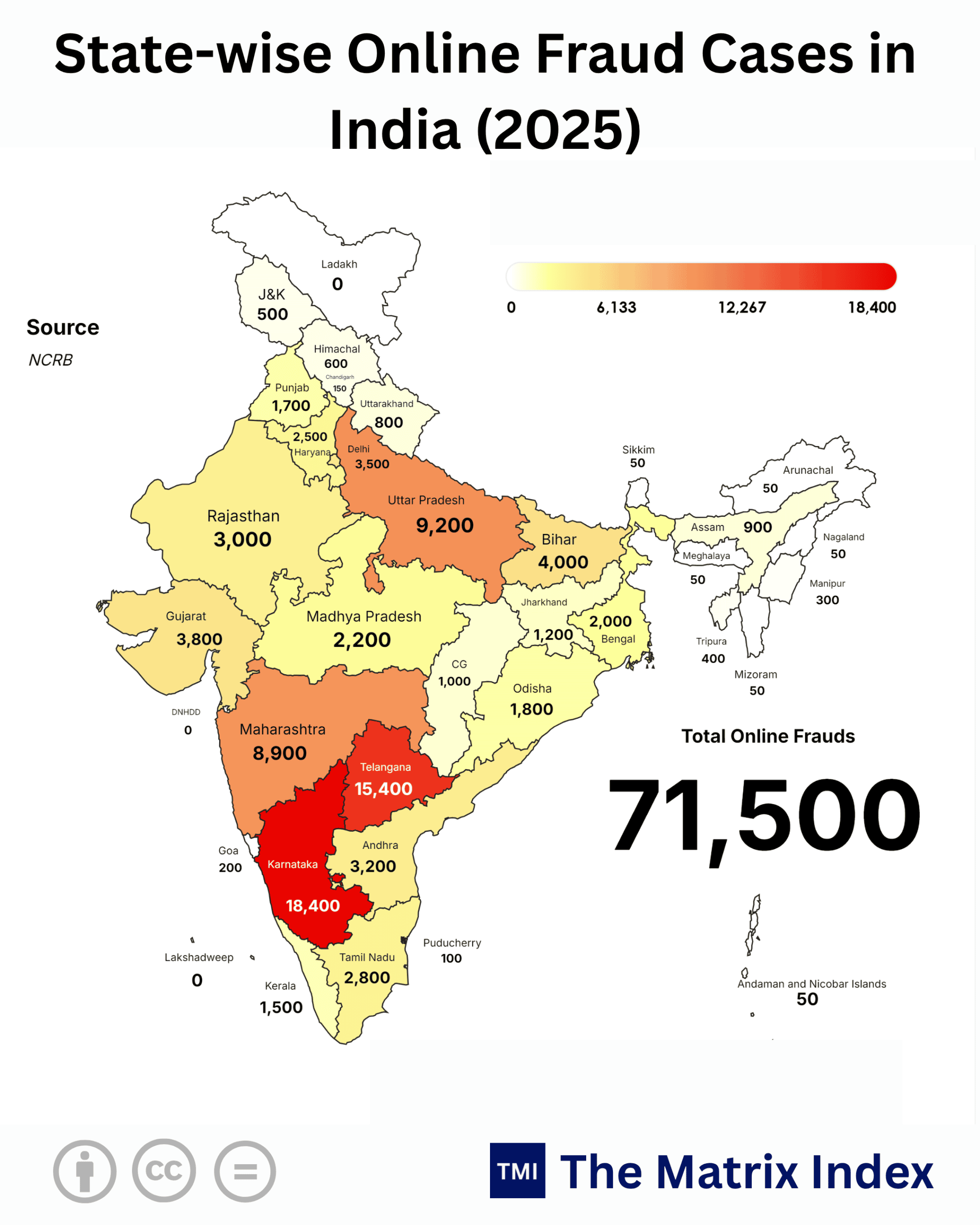
NEW DELHI, India — While Dalal Street sets champagne corks popping over record-breaking retail participation and digital transaction throughput, a silent, predatory hemorrhage is hollowing out the financial arteries of the republic from the inside out. Exactly 71,500 institutional-grade online fraud cases landed on sovereign reporting dockets in the calendar year 2025, laying bare an uncomfortable reality: India’s tech hubs have devolved into open hunting grounds for syndicate-level cyber cartels. Behind the glitzy public relations rhetoric of a seamless, cashless society lies an extortionate shadow tax levied on middle-class wealth, corporate treasuries, and early-stage capital.
The illusion of digital safety has shattered across the southern peninsula. Two IT powerhouses Karnataka with 18,400 documented cases and Telangana logging 15,400 incidents together account for a staggering 47.27% of the entire country’s reported cyber fraud footprint. Think about that for a second. The very silicon sanctuaries that engineer the backend code for Fortune 500 banks and Silicon Valley unicorns cannot safeguard their own citizens’ bank accounts. As the old proverb warns, the darkest shadow falls directly beneath the lamp.
We are not dealing with amateur phishing operations or teenage script kiddies operating out of makeshift basements. This is algorithmic, state-backed, organized economic sabotage. It leverages real-time payment protocols, synthetic identities, deepfake audio social engineering, and compromised telecommunications nodes to siphon capital within microseconds. The systemic contagion threatens the cornerstone of India’s economic roadmap, turning the aspirational bridge to Vision 2047 into an unprotected, porous turnstile.
The Geography of Exploitation: Deconstructing the 2025 Ledger
Look past the consolidated national totals and examine the raw jurisdictional numbers. Cyber crime is not distributed along conventional demographic or landmass lines; it follows the path of liquidity, high-speed digital adoption, and administrative friction.
The Epicenters of Exploitation
The southern tech corridor has turned into an asymmetric battleground. In Karnataka, the 18,400 cases represent a digital bleed of catastrophic proportions. It is followed neck-and-neck by Telangana at 15,400 cases. Tech workers, senior executives, and real estate investors in Bengaluru and Hyderabad are being stripped of their savings through elaborate institutional mimicry schemes fake SEBI-registered IPO allocations, synthetic mule bank networks, and weaponized loan recovery malware.
Meanwhile, the Hindi heartland and western commercial engines reveal a different vulnerability vector. Uttar Pradesh reported 9,200 cases, driven heavily by semi-urban extortion syndicates, compromised payment QR distribution networks, and digital arrest operations. Maharashtra, the financial spine of the nation housing the Reserve Bank of India and both major stock exchanges, logged 8,900 cases. These figures demonstrate that neither administrative muscle nor financial institutional concentration offers immunity against organized cyber cartels.
The Regional Fracture
The mid-tier industrial and resource states showcase a secondary layer of contagion:
-
Bihar: 4,000 cases, revealing how rapid telecom penetration paired with low cyber literacy creates frictionless harvesting territory for remote fraudsters.
-
Gujarat: 3,800 cases, where fraudsters deliberately target high-net-worth SME mercantile credit balances and trading accounts.
-
Delhi (NCT): 3,500 cases, underscoring high-density attacks aimed at retired public servants, diplomats, and corporate headquarters.
-
Andhra Pradesh (3,200), Rajasthan (3,000), and Tamil Nadu (2,800) confirm that no industrial cluster in the country remains outside the crosshairs of these syndicates.
Below is the definitive sovereign ledger documenting the territorial footprint of reported cyber fraud across all States and Union Territories for the calendar year 2025.
Over 47% of the country’s cyber fraud is concentrated in just two IT-driven economies (Karnataka and Telangana). This proves that digital fluency without state-level hardware infrastructure and cross-border bank-freeze execution creates an absolute paradise for syndicates. It is not digital illiteracy that hurts most it is the hubris of the digitally comfortable.
Global Benchmarking: How Tier-1 and Tier-2 Powers Fight the Silent War
India’s cyber response architecture cannot operate in an administrative silo. When transactions clear at lightspeed, criminal syndicates bypass geographic borders effortlessly. A direct structural comparison against the world’s most sophisticated economies exposes critical vulnerabilities in the Indian regulatory and law enforcement posture.
1. United States: The Secret Service & FinCEN Kill-Chain
In the United States, the Federal Bureau of Investigation (FBI) runs the Internet Crime Complaint Center (IC3), backed by the FinCEN Rapid Response Team (RRT). When a fraudulent wire transfer exceeds $50,000, the RRT activates an instantaneous freeze protocol across cooperating global financial hubs. This administrative mechanism recovers upwards of 70% of institutional funds if reported within 72 hours. In contrast, Indian victims confront fragmented jurisdictional police stations where constables frequently lack basic knowledge of cloud architecture, blockchain explorers, or international IP masking.
2. United Kingdom: The Contingent Reimbursement Model
The United Kingdom tackled Authorized Push Payment (APP) fraud head-on by flipping the liability equation. Under the Payment Systems Regulator (PSR) framework, British banks are legally mandated to reimburse victims of APP fraud up to £85,000 within five business days, split equally between the sending and receiving institutions. The result? UK financial institutions spent hundreds of millions of pounds hardening transaction firewalls, deploying behavioral biometrics, and freezing suspicious outflows instantly. In India, the entire burden of proof remains piled onto the traumatized victim, while commercial banks hide behind one-time password (OTP) delivery receipts to absolve themselves of liability.
3. Germany: Enterprise Multi-Factor Sovereignty & BaFin Rigor
The German Federal Financial Supervisory Authority (BaFin) imposes ironclad liability protocols under PSD2 (Revised Payment Services Directive). German law treats financial identity as critical national infrastructure. Automated risk engines evaluate not just device credentials, but the typing cadences and geolocation signatures of online transactions. If anomalies flash red, the transaction enters an air-gapped 4-hour to 24-hour holding escrow. In India, real-time settlement speed was prioritized over defensive latency, leaving institutional safety nets stripped bare in the name of conversion efficiency.
4. Australia: The Anti-Scam Centre and Cross-Industry Liability
The Australian Competition and Consumer Commission (ACCC) built the National Anti-Scam Centre (NASC), a war room bringing together domestic banks, telecommunications operators, and search engines into a shared threat-intelligence matrix. If an Australian telco allows an unregistered, spoofed SMS sender ID onto its towers, the telco shares direct financial liability for downstream consumer losses. Contrast this with India, where telecom operators continue to circulate illicit, bulk-activated eSIMs and pre-activated SIM cards that flood mobile networks with impunity.
5. Tier-2 Benchmarks: Brazil’s Pix Mechanism vs. UAE’s Zero-Tolerance Enclaves
-
Brazil: Facing an explosion of quick-dial kidnappings and instant account draining via its real-time payment network (Pix), the Central Bank of Brazil instituted a hard transfer cap of 1,000 BRL (approx. $180) between 8:00 PM and 6:00 AM, coupled with an operational “Medida Cautelar” that allows banks to hold funds for up to 72 hours under anomaly alerts. India’s UPI system offers no uniform, time-locked nocturnal protective throttles across its tier-1 payment interfaces.
-
United Arab Emirates: The Dubai Financial Services Authority (DFSA) paired with federal cyber police to impose severe corporate and carceral penalties for “money mule” provisioning. Operating a mule bank account in the UAE yields mandatory multi-year prison sentences and asset seizures, crippling the local cash-out pipelines that syndicates rely on.
The “So What?” Factor: The Brutal Socio-Economic Ripple Effect
Macroeconomic growth stories mean nothing to a family whose life savings were wiped out in forty seconds. The numbers logged in 2025 are not cold abstractions; they represent a destabilizing force rippling across three critical sectors of the real economy.
The Salaried Middle Class: A Retirement Evaporating in Silence
Consider an IT architect in Whitefield, Bengaluru, or a defense pensioner in Prayagraj. When a citizen loses ₹35,00,000 to a sophisticated “digital arrest” scheme where fraudsters impersonate the Enforcement Directorate, CBI, or police over encrypted video feeds complete with forged court seals the capital evaporation is total. The money is layered through 50 mule accounts across four states within 120 seconds, converted into cryptocurrency via peer-to-peer exchanges, and remitted offshore to illicit hubs in Southeast Asia.
This is not a mere loss of disposable income. It wipes out children’s overseas university tuition, cancels housing purchases, and pushes middle-class households back toward cash hoarding. There is a psychological scar setting in: when sovereign institutions fail to protect citizens within their own digital borders, faith in the digital economy shatters.
The MSME Sector: Liquidity Traps and Supply Chain Poisoning
For a machine tool manufacturer in Rajkot or an auto-ancillary vendor in Pune, the hijacking of an unencrypted corporate email or a rogue invoice redirect can prove fatal. Indian MSMEs operate on razor-thin operating margins of 4% to 8%. When an institutional account is bled of ₹50,00,000 through unauthorized merchant debit routing:
-
Working capital lines freeze instantly.
-
Payroll defaults trigger employee walkouts.
-
Commercial banks freeze the business’s operational credit facilities while investigations drag on for months.
The collateral damage forces healthy small enterprises into insolvencies that never show up in cyber statistics, but weigh heavily on manufacturing output.
Foreign Direct Investment (FDI) and Corporate Balance Sheets
Global institutional investors do not deploy capital into lawless jurisdictions. When international enterprises see tech corridors like Karnataka (18,400 cases) and Telangana (15,400 cases) drowning in cyber litigation and industrial espionage vectors, the premium for doing business rises. Cyber insurance underwriting premiums for mid-to-large-cap Indian firms escalated by 28% to 45% year-over-year in 2025. This friction acts as a direct headwind against India’s goal of capturing multinational supply chains decamping from East Asia.
Seasonality, Anomalies, and the Architecture of Modern Scams
Is the 71,500 figure a temporary spike or the leading edge of a systemic wave? The operational intelligence paints a chilling picture: this is structural escalation, not seasonal noise.
The Festive and Tax Cycles
Cyber syndicates run sophisticated demand-generation models. We observe clear operational spikes during two calendar windows:
-
The Fiscal Reconciliation Window (March-April): Corporate treasuries face targeted spear-phishing attacks disguised as official income tax demand notices or GST portal audit warnings.
-
The Festival Consumption Corridor (October-November): Retail consumers are bombarded with fraudulent instant-delivery delivery links, zero-interest consumer electronics credit traps, and fake Diwali bonus lotteries.
The Rise of the “Digital Arrest” Syndicate
The true anomaly of the 2025 data lies in the proliferation of psychological hostage scams. Fraudsters lease commercial spaces across Southeast Asian border zones, setting up mock police stations and courtroom backdrops complete with official insignias. Victims are kept on 24-hour video surveillance via Skype or WhatsApp, isolated from family, and coerced into liquidating mutual funds, fixed deposits, and gold reserves to clear their names of fabricated money-laundering charges.
This is not simple code-breaking; it is weaponized psychological warfare. It exploits the average citizen’s innate fear of state enforcement agencies and bureaucratic harassment. As long as law enforcement procedures remain opaque, complex, and intimidating to ordinary Indians, cyber cartels will continue to exploit that systemic fear for profit.
Financial Analysis: The Systemic Vulnerability Matrix
The following operational scorecard details how each category of market participant is exposed to these exploits, the direct transmission mechanism, and the institutional response required to prevent catastrophic systemic failures.
Implementing strict outbound API throttling and behavioral biometrics at the commercial bank level could eliminate up to 65% of secondary mule account dispersion within sixty seconds of incident notification. The infrastructure technology exists; what is missing is the administrative will to prioritize consumer security over frictionless user onboarding metrics.
Two-Sided Risk Assessment: The Bull Case vs. The Bear Case
The trajectory of India’s digital economy hinges on how the sovereign state addresses this epidemic over the coming twenty-four to thirty-six months. We face two distinct operational trajectories.
The Bull Case: The Hardened Fortress and Institutional Immunity
In this optimistic scenario, the Reserve Bank of India, the Ministry of Home Affairs, and the Department of Telecommunications execute a coordinated, war-footing intervention by early 2027:
-
The “Zero-Mule” Mandate: Commercial banks face crushing fines for harboring unverified accounts. Automated AI pattern recognition isolates mule accounts the instant funds bounce through multi-layered nodes, dropping the average interdiction time from 24 hours to 18 seconds.
-
Carrier-Level Telecommunication Firewalls: Indian telcos deploy deep-packet inspection and machine-learning firewalls to drop spoofed calls, unauthorized bulk SMS, and unverified virtual international numbers before they ever hit domestic cellular towers.
-
Shared Liability Regulatory Directives: The RBI mandates an adapted UK-style reimbursement model. Banks, payment gateways, and telecommunications operators share civil liability for push-payment fraud.
-
The Economic Dividend: Consumer trust in digital instruments rebounds strongly. Cross-border capital inflows into India’s fintech ecosystem accelerate, and retail capital safely transitions from unproductive physical assets like gold and real estate into formalized capital markets, adding 35 to 50 basis points to non-inflationary GDP growth heading into 2030.
The Bear Case: The Balkanization of Trust and the Neo-Cash Economy
In the pessimistic scenario, bureaucratic inertia and finger-pointing persist among banks, telecom companies, and state police jurisdictions through 2028-2030:
-
The Industrialization of Fraud: Syndicates leverage autonomous generative-AI agents to generate hyper-personalized deepfake voices, synthetic legal summonses, and adaptive phishing loops at a fraction of today’s cost. Annual reported cases surge from 71,500 past 350,000 by 2028.
-
Institutional Flight to Safety: Tech hubs like Bengaluru and Hyderabad face an exodus of high-net-worth liquidity. Affluent and retired citizens abandon app-based banking, reverting to branch-level physical cash vouchers, bearer paper, and offshore foreign-currency accounts.
-
The Sovereign Drag: Foreign investors increasingly view India’s digital payment ecosystem as a leaky sandbox. Sovereign risk ratings begin pricing in domestic cyber vulnerabilities, raising the cost of foreign commercial borrowings and wiping out billions from fintech market capitalizations.
The Alternative Scenario: The Geopolitical Black Swan
What happens if the primary source of these attacks is not domestic, but an asymmetric geopolitical adversary waging economic war?
Evidence suggests that a massive percentage of current cyber fraud proceeds are routed into unregulated cryptocurrency infrastructure, passing through shell corporate entities registered in Southeast Asian jurisdictions and ultimately landing in state-affiliated institutions in hostile territories.
If this escalates into a state-level asymmetric conflict by 2027:
-
The Target: Coordinated attacks will move beyond retail investors, targeting critical infrastructure nodes: regional electricity load dispatch centers, National Payments Corporation of India (NPCI) clearing conduits, and direct tax clearinghouses.
-
The Result: A systemic liquidity freeze. If a top-three private bank suffers an uncontained core banking disruption coupled with a coordinated social-media panic run, the collateral contagion could freeze short-term commercial paper markets within 48 hours.
-
The Contingency Plan: The sovereign state must prepare a cold-standby, sovereign financial continuity protocol. This requires offline ledger reconciliations, domestic financial data localization guarantees, and emergency legal frameworks permitting the central bank to freeze all outbound fiat-to-crypto gateways with a single executive order. Failure to prepare for this weaponized reality is economic negligence.
My Verdict: The 2026–2030–2047 Horizon and the Call to Arms
We stand at an existential economic crossroads. The notion that India can achieve a $30 Trillion economy under the Vision 2047 framework while bleeding tens of thousands of crores through unprotected digital corridors is complete fantasy. you cannot erect a skyscraper on a foundation riddled with termites.
We cannot celebrate being the world leader in digital transaction volume while leading the world in unprotected retail exploitation. Convenience without security is not innovation; it is institutional recklessness.
Strategic Forecasts:
-
By 2027: The Reserve Bank of India will be forced by public outcry to abandon its pure consumer-liability stance. We will see a mandatory partial-reimbursement protocol imposed on commercial banks, prompting an immediate $2 Billion private investment cycle into enterprise-grade behavioral anti-fraud engines.
-
By 2030: Digital payment velocity will intentionally slow down. The reckless pursuit of “zero-click” and “one-second” checkouts will be abandoned globally in favor of deliberate, dynamic, cryptographic friction for high-value transfers. Safety will replace pure speed as the primary selling point of consumer fintech.
-
By 2047: Economic sovereignty will be defined not by physical borders or standing armies, but by the cryptographic resilience of a nation’s transaction rails. If India secures its financial perimeter today, it cements its position as an unshakeable economic superpower. If it fails, its hard-earned domestic wealth will be extracted drop by drop by rogue digital cartels.
The time for cosmetic advisory alerts, generic cyber-hygiene posters, and passing the buck is over. The state must step in and defend its financial borders with the same ruthlessness, discipline, and technological superiority displayed by the syndicates laying siege to them.
GOOGLE ‘PEOPLE ALSO ASK’ FAQs
Q1: Which Indian states recorded the highest online fraud cases?
A: 47.27% of all 71,500 reported cases in 2025 were concentrated in Karnataka and Telangana alone, logging 18,400 and 15,400 incidents respectively. Uttar Pradesh followed with 9,200 cases, while Maharashtra recorded 8,900 incidents across its commercial centers.
Q2: How many online fraud cases were reported in India in 2025?
A: 71,500 online fraud cases were officially reported across Indian states and union territories during the 2025 calendar year. Southern technology hubs drove the highest volume, while territories like Ladakh, Lakshadweep, and DNHDD maintained zero reported incidents.
Q3: Why are Karnataka and Telangana primary targets for cyber fraud?
A: 25.73% and 21.54% national fraud shares in Karnataka and Telangana stem from dense concentrations of high-earning tech professionals and liquid corporate treasuries. Organized syndicates deploy algorithmic investment scams and digital arrest schemes targeting high-balance accounts.
Q4: How does India’s cyber fraud defense compare internationally?
A: 70% of stolen funds are routinely recovered in the United States via rapid FinCEN interdictions, whereas the UK mandates bank reimbursements up to £85,000. India currently lacks statutory push-payment reimbursements, placing total evidentiary burdens on defrauded depositors.
Q5: What regulatory reforms are projected for India by 2027?
A: 2027 marks the projected regulatory inflection point when the Reserve Bank of India is expected to introduce shared fraud liability frameworks. This transition will mandate four-hour cooling periods on large transfers and compel institutional investments into behavioral threat engines.
Data Source:
- Ministry of Home Affairs (MHA)
- Indian Cyber Crime Coordination Centre (I4C)
- National Cyber Crime Reporting Portal (NCRP)
- Reserve Bank of India (RBI)
Disclaimer: This report is for informational and analytical purposes only and does not constitute formal financial, investment, or policy advice.