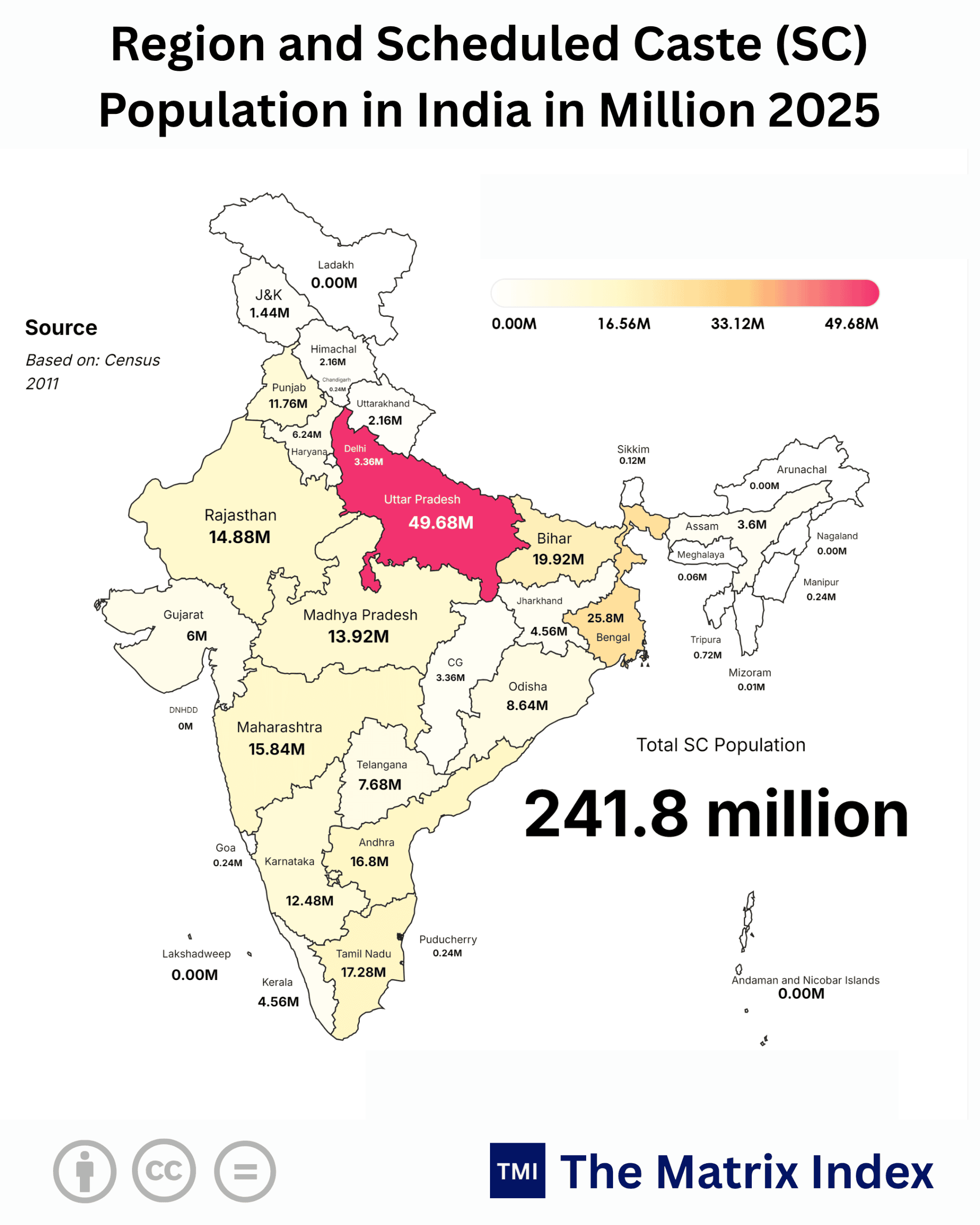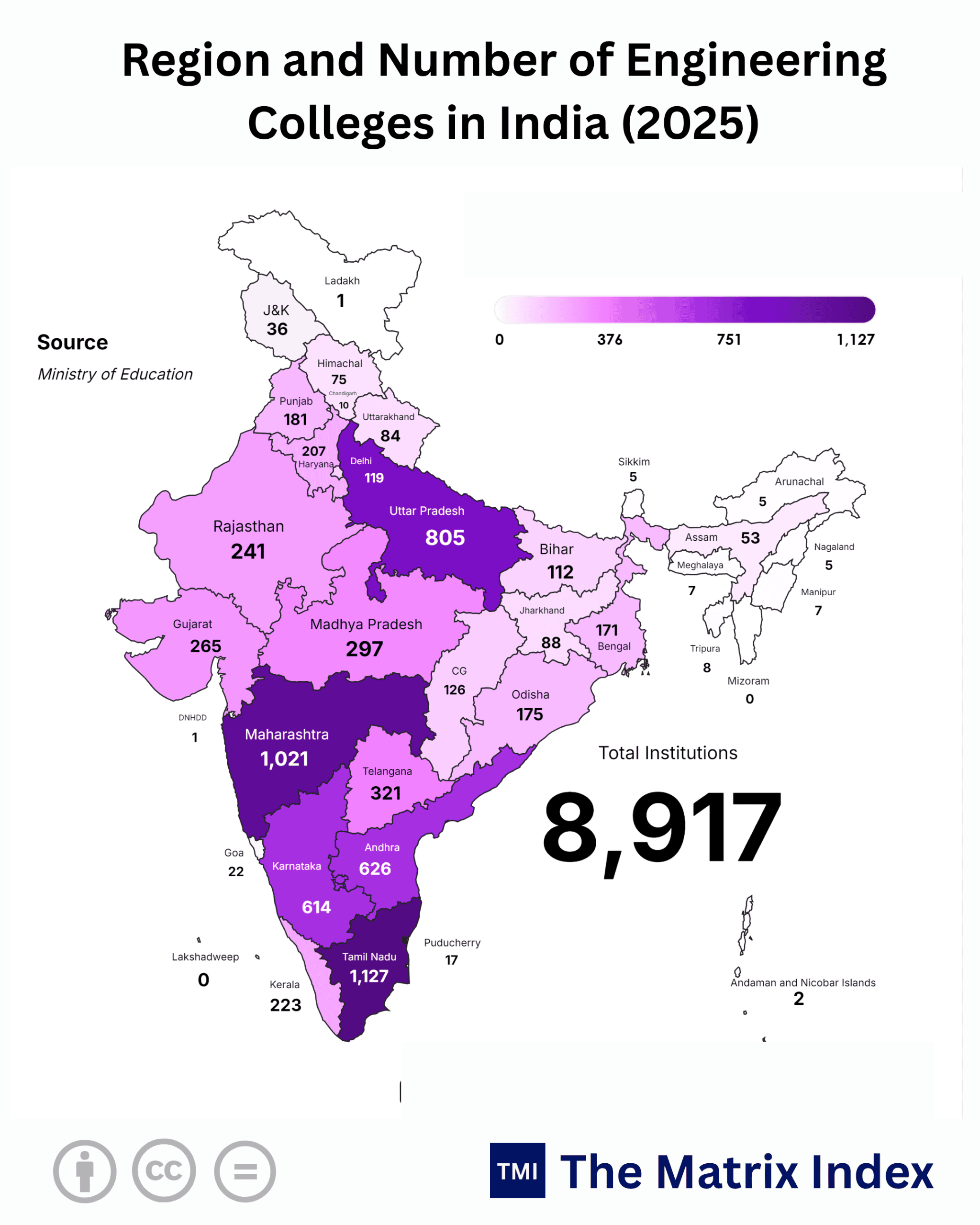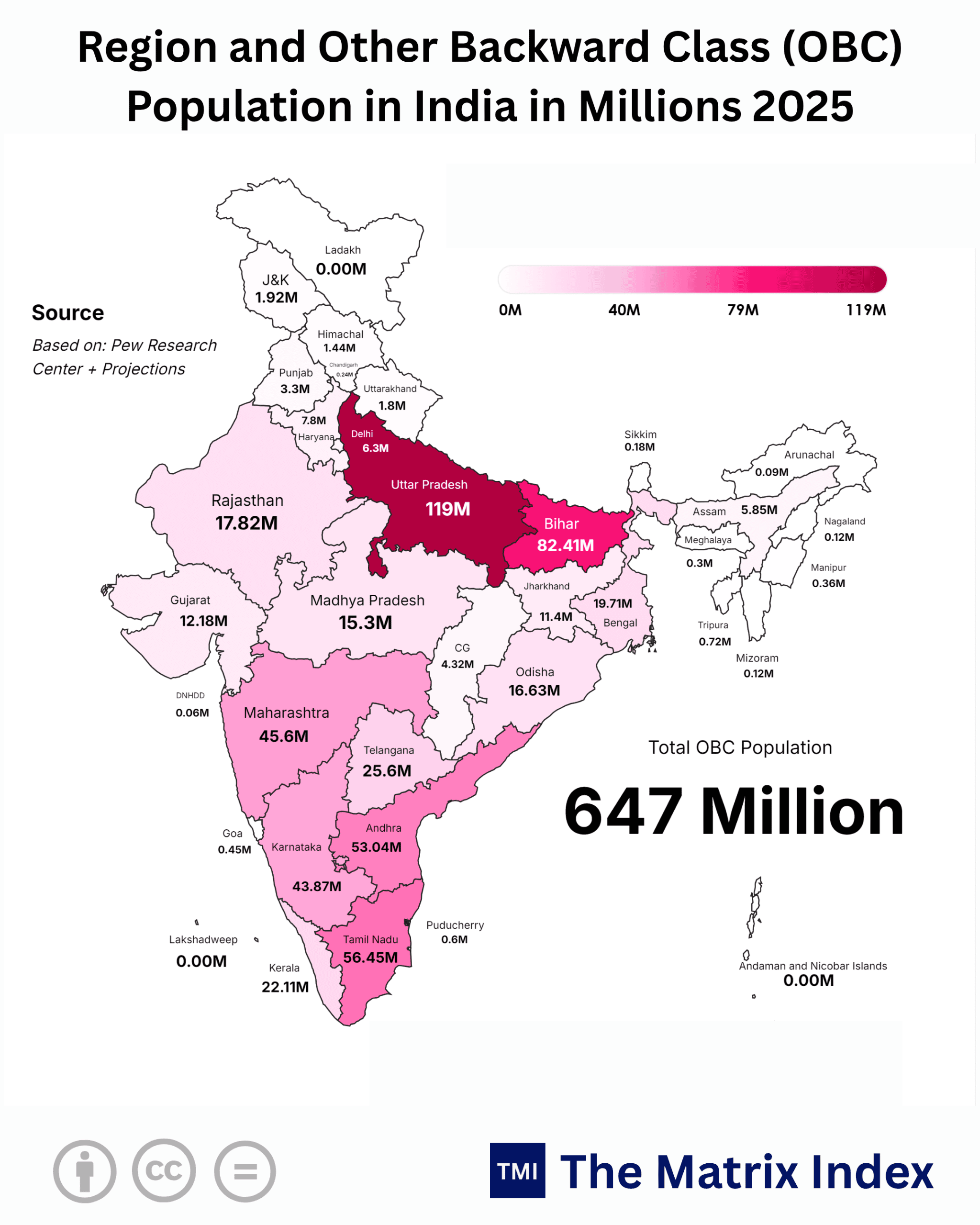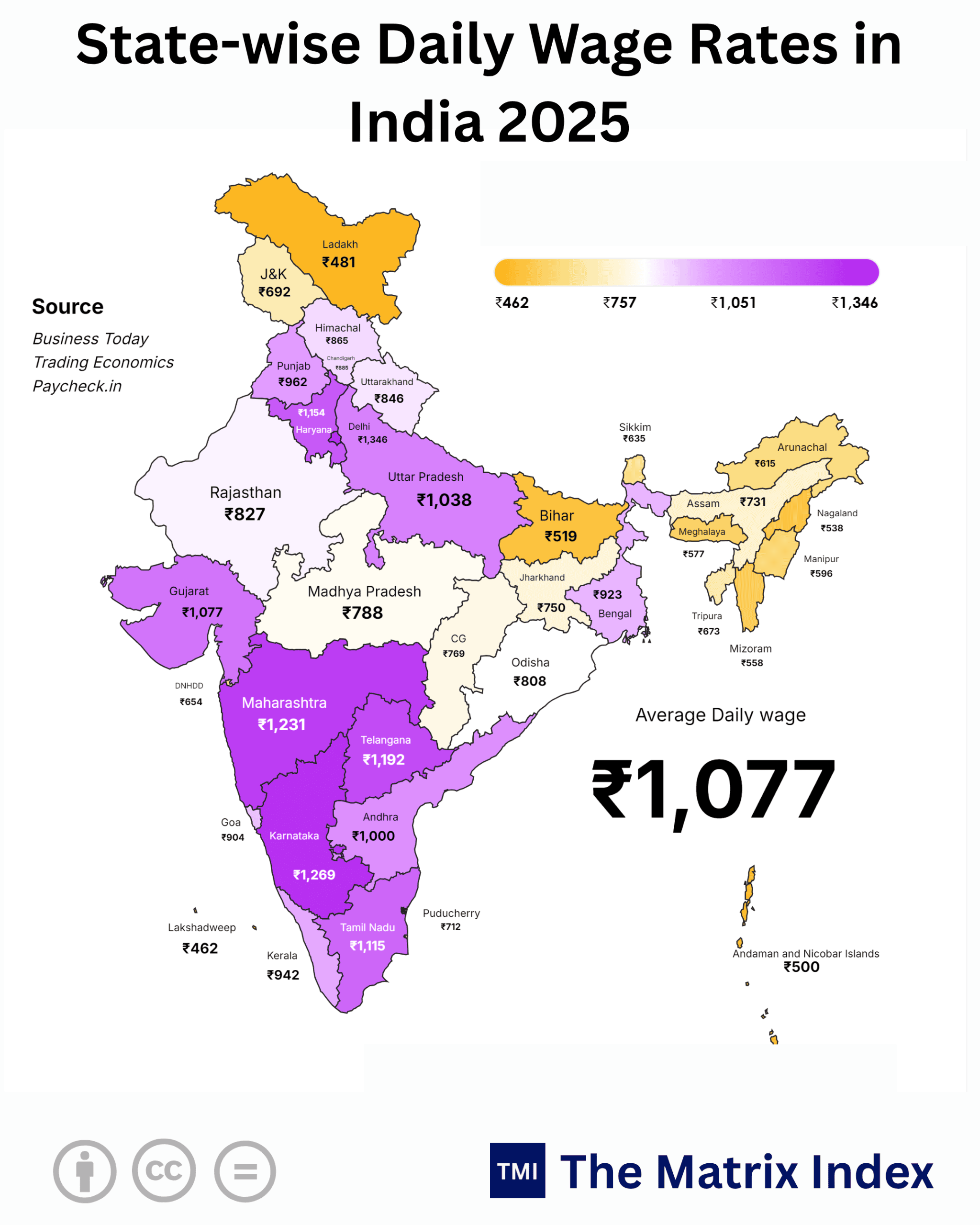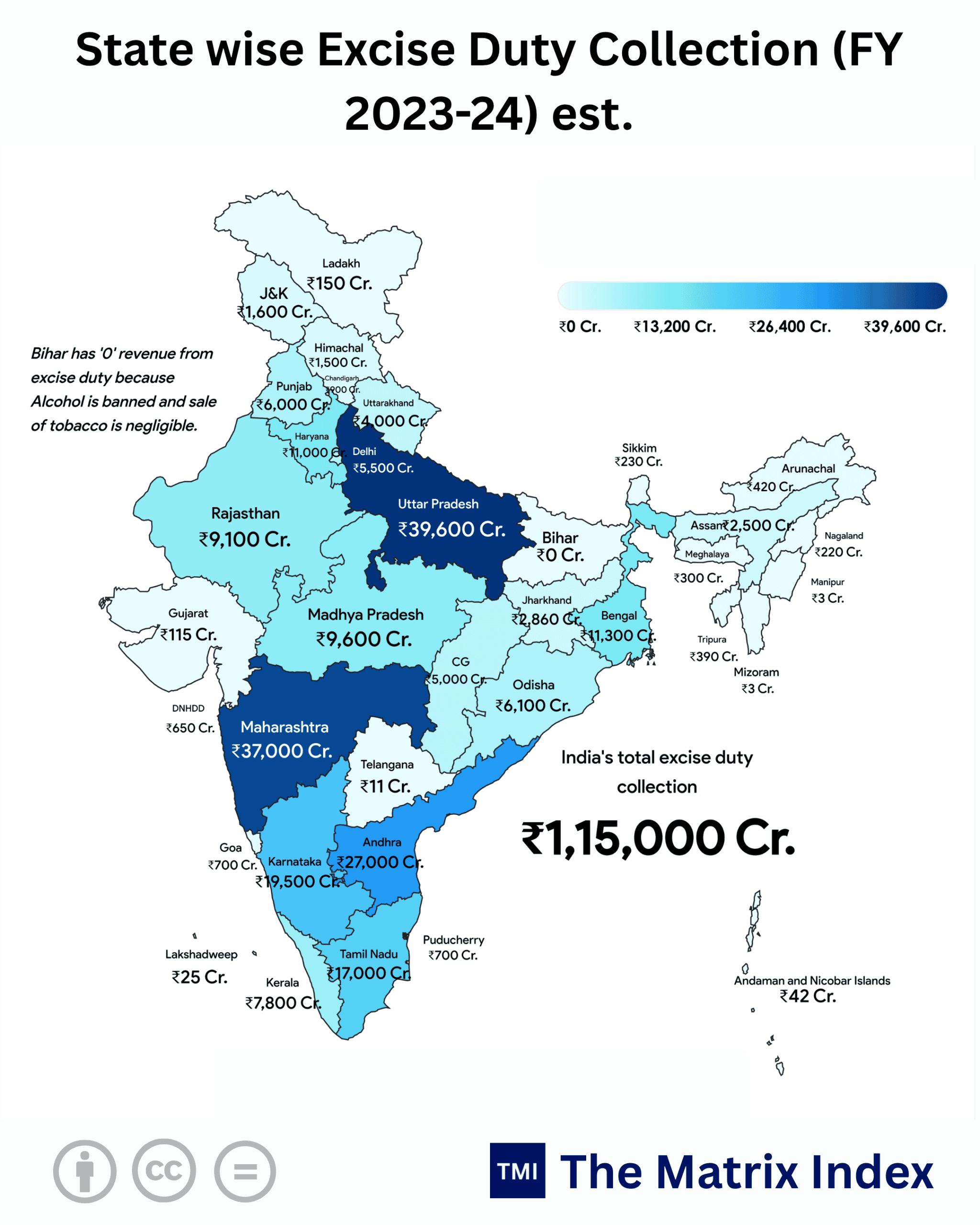
| State / Union Territory | Estimated Excise Duty Collection (FY 2023-24) |
| Uttar Pradesh | ₹39,600 Cr. |
| Maharashtra | ₹37,000 Cr. |
| Andhra Pradesh | ₹27,000 Cr. |
| Karnataka | ₹19,500 Cr. |
| Tamil Nadu | ₹17,000 Cr. |
| West Bengal (Bengal) | ₹11,300 Cr. |
| Haryana | ₹11,000 Cr. |
| Madhya Pradesh | ₹9,600 Cr. |
| Rajasthan | ₹9,100 Cr. |
| Kerala | ₹7,800 Cr. |
| Punjab | ₹6,000 Cr. |
| Odisha | ₹6,100 Cr. |
| Delhi | ₹5,500 Cr. |
| Chhattisgarh (CG) | ₹5,000 Cr. |
| Uttarakhand | ₹4,000 Cr. |
| Jharkhand | ₹2,860 Cr. |
| Assam | ₹2,500 Cr. |
| Himachal Pradesh | ₹1,500 Cr. |
| Jammu & Kashmir (J&K) | ₹1,600 Cr. |
| Goa | ₹700 Cr. |
| Puducherry | ₹700 Cr. |
| DNHDD (DNH and DD) | ₹650 Cr. |
| Arunachal Pradesh | ₹420 Cr. |
| Tripura | ₹390 Cr. |
| Meghalaya | ₹300 Cr. |
| Sikkim | ₹230 Cr. |
| Nagaland | ₹220 Cr. |
| Ladakh | ₹150 Cr. |
| Gujarat | ₹115 Cr. |
| Chandigarh | ₹200 Cr. |
| Andaman and Nicobar Islands | ₹42 Cr. |
| Lakshadweep | ₹25 Cr. |
| Telangana | ₹11 Cr. |
| Manipur | ₹3 Cr. |
| Mizoram | ₹3 Cr. |
| Bihar | ₹0 Cr. |
| India’s Total Reported | ₹1,15,000 Cr. |
(Note: The infographic highlights that Bihar has ₹0 revenue from excise duty due to the alcohol ban and negligible tobacco sales).
NEW DELHI, India — Behind the glittering macroeconomic rhetoric of India’s journey toward a $5 Trillion and ultimately a $30 Trillion developed economy by 2047, lies an open, pungent, and politically radioactive secret: the federal machinery is structurally hooked on the liquor bottle. State finance ministers may lecture the public on digital public infrastructure, green hydrogen corridors, and progressive manufacturing, yet when dawn breaks, the state treasury depends on an unending queue of citizens standing before grated counter windows to buy cheap spirits. The cold, unvarnished balance sheet of Indian fiscal federalism proves that moral governance ends precisely where alcohol excise collections begin.
We are witnessing an addiction far more dangerous than that of the desperate laborer numbing his daily misery—an institutional addiction to sin-tax rentier capitalism. State governments have turned sovereign authority into a glorified bar tab.
The Great Sovereign Hangover: Dissecting India’s ₹1.15 Lakh Crore State Excise Addiction
Every rupee collected under the label of State Excise Duty is an indictment of our industrial failure. When a sovereign administration must rely on ethanol consumption to build rural roads, pay civil servant pensions, and fund election-year handouts, it is not running a resilient economy; it is running a fiscal hostage crisis. The latest state excise ledger, tallying an astonishing ₹1,15,000 Crore across Indian states and union territories, tells a grim story of regional disparity, unhedged fiscal vulnerability, and calculated hypocrisy.
Consider the reality of how these states stack up against one another.
The Bitter Reality: A mere 5 states account for ₹1,40,100 Crore in combined economic muscle across excise, VAT splits, and beverage corporations, while states claiming total moral superiority balance their losses by demanding federal hand-outs or draining their capital budgets dry.
The ₹1.15 Lakh Crore Illusion: A Critical Accounting Dissection
Look past the consolidated headline numbers and you will see a maze of accounting distortion. The headline ₹1,15,000 Crore reported across state ledgers does not capture the true, terrifying scale of what Indian consumers pour down their throats to keep state machineries solvent. In practical terms, when Value Added Tax (VAT), special infrastructure cesses, and state beverage corporation wholesale revenues are folded into the equation, the gross turnover easily crosses ₹3,00,000 Crore.
Why is Telangana listed at a bizarre ₹11 Crore? Is the IT hub of Hyderabad suddenly drinking herbal tea? Far from it. This is pure bureaucratic misdirection. Telangana shifts the bulk of its revenue capture out of the traditional “State Excise Duty” ledger and funnels it straight into special VAT mechanisms, beverage corporation retail margins, and ad-hoc infrastructure levies.
Take a hard look at Bihar. Its listed revenue is an absolute ₹0 Crore. This number is an administrative farce. Bihar did not eliminate the demand for alcohol; it merely handed the multi-thousand-crore industry over to entrenched criminal syndicates, corrupt border networks, and parallel economies.
The money did not vanish. It migrated from the state’s public accounts directly into the pockets of an unregulated mafia, leaving the state treasury to bleed out its developmental spending.
The Anatomy of the Big Five: Masters of the Liquidity Tap
To understand why real economic reform stalls in India, look at the five states driving this extraction machine: Uttar Pradesh, Maharashtra, Andhra Pradesh, Karnataka, and Tamil Nadu. Together, they form an unshakeable fiscal cartel.
Uttar Pradesh: The Volume-Driven Behemoth (₹39,600 Cr.)
Uttar Pradesh operates on raw demographic volume and ruthless distribution mechanics. By streamlining licensing through public auctions, eliminating retail bottlenecks, and turning rural highways into excise collection funnels, Lucknow has built an unassailable financial reservoir.
Every village boundary in UP doubles as an excise zone. When the state plans industrial expressways or claims fiscal surpluses, the foundation of that balance sheet is poured from standard-issue bottles of country liquor consumed by millions of underpaid rural workers.
Maharashtra: The Corporate Sin Factory (₹37,000 Cr.)
Maharashtra approaches the trade with cold, calculated corporate precision. It does not just tax the end-consumer; it extracts revenue across the entire supply chain. From the sugar-belt distilleries of western Maharashtra to the swanky, high-end lounges of Mumbai, the state levies compounding margins at every touchpoint.
It imposes the highest duty slabs on Indian Made Foreign Liquor (IMFL) and imported spirits, turning lifestyle leisure into public works capital. The state knows that Mumbai’s white-collar workforce will pay ₹1,200 for a pour that costs ₹150 to import. That is not luxury consumption; it is sovereign arbitrage.
Andhra Pradesh: The State-Sanctioned Cash Dispensary (₹27,000 Cr.)
Andhra Pradesh strips away all private-market pretense. By running state-managed retail outlets and taking direct control of cash counters, the government converted the retail trade into an immediate daily liquidity pipeline.
When a state takes over the counter, it stops acting as an impartial regulator. It becomes an aggressive merchant with an existential need to meet daily sales targets to fund expansive welfare transfers. The state sells the poison by day and funds the medical treatment by night.
Karnataka: Extracting Rent from the Silicon Spine (₹19,500 Cr.)
Karnataka’s strategy targets a captive audience: the IT services economy. The state holds some of the highest beer and premium spirit excise duties on earth.
Tech professionals working 70-hour weeks across Bengaluru’s tech corridors are drained of income tax by New Delhi by day, and drained of their disposable income by Vidhana Soudha over the weekend. Karnataka treats its nightlife not as urban culture, but as an indispensable budget-balancing lever.
Tamil Nadu: The Closed-Loop TASMAC Monopoly (₹17,000 Cr.)
Through TASMAC (Tamil Nadu State Marketing Corporation), Tamil Nadu operates a state-run distribution monopoly. The state owns the warehouse, controls the supplier, dictates the shelf space, and operates the register.
It is a completely closed loop. It provides the state with instant, non-volatile cash flow, insulating it from market shocks while locking an entire generation of working-class families into subsidized dependence.
Global Benchmarks: How the World Milks the Golden Goose
How does India’s state-level extraction compare to international governance? The difference is revealing. Developed and rapidly developing economies treat sin taxes as Pigouvian levers—economic instruments designed to offset systemic public health burdens. India’s federal units treat them as an indispensable lifeline to stave off insolvency.
1. United States: The Fractured Three-Tier Architecture
The United States splits alcohol revenue across federal excise duties and individual state levies, mediated by a mandatory three-tier system: manufacturer, distributor, and independent retailer. States like Pennsylvania and Utah maintain direct state control over wholesale or retail distribution, generating between $500 Million and $1.5 Billion annually.
The core divergence is fiscal resilience: excise duties make up less than 1.8% of a typical US state’s aggregate own-source tax revenue. In India, that share routinely blows past 15% to 22%.
2. United Kingdom: The Pigouvian Treasury Dragnet
Her Majesty’s Revenue and Customs (HMRC) pulls upwards of £12.5 Billion annually through alcohol duty, tied directly to alcohol-by-volume (ABV) metrics. When London raises the duty, the explicit economic rationale is mitigating the multi-billion-pound strain on the National Health Service (NHS).
The proceeds are absorbed into a central consolidated fund, rather than being carved out to patch over immediate state-level budget deficits.
3. Germany: The Sovereign Manufacturing Exemption
Germany runs in the completely opposite direction, prioritizing industrial lobbying and cultural entrenchment over fiscal extraction. Its beer tax (Bierstot) brings in a negligible €600 Million to €800 Million a year.
Berlin relies on robust corporate income taxes, a balanced Value Added Tax (VAT/USt), and high-output industrial exports. Germany views alcohol taxation as a cultural footnote, proving that a truly industrialized economy does not need to rely on its citizens’ worst habits to pave its roads.
4. Japan: Demographic Collapse and the Reversal Strategy
Japan provides a fascinating, cautionary economic case study. For decades, the National Tax Agency leaned heavily on liquor taxes (Shuzei), which accounted for over 3% of national tax receipts in the late 20th century.
As its population rapidly aged and sober younger demographics abandoned social drinking, liquor tax revenues cratered beneath 1%. The crisis became so acute that Tokyo launched national campaigns nudging young adults to drink more to patch state budget gaps. It stands as a warning to developing nations of what happens when a state bases long-term budgeting on transient social vices.
5. China: State-Owned Enterprise Direct Profit Share
China does not rely solely on retail consumption taxes. Instead, the state captures equity inside the distilleries themselves.
Giants like Kweichow Moutai are part-owned by local state-owned assets supervision commissions. When Moutai’s valuations skyrocket, the municipal government of Guizhou does not just collect a retail tax; it collects equity dividends, industrial corporate revenues, and sovereign asset appreciation.
The “So What?” Factor: The Brutal Ripple Effect on Ordinary Lives
What does this frantic race for excise revenue mean for an ordinary middle-class family, an ambitious business owner, or an unhedged institutional investor? The impacts cut straight to the core of personal finance and community safety.
For the retail consumer and industrial worker, it represents an inescapable regressive tax. A landless laborer earning ₹300 a day in rural Uttar Pradesh spends up to ₹120 of that daily wage on heavily taxed country liquor.
That money is directly siphoned away from his children’s nutrition, school fees, and out-of-pocket health savings. The state reclaims over 35% of that wage at the bottle shop, books it as “development revenue,” and redistributes a small portion back as an election-cycle ration kit or cash subsidy. It is a closed loop of engineered poverty.
For institutional investors and entrepreneurs, it creates a treacherous policy environment. When a state relies on a single volatile revenue lever, its regulatory landscape shifts overnight. If excise receipts drop, states immediately invent emergency surcharges, hike licensing fees, or delay input tax credits.
Capital allocators must realize that states showing an unhealthy reliance on excise are hiding structural deficits across manufacturing, formal services, and long-term tax collection. When a state’s excise tap runs dry, the private sector’s profits are the very first thing it targets next.
Seasonality & Anomaly Alert: The Artificial Spring
Do not let these aggregate excise collections fool you into seeing permanent, linear economic expansion. The apparent health of these numbers is distorted by short-term fiscal manipulations and cyclical anomalies.
First, consider the Electoral Liquidity Surge. State excise numbers predictably spike in the 12 to 18 months leading into state assembly elections. Retail quotas are quietly expanded, local distribution licenses are pushed through the system, and enforcement against after-hours sales is intentionally relaxed.
This is not sustainable consumer demand; it is a temporary, state-engineered cash hunt designed to build campaign war chests and finance populist pre-election giveaways.
Second, the numbers are inflated by Inflationary Duty Compounding. As broad-based inflation squeezes household budgets, consumers naturally downgrade from premium foreign spirits to cheaper, locally bottled alternatives. State finance departments counter this volume shift by hiking duty rates on the lower slabs.
The aggregate revenue holds steady or rises, masking a collapse in disposable consumer income. What looks like fiscal strength on an official report is actually the aggressive extraction of cash from a stressed, downgrading market.
The Twin-Engine Deception: Why GST Left Sin Behind
The institutional addiction to alcohol excise duty is not an accident of history. It was deliberately engineered in 2017 during the creation of the Goods and Services Tax (GST). When states agreed to give up their sovereign sales taxes to create a unified national market, they dug their heels in on two major items: petroleum products and potable alcohol.
The state finance ministers made a cold, hard calculation. They knew that if alcohol was folded into the GST’s maximum 28% bracket, their immediate cash lifelines would vanish overnight. Under the GST framework, every rupee collected must pass through the clearinghouse, with proceeds split evenly between the Union and the States according to strict distribution formulas.
States demanded a direct, private cash register they could ring at will—free from federal oversight, legislative debates, or statutory caps. Potable alcohol was kept out of the GST to give states a bypass around fiscal discipline.
Whenever a state administration overspends on subsidies, it does not have to issue bonds or make hard budget cuts. It simply issues an executive order, adds a ₹20 “cess” to every bottle of liquor sold within its borders, and watches the cash roll in within forty-eight hours. It is an undemocratic, unaccountable cash machine hidden in plain sight.
The Prohibition Paradox: The Disasters of Bihar and Gujarat
No economic analysis of India’s excise landscape can ignore the alternate, hypocritical path: legislative prohibition. The zero-duty figure beside Bihar and the low-duty collection of Gujarat (₹115 Crore) are not triumphs of temperance. They are case studies in how state-mandated moral policing breaks an economy.
Bihar: The Fiscal Self-Harm Experiment
In 2016, Bihar outlawed the manufacture, sale, and consumption of alcohol with sweeping moral rhetoric. The stated goal was to protect low-income families and stop household abuse.
The economic fallout, however, has been devastating. The state wiped out an immediate ₹4,000 Crore to ₹5,000 Crore in annual excise duties. Factoring in economic expansion, this costs the state over ₹8,000 Crore in lost annual revenue today.
Has consumption stopped? Walk through Patna, Gaya, or Muzaffarpur.
Spirits flow uninterrupted across porous borders with Nepal, West Bengal, Jharkhand, and Uttar Pradesh. The trade is simply run by a shadow industry. Instead of generating revenue for schools, water projects, and hospitals, that wealth is captured by corrupt border police, illicit bootleggers, and politically protected distribution rings.
Meanwhile, thousands of low-income citizens, unable to afford smuggled branded products, turn to adulterated hooch brewed in drainage ditches and sugar vats. When a toxic batch hits, dozens die overnight.
The judicial cost is just as staggering: the state’s courts are choked with over 400,000 pending prohibition cases. The state threw away its sovereign revenue, overloaded its police and courts, and created an unchecked criminal syndicate. It is an economic disaster passed off as social reform.
Gujarat: The Bureaucratic Permitting Game
Gujarat’s model is altogether different, wrapped in corporate carve-outs. Enacted under historic guidelines, the state’s prohibition includes an intricate system of “Health Permits” and tourism exemptions.
If you have a foreign passport, an out-of-state airline ticket, or a doctor willing to certify that your health requires moderate spirits, the state will let you buy what you want through licensed, high-end tourist counters.
That is how Gujarat collects ₹115 Crore in residual excise: by commodifying its exemptions. Behind this sanitized system lies an open secret: a massive, highly efficient illicit supply chain running out of Rajasthan, Daman, and Madhya Pradesh that serves the corporate and industrial hubs of Ahmedabad and Surat. It is prohibition in name only—a quiet compromise that starves the public purse while keeping the private taps running.
Two-Sided Risk Assessment: The Fiscal Trap Ahead
Investors, policy analysts, and regional leaders must navigate two distinct future scenarios:
The Bull Case: The Premiumization Engine
The optimistic economic thesis relies on a structural shift in demographics:
-
The Rise of Premiumization: India’s expanding upper-middle-class abandons country liquor in favor of premium craft beers, single malts, and domestically distilled gin. This shifts the tax burden up the income ladder, raising revenue yields per unit volume without worsening low-income exploitation.
-
Streamlined Digital Distribution: States replace opaque, discretionary licensing with transparent e-governance distribution networks (as seen in parts of Maharashtra and Karnataka), cutting out cartels and boosting state revenues.
-
Agri-Distillery Linkages: Expanding state-of-the-art grain distillation facilities supports agricultural supply chains by converting surplus grain into commercial alcohol and biofuels, creating durable rural wealth.
-
Corporate Formalization: Publicly traded, institutional beverage brands push out unorganized players, ensuring higher compliance, strict quality safety standards, and reliable corporate tax yields.
The Bear Case: The Breaking of the Binge
The looming structural risks could shatter state finances:
-
Socio-Political Backlash and Abrupt Bans: Spurred by grassroots female voter mobilization, competing political parties could launch populist prohibition campaigns, wiping out state budgets overnight (the Bihar-ification of broader India).
-
Demographic Sobriety Shifts: Emulating trends seen in Western markets and Japan, Gen-Z and post-millennial demographics increasingly turn away from traditional alcohol toward low-alcohol beverages, non-intoxicants, or health-conscious lifestyles, eroding the consumption base.
-
Inter-State Arbitrage Wars: Rising duties in high-tax states trigger border-smuggling spirals, forcing states into costly enforcement crackdowns that erase incremental tax yields.
-
Federal Re-Centralization Under GST: The Union government could eventually force alcohol into the GST umbrella during comprehensive fiscal reforms, stripping states of their last independent, discretionary pricing weapon.
The Alternative Scenario: Surviving the Dry Spell
What happens if India’s regional alcohol extraction model breaks down? Imagine a wave of populist prohibition sweeping across southern or western states, combined with a sober youth demographic, cutting aggregate collections by 50% over five years. How would the states survive?
States would be forced to abandon their reliance on easy sin taxes and finally execute long-overdue, hard-nosed structural tax reforms:
-
Modernizing Property Registers: States would have to build digital property mapping systems, update outdated land-valuation rates, and extract real municipal wealth from real estate, rather than leaving thousands of crores on the table.
-
Reforming Power and Water Tariffs: Governments would have to end indiscriminate electricity and agricultural water subsidies, replacing them with means-tested direct benefit transfers to plug systemic losses.
-
Closing Gaps in Mineral Royalties: Resource-rich states like Odisha, Jharkhand, and Chhattisgarh would have to stop relying on liquor stores and instead aggressively plug leaks in their coal, bauxite, and iron-ore royalty systems.
-
Widening the Local Services Tax Net: States would need to build administrative capacity to capture taxes from the expanding informal services sector, from luxury event properties to elite private tutoring centers.
Strategic Roadmap to 2030–2047: Ending the Sovereign Liquidity Addiction
India cannot march into the centenary of its independence in 2047 claiming to be a developed global economic powerhouse while relying on the corner liquor shop to balance its regional budgets. A high-income economy builds its treasury on the back of intellectual property, advanced manufacturing, transparent corporate services, and sustainable public capital—not on the managed intoxication of its workforce.
To break this vicious cycle, Indian policymakers must execute a multi-decade transition strategy:
Phase 1: Cap and Divert (2026–2030)
States must place an absolute statutory cap on the share of excise duty within their aggregate Own-Tax Revenue (OTR), limiting it to no more than 10%. Every rupee collected above this threshold must be ring-fenced by law into dedicated public healthcare infrastructure and addiction-recovery clinics, neutralizing the state’s perverse incentive to drive consumption.
Simultaneously, states must build out digital municipal land registries to replace lost excise revenues with sustainable property taxes.
Phase 2: Structural GST Integration (2030–2038)
Bring potable alcohol under the Goods and Services Tax (GST), introducing an upper-tier 40% special rate band alongside a sharply regulated, time-bound local health surcharge. This move would dismantle the parallel cash economy, eliminate state-to-state border smuggling, and force regional governments to stand on their own industrial feet.
Phase 3: True Pigouvian Ring-Fencing (2038–2047)
By 2047, the state excise ledger must cease to function as a source of general budgetary cash. Alcohol taxation must transition entirely to a pure Pigouvian duty: explicitly dedicated to compensating for the public health, social, and economic damages of alcohol consumption.
An economy that plans to launch spacecraft and export advanced microchips should not depend on the sales volume of an open-air bottle shop to fund its schools.
The data before us is not just a ledger of revenue; it is an x-ray of institutional weakness. India’s leaders must decide whether they are going to build a productive, industrialized economy, or continue running the world’s most lucrative, state-sanctioned bar.
True fiscal independence begins the day the state finally gets sober.
GOOGLE ‘PEOPLE ALSO ASK’ FAQs
Q1: Which Indian states collect the highest state excise duty on alcohol?
A: ₹39,600 Crore and ₹37,000 Crore were generated by Uttar Pradesh and Maharashtra respectively in FY 2023-24, leading national collections. Together with Andhra Pradesh, Karnataka, and Tamil Nadu, these five states control over 60% of India’s aggregate state excise receipts.
Q2: Why is Bihar’s state excise duty collection reported at zero?
₹0 in legal excise revenue is recorded due to Bihar’s comprehensive prohibition enforcement enacted in 2016. This statutory ban eliminated over ₹4,000 Crore in annual public receipts, redirecting consumption into cross-border illicit markets.
Q3: Why was potable alcohol excluded from India’s GST framework?
15% to 22% of own-source tax revenue for major states relies on direct liquor levies, prompting state finance ministries to block GST inclusion in 2017. Retaining independent excise powers allows states to impose immediate surcharges to resolve budget deficits.
Q4: How does India’s alcohol tax reliance compare to global economies?
18% to 24% of state own-tax receipts in India stem from alcohol, compared to under 1.8% across US state taxes and 1.4% in the UK. Advanced economies deploy sin taxes as Pigouvian health measures rather than primary operational budget drivers.
Q5: What fiscal alternative exists for states if excise duties decline by 2030?
10% statutory caps on excise dependency would require states to monetize digital municipal land registries and expand direct property tax capture. Reforming power tariffs and closing mineral royalty leaks provide the required capital buffers through 2047.
Data Source:
- Reserve Bank of India (State Finances: A Study of Budgets)
- Ministry of Statistics and Programme Implementation (MoSPI)
- State State Excise Departments (Annual Administrative Reports FY 2023-24).
Disclaimer: This report is for informational and analytical purposes only and does not constitute formal financial, investment, or policy advice.