The Great Indian Startup Mirage: Why 121 Unicorns Mask an Existential Economic Crisis
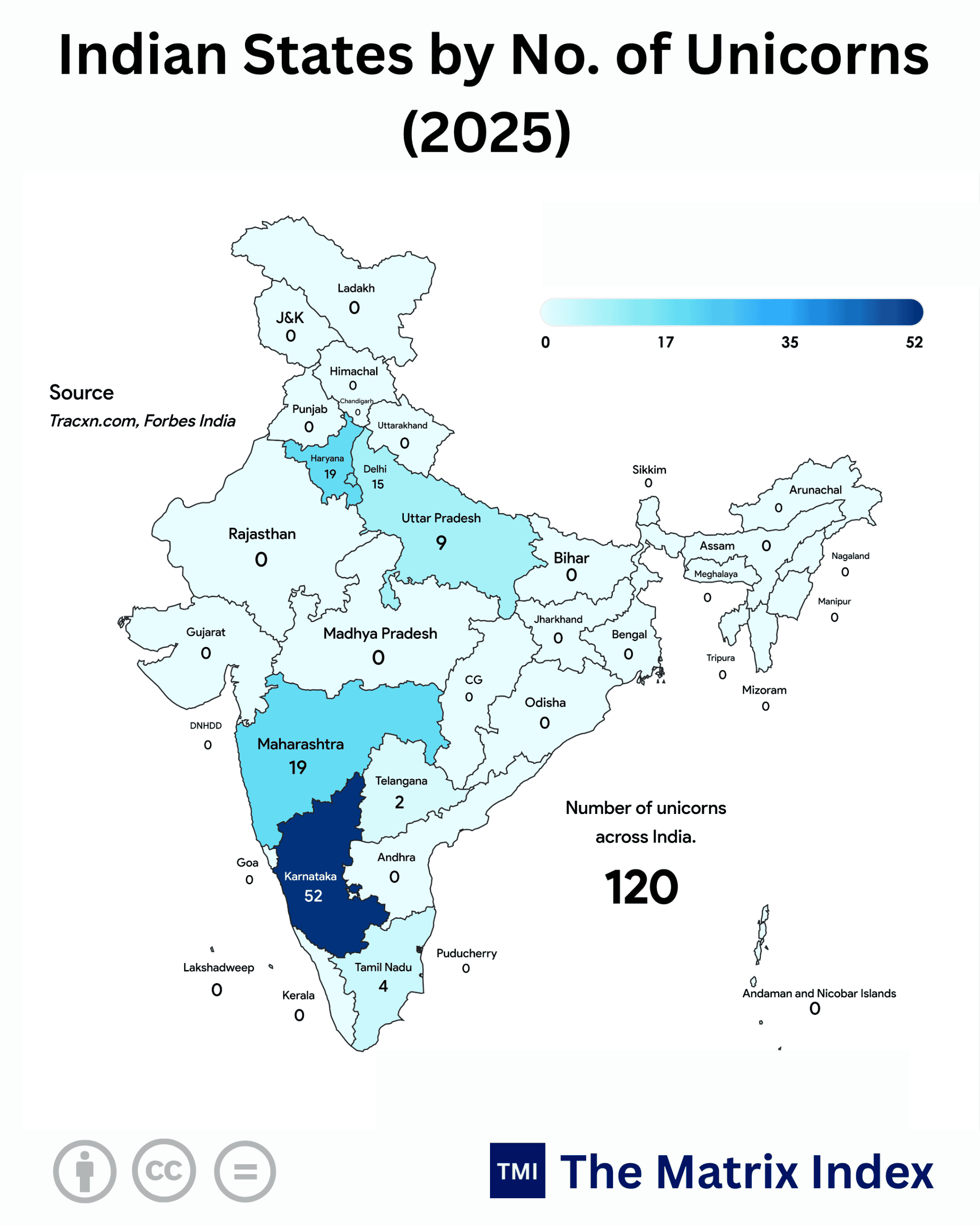
(Note: The map graphic states a national total of 120, while the sum of the individual values labeled on the map equals 121: 52 + 19 + 19 + 15 + 9 + 4 + 2).
NEW DELHI, India — Strip away the triumphalist press releases, cut through the vanity pitch decks, and discard the breathless television commentary celebrating the subcontinent’s digital ascent: India’s multi-billion-dollar unicorn economy is not an economic democratization engine. It is an ultra-concentrated, geographically claustrophobic financial enclave that leaves over 80% of the republic completely untouched by wealth creation.
A forensic audit of proprietary sub-national corporate registries reveals that India holds an aggregated stable of either 120 or 121 unicorn-grade entities depending on whether you trust the Department for Promotion of Industry and Internal Trade (DPIIT) headline summary or add the raw territorial components (52 + 19 + 19 + 15 + 9 + 4 + 2). That solitary mathematical discrepancy of one missing enterprise is an apt metaphor for the broader systemic rot. Behind the national cheerleading lies a brutal geographical truth: just 3 states and 1 union territory control 86.77% of the nation’s billion-dollar enterprises.
A staggering 22 states and 8 union territories have built precisely zero unicorns.
If you are an entrepreneur outside the four primary pin codes of Bengaluru, Gurugram, South Delhi, and Mumbai, institutional capital views your pin code as a sovereign default risk. We have built an ecosystem that mimics the colonial extractive models of the 18th century, draining intellectual capital and domestic savings from the hinterlands to feed paper valuations in three air-conditioned metropolitan bubbles.
This is not a distribution of prosperity. It is an economic oligopoly dressed up in the language of Silicon Valley meritocracy.
The Anatomy of a Hyper-Concentrated Empire
Consider the raw baseline data. Out of 36 states and union territories, precisely seven appear on the national unicorn map. The remaining 29 territorial jurisdictions represent an absolute institutional desert.
(The Bitter Truth): Over 70% of India’s population lives in states that have produced precisely zero software unicorns. The Indian economic miracle is structurally gated behind an urban tollbooth.
Look closely at the numbers. Karnataka is not just leading; it is eating the entire country’s lunch with 52 unicorns, commanding an astonishing 42.98% of the entire national landscape. When combined with Maharashtra (19) and Haryana (19), these three states alone wield a commanding 74.38% monopoly over India’s billion-dollar tech assets.
Add Delhi’s 15 unicorns, and you cross 86.77%.
What remains for the rest of the fifth-largest economy on earth? Scraps. Uttar Pradesh registers 9, driven entirely by the spillover gravity of Noida, which functions economically as a satellite suburb of Delhi rather than an organic byproduct of UP’s broader provincial economy. Tamil Nadu, despite its vaunted manufacturing capacity and engineering output, manages an underwhelming 4 (3.31%).
Telangana, despite decades of aggressive branding around Hyderabad’s HITEC City, logs a meager 2 (1.65%).
The Ghost States of Indian Capitalism
The silence from the rest of the republic is deafening.
Consider Gujarat. It is the industrial powerhouse of modern India, a state celebrated for generating merchant wealth, dominating maritime trade, and providing the political leadership that shapes current national economic doctrine. Yet its unicorn count sits stubbornly at zero.
Why? Because Gujarat’s domestic capital allocators understand real cash flow. They demand working-capital discipline, tangible assets, and immediate return on capital employed (ROCE). They have historically refused to touch the speculative, zero-operating-margin metrics that venture capitalists swap in Bengaluru coffee shops.
Yet, by shunning venture models, Gujarat has surrendered the commanding heights of intellectual property, software platforms, and high-margin algorithms to southern tech corridors.
Now look at West Bengal. A state that housed the intellectual and financial capital of the subcontinent until the mid-20th century now registers an absolute zero. The capital flight from Kolkata over the last four decades has turned the state into an exporter of cheap manual labor and elite corporate executives, but a graveyard for home-grown technology empires.
Young engineers graduate from Jadavpur University or IIT Kharagpur, pack their bags within twenty-four hours of their final semester exams, and board flights to Bengaluru or San Francisco. They do not build in Bengal because Bengal’s institutional environment remains allergic to venture capital, private enterprise, and the creative destruction that tech capitalism demands.
Then there are Bihar and Jharkhand combined populations exceeding 160 million people, representing a market larger than Germany and the United Kingdom combined. Their unicorn tally? Zero.
These regions operate as labor colonies for the industrial and tech hubs of the West and South. Their brightest minds migrate to Delhi and Bengaluru to write code, while their working-class youth migrate to build the physical flyovers, high-rises, and data centers of those same destination cities. The hinterland bears the biological and educational costs of rearing talent, while the urban hubs capture the economic rents, intellectual property, and equity upside.
Even Kerala, boasting a near 100% literacy rate, a high Human Development Index (HDI), and unmatched primary healthcare, is an economic museum. It has produced zero unicorns. It produces exceptional nurses, brilliant teachers, and elite white-collar professionals who populate the corporate hierarchies of the Gulf Cooperation Council (GCC) nations and Western Europe. But its hostility toward corporate scale, radical unionization legacy, and complex regulatory landscape make building an enterprise worth $1 billion an exercise in futility.
Global Benchmarks — A Structural Reality Check
To understand just how bizarre this geographic imbalance is, we must look beyond our borders. How does India’s startup concentration measure up against peer global powers?
The United States (Tier-1 Anchor)
In the United States, Silicon Valley (California) remains the historic spiritual core of technology ventures. Yet, the American ecosystem decentralized dramatically between 2018 and 2026. High corporate tax rates, urban friction, and cost-of-living crises triggered a flight of institutional capital toward Austin (Texas), Miami (Florida), Denver (Colorado), and Nashville (Tennessee). Today, while California, New York, and Massachusetts still dominate roughly 64% of venture investments, the remaining 36% is robustly distributed across a dozen thriving secondary and tertiary hubs. An entrepreneur in Salt Lake City, Utah, can secure a $50 million Series B funding round without moving their headquarters to San Francisco. In India, an entrepreneur in Bhubaneswar or Indore is routinely told by institutional investors that their term sheet is conditional on moving their registered corporate headquarters to Bengaluru or Gurugram.
China (Tier-2 Global Competitor)
Look at our primary strategic competitor across the Himalayas. China’s unicorn distribution is concentrated, but it is anchored across multiple industrial engines: Beijing (software, consumer platforms, AI), Shanghai (fintech, semiconductors), Shenzhen (hardware, IoT, telecoms), and Hangzhou (e-commerce, cloud architecture). Crucially, the Chinese state deliberately engineered secondary hubs across central and western provinces. Cities like Chengdu, Wuhan, and Chongqing boast massive, state-backed innovation corridors with native venture pools. China’s manufacturing-tech ecosystem is geographically integrated; India’s is an isolated island of code disconnected from physical industrial production.
Germany (The Distributed Model)
Germany offers the inverse of India’s pathology. Its startup ecosystem is anchored by Berlin (fintech, consumer platforms) and Munich (B2B deep tech, automotive software), but its true economic bedrock is the Mittelstand thousands of medium-sized, highly specialized manufacturing and software firms distributed across Baden-Württemberg, Bavaria, North Rhine-Westphalia, and Saxony. Germany’s industrial wealth is deliberately decentered. A small town of 40,000 people in Germany routinely hosts a global market leader in precision robotics. In India, a town of 400,000 people in Uttar Pradesh or Madhya Pradesh struggles to provide uninterrupted three-phase electricity and high-speed fiber connectivity to its industrial estates.
The Mechanics of Institutional Injustice
Why does this geographical apartheid persist? The common refrain from venture capitalists is simple: “Agglomeration effects. Talent attracts capital, capital attracts talent.”
This explanation is lazy, self-serving, and intellectually dishonest. Agglomeration is real, but in India, it has metastasized into an anti-competitive cartel.
First, look at the Lender-Founder Network Graph. Over 85% of institutional venture capital flowing into India originates from foreign Limited Partners (LPs) pension funds in Ontario, sovereign wealth funds in Abu Dhabi and Singapore, and university endowments in the United States. When these billions land in the funds of Sand Hill Road offshoots in Indiranagar (Bengaluru) or the Bandra-Kurla Complex (Mumbai), the fund managers face immense pressure to deploy dry powder rapidly.
They do not have the time, the risk tolerance, or the operational willingness to conduct on-the-ground due diligence in Bhopal, Cuttack, or Coimbatore. Instead, they rely on social-proof heuristics: Has the founder attended an IIT or IIM? Did they work at McKinsey or Google? Do they hang out at the same private clubs in Koramangala?
This creates an insular, self-referential country club. A mediocre business plan presented by an alumnus of an elite engineering school in Bengaluru easily secures a $5 million seed round on a paper napkin. Meanwhile, an operationally profitable, cash-flow-positive enterprise in Kanpur or Visakhapatnam is dismissed as a “regional lifestyle business.”
Second, analyze the Infrastructure Asymmetry. High-tier tech enterprises do not merely require road connectivity; they demand deep, specialized institutional ecosystems. They need Tier-4 data centers, international airports with non-stop flights to San Francisco, London, and Tokyo, specialized intellectual property litigators, and elite cross-border tax advisory firms.
When the Union Government and state administrations pour hundreds of millions of dollars into upgrading airport express lines and luxury transit corridors in Gurugram and Bengaluru, they are effectively subsidizing venture-backed startups while regional municipal corporations across the heartland cannot even fix open drainage networks.
The “So What?” Factor — The Real Economic Cost
What does this mean for the average citizen, the retail investor, and the broader Indian republic?
The Real Estate Nightmare and Municipal Collapse
By compressing 86.77% of the country’s multi-billion-dollar enterprise leadership into five congested cities, we have broken the urban carrying capacity of modern India. Bengaluru’s water tables are dry, its roads are permanently paralyzed, and its housing market has become a casino where young engineers spend 40% to 50% of their post-tax income on rent.
The economic surplus created by these unicorns does not trickle down to the working class; it is captured almost entirely by urban land-owning cartels and luxury commercial developers. We are forcing millions of our best young minds to live in deteriorating municipal conditions simply because venture capital refuses to deploy funds beyond four metropolitan borders.
The Brain Drain of the Hinterlands
When every ambitious 22-year-old in Odisha, Bihar, Rajasthan, or Madhya Pradesh is forced to migrate to Haryana or Karnataka to build a career in technology, their home states are drained of intellectual vitality, consumer spending, and municipal tax revenue.
The local economies of these abandoned states remain trapped in low-productivity agriculture and government contracts. The local schools decline because the educated middle class departs. The local politics becomes increasingly regressive because the progressive, forward-looking youth have moved to Whitefield or CyberCity.
As the old saying goes: “The tree whose roots are starved cannot bear fruit simply because its topmost branch is painted green.” By starving the provincial roots of India, our metropolitan canopy is destined to collapse.
The Systemic Fragility of Paper Wealth
The average Indian unicorn does not make a net profit. In truth, over 70% of these 121 companies burn capital to buy market share, subsidizing urban middle-class consumption through discounted cab rides, ultra-cheap grocery deliveries, and heavily funded consumer electronics.
The capital that keeps these operations afloat is foreign and speculative. If geopolitical tensions flare, if interest rates stay structurally higher for longer in Western economies, or if global institutional allocators turn off the venture capital tap, India’s unicorn economy contracts instantly. And because these companies are concentrated in just a few micro-markets, the resulting layoffs, commercial real estate defaults, and equity wipeouts will slam those specific urban centers with catastrophic force.
Seasonality & Anomaly Alert — Trend vs. Bubble
Let us be completely candid about the timeline: Is this surge in unicorns a structural maturation of Indian enterprise, or a liquidity-fueled anomaly?
The data shows an unmistakable historical pattern. Between 2021 and 2022, the global era of near-zero interest rates engineered an unprecedented financial frenzy. India printed unicorns at the rate of one every few weeks. Every consumer internet company with a functional mobile application and aggressive growth projections was handed an arbitrary $1 billion valuation by foreign private equity houses looking for quick exits.
That was an anomaly. The subsequent capital drought of 2023 and 2024 exposed how fragile that valuation model was. Between 2024 and 2026, the velocity of unicorn creation plummeted, valuations were marked down by 30% to 70%, and several headline-grabbing enterprises collapsed into governance scandals, audit resignations, and mass terminations.
The current baseline of 120 to 121 entities is not an accelerating, compounding curve. It is a heavily contested plateau.
The historical easy money is gone. Global capital allocators are demanding statutory compliance, positive unit economics, and audited cash flows. The entities that remain are those that have managed to slash workforces, cut operational burn, and transition from raw customer acquisition to monetization.
The geographical concentration, however, is not an anomaly. It is a long-term, compounding trend that has hardened over twenty years. Unless government policy breaks this spatial monopoly, India’s next 100 unicorns will continue to emerge from the exact same four pin codes.
Deep-Dive Into the Industrial Corridors
To diagnose the malady, we must examine the specific mechanics of the individual regions on this ledger.
Karnataka: The High-Altitude Monolith (52 Unicorns)
Karnataka’s 42.98% share of the national unicorn registry is both its greatest triumph and its single point of failure. The state’s dominance is anchored entirely by Bengaluru Urban. The historical accident that placed premier public sector undertakings like Bharat Electronics Limited (BEL), Hindustan Aeronautics Limited (HAL), and the Indian Space Research Organisation (ISRO) in Bengaluru during the mid-20th century created a deep culture of precision engineering.
When Texas Instruments arrived in 1985, followed by the IT services boom led by Infosys and Wipro, the foundation was set.
Yet today, this success has turned cannibalistic. Bengaluru’s infrastructure is buckling under the weight of its own success. The city’s political machinery is perpetually distracted by commercial real estate lobbying, while the broader state of Karnataka districts like Raichur, Kalaburagi, and Yadgir remains among the poorest, most developmentally challenged regions in peninsular India.
The prosperity of Karnataka is a solitary, hyper-wealthy island surrounded by a sea of agrarian stress. If a major earthquake, water crisis, or prolonged civil infrastructure collapse strikes Bengaluru, nearly half of India’s digital intellectual property faces immediate operational disruption.
Maharashtra: The Financial Bastion (19 Unicorns)
Maharashtra’s 19 unicorns reflect an entirely different dynamic: financial muscle. Unlike Bengaluru’s software and consumer-app bias, Mumbai’s unicorns are dominated by fintech platforms, logistics hubs, and mature corporate-backed ventures. The presence of the Reserve Bank of India (RBI), the Securities and Exchange Board of India (SEBI), the Bombay Stock Exchange (BSE), and the National Stock Exchange (NSE) gives Mumbai an unassailable advantage in capital allocation.
Pune provides the engineering and industrial counterbalance. Yet, Maharashtra’s reach remains fundamentally trapped within the Mumbai-Pune expressway corridor. The vast interiors of Vidarbha and Marathwada have seen zero venture capital investment, maintaining an era of agrarian crisis that contrasts starkly with the wealth flowing through Nariman Point and the Bandra-Kurla Complex.
Haryana & Delhi: The Political Enclave (34 Unicorns Combined)
Combine Haryana’s 19 unicorns with Delhi’s 15, and you have the National Capital Region (NCR) commanding 34 unicorns more than 28% of the nation’s total. Haryana’s entire score is driven by Gurugram.
Gurugram is a city built by private corporations on agricultural land, bypassing the need for an effective municipal government by constructing private luxury islands with their own private security, private backup generators, and private water tankers.
The capital flowing into Gurugram and Delhi is heavily tied to e-commerce marketplaces, logistics aggregators, and regulatory-sensitive business models that require close physical proximity to central government ministries. It is an ecosystem that understands power, lobbying, and market access.
Yet, cross the border from Gurugram into southern or western Haryana places like Mewat or Bhiwani and you are thrown backward half a century into economic destitution and chronic unemployment.
The Southern Underachievers: Tamil Nadu (4) and Telangana (2)
The most striking figures on the ledger are the low numbers for Tamil Nadu (4) and Telangana (2).
Tamil Nadu is arguably India’s most industrialized state, boasting a massive automobile manufacturing belt, an export-driven textile sector, and an exceptional network of engineering universities. Its software corridor along Chennai’s Old Mahabalipuram Road (OMR) is legendary. Yet it has produced only 4 unicorns. Why?
Because Tamil Nadu’s industrial DNA favors capital preservation, positive cash flows, and tangible asset manufacturing. Founders in Chennai like Zoho’s leadership have historically championed bootstrapped, profitable business models over venture-backed growth traps. This conservative fiscal culture protected the state from the reckless down-rounds of recent years, but it also sidelined it from the massive institutional equity pools that funded global tech scale.
Telangana’s tally of 2 unicorns is an outright embarrassment for a state that has marketed Hyderabad as the ultimate rival to Bengaluru. Despite world-class urban infrastructure, modern expressways, and aggressive corporate wooing, Hyderabad has largely functioned as a back-office delivery center for American technology conglomerates (Microsoft, Google, Amazon, Apple) rather than a foundry for independent, Indian-owned venture platforms. The multi-billion-dollar enterprise value created on Hyderabad’s soil has been exported back to public markets in New York and California.
The Two-Sided Risk Assessment
An economic analysis that provides only a single directional path is not strategic research; it is propaganda. We must weigh the two competing trajectories for India’s innovation economy over the coming decade.
The Bull Case: The Decentralized Awakening
In the optimistic scenario, the extreme spatial concentration seen in the 2026 data represents the end of the first wave of Indian tech capitalism, not its permanent state.
-
Digital Public Infrastructure (DPI) Disruption: The widespread adoption of unified payment interfaces, open networks for digital commerce, and public data registries will systematically erode the defensive moats of current metropolitan platforms. When an artisan in Jaipur or a precision machinist in Coimbatore can access national logistics and credit networks without paying high fees to a Bengaluru platform, margins will decentralize.
-
The Cost-of-Living Realignment: As Bengaluru, Mumbai, and Gurugram become unlivable due to real estate hyperinflation and urban gridlock, tier-2 cities will mount aggressive corporate assaults. Cities like Ahmedabad, Indore, Chandigarh, Kochi, and Bhubaneswar are building advanced road and optical-fiber networks. A startup operating out of Indore enjoys a 60% lower payroll burn and an 80% reduction in office rent compared to Indiranagar or Lower Parel. As venture capital embraces financial discipline, capital will flow to where the burn rate is lowest.
-
The Rise of Generative Deep Tech: The era of building cheap consumer apps that simply copy American business models is over. The next wave of value creation belongs to AI-driven industrial automation, synthetic biology, space technologies, and defense software. These businesses require direct integration with factories, agricultural hubs, and defense laboratories which are located not in consumer software corridors, but in Gujarat, Tamil Nadu, Telangana, and Odisha. Under this bull run, the unicorn map will expand to at least 20 states by 2035.
The Bear Case: The Extractive Trap
In the pessimistic scenario, the structural pathologies documented today harden into an irreversible economic caste system.
-
The Cartelization of Venture Capital: Foreign and elite domestic venture funds will double down on their existing portfolios, continually injecting capital into their distressed metropolitan investments to protect book values. Starved of early-stage funding, talented founders in tier-2 and tier-3 cities will abandon independent ventures and take mid-level developer jobs at existing unicorns, permanently choking provincial entrepreneurship.
-
The Great Metropolitan Water and Power Shock: Between 2027 and 2032, acute climate-induced municipal failures severe water shortages in Bengaluru, catastrophic monsoon flooding in Mumbai and Gurugram, and unbearable heatwaves in Delhi will bring corporate infrastructure to a halt. Instead of dispersing to Indian provincial cities, multinational enterprises and high-tier talent will simply exit the country entirely, relocating to Dubai, Singapore, and Southeast Asia.
-
Fiscal and Social Balkanization: As the population of non-performing states (Uttar Pradesh, Bihar, West Bengal) continues to grow, while their economies remain entirely cut off from the wealth generated by southern and western tech corridors, political tensions over federal tax devolution will boil over. The northern and eastern heartlands will demand ever-higher fiscal transfers to survive, while the southern tech states will protest subsidizing regions that fail to build their own corporate tax engines. This friction will fracture national economic coherence, scaring away international institutional investors.
The Alternative Scenario — What If the Tide Turns?
What happens if public policy intervenes aggressively? Consider a radical counter-narrative: What if the Ministry of Finance and state administrations decide that geographical concentration is an urgent national security threat?
Imagine a policy package launched with statutory force:
If these policies are enacted, the entire dynamic reverses within 36 months.
If institutional investors are offered a complete capital gains tax waiver for backing a company registered in Patna, Cuttack, or Gwalior, fund managers will immediately open regional offices in those cities.
Real estate capital will follow. Local engineering colleges will overhaul their curricula to match global market needs, and returning migrant workers will bring their metropolitan expertise back home.
Under this counter-scenario, India would emulate the industrial resilience of post-war Germany, transforming each state into a specialized global exporter: Tamil Nadu for robotics, Gujarat for energy software, Kerala for healthcare technology, and Punjab for agricultural intelligence.
Strategic Scorecard — India’s Emerging Tier-2 Hubs
To identify where the next generation of value will genuinely emerge, we must look past the press releases and evaluate real, operational capability.
(The Golden Opportunity): The tier-2 ecosystems listed above represent the single greatest arbitrage opportunity in global emerging markets. Investors who step outside the five primary metropolitan hubs will capture deep-tech and hardware-software convergence assets at an 80% valuation discount compared to overinflated Bengaluru alternatives.
My Verdict — The 2026-2030-2047 Horizon
As an investigative journalist who has walked both the pristine server rooms of Whitefield and the potholed industrial estates of Kanpur, here is my unvarnished strategic forecast for the next two decades:
The 2026-2030 Cycle: The Great Real Estate & Valuation Shakeout
The era of the frictionless consumer app unicorn is dead. Over the next four years, at least 25% of the current 121 unicorns will quietly disappear either through fire-sale acquisitions, distressed asset mergers, or outright liquidation. The public markets have run out of patience for billion-dollar entities whose primary economic contribution is transferring investor cash to affluent urban consumers via cheap services.
Simultaneously, the urban infrastructure collapse of Bengaluru and Gurugram will force a corporate migration. Institutional capital will be dragged out of its comfort zones by the brute reality of balance sheets.
We will see the first true wave of industrial software unicorns emerge from Ahmedabad, Pune, and Coimbatore. By 2030, Karnataka’s share of the national unicorn registry will fall from 42.98% to below 30%, not because Bengaluru will shrink, but because the rest of the nation will finally begin to assert its economic independence.
The 2030-2047 Horizon: Towards the Centennial Republic
By 2047, the centenary of Indian independence, the concept of a software-only unicorn will be viewed as an economic relic of the early 21st century. The metrics that define national greatness will center on advanced semiconductor fabrication, quantum computing protocols, green hydrogen infrastructure, and automated deep-sea logistics.
If India remains trapped in the geographical distribution shown on the current map where a handful of metropolitan hubs generate the nation’s wealth while hundreds of millions in the interior remain spectators the republic will face severe social unrest, political destabilization, and institutional decay. A nation cannot stand tall on one or two overdeveloped legs while the rest of its body is withered by economic neglect.
True national power cannot be calculated on a spreadsheet in San Francisco or confirmed by a press release from Indiranagar. True economic power is proven when a daughter of a farmer in Samastipur, Bihar, or a young son of a weaver in Varanasi, can build a globally competitive, billion-dollar technology enterprise without ever buying a train ticket to Bengaluru or a plane ticket to New Delhi.
Until that happens, let us stop celebrating the 121 unicorns. Let us look at the 29 empty territories, face the reality of our systemic failure, and get to work dismantling this geographic empire.
Strategic Call-to-Action (CTA)
For Institutional Investors & Fund Managers: Tear up your historical deal-flow playbooks. Close your private offices in Indiranagar and BKC for two weeks every quarter. Send your investment analysts on mandatory research tours through the industrial belts of Coimbatore, Vadodara, Indore, and Bhubaneswar. The era of securing outsized alpha by funding yet another quick-commerce delivery app in Bengaluru is over. The true alpha of the next twenty years sits in provincial, capital-efficient, industrial technologies waiting for professional equity.
For State Policymakers & Chief Ministers: Stop hosting lavish, multi-million-dollar “Global Investor Summits” that produce useless, non-binding Memorandums of Understanding (MoUs). If you want unicorns in your state, build the unglamorous foundations: statutory certainty, dispute-resolution tribunals that move quickly, uninterrupted water and clean power, and world-class, autonomous polytechnics. Stop begging Bengaluru for its castoffs; build the tax environments and industrial freedom that force corporations to abandon the high-cost metropolitan hubs on their own accord.
For the Next-Generation Founder: Reject the metropolitan lie. You do not need to pay astronomical rents in South Delhi or sacrifice your health in Bengaluru’s traffic to build an enterprise that matters. Build your company where your costs are low, where your people are loyal, and where your operational foundation touches real problems.
Build for the real India, from the real India.
GOOGLE ‘PEOPLE ALSO ASK’ FAQs
Q1: Which Indian states have the highest number of unicorn startups?
A: 42.98% of India’s unicorns (52) operate out of Karnataka, followed by Maharashtra (19), Haryana (19), and Delhi (15). Together, these four regions monopolize 86.77% of the country’s multi-billion-dollar technology ecosystem.
Q2: How many Indian states have zero unicorn startups?
A: 22 states and 8 union territories have produced zero tech unicorns, leaving 29 territorial jurisdictions without a single billion-dollar startup. This excludes major industrial powerhouses like Gujarat, West Bengal, and Kerala from the national digital equity map.
Q3: Why is India’s startup capital concentrated in Bengaluru?
A: 85% of early venture capital flows into founders from elite networks situated near Bengaluru’s established IT corridors and aerospace infrastructure. This self-reinforcing agglomeration bias starves tier-2 cities of institutional seed funding and cross-border advisory support.
Q4: Will Indian unicorn valuations drop before 2030?
A: 25% of existing unicorns risk fire-sale liquidation or aggressive down-rounds before 2030 as global allocators discard cash-burning models for positive operating margins. High urban real-estate costs and infrastructure decay will accelerate migration toward capital-efficient industrial software hubs.
Q5: What is the economic risk of regional startup concentration in India?
A: Over 70% of India’s population remains trapped in remittance-dependent, low-productivity zones while capital concentrates in four collapsing urban centers. This spatial divide bleeds provincial tax bases, accelerates inter-state brain drain, and risks federal fiscal instability heading into 2047.
Data Source:
- Department for Promotion of Industry and Internal Trade (DPIIT)
- Ministry of Commerce and Industry (Govt. of India)
- Startup India Database.
Disclaimer: This report is for informational and analytical purposes only and does not constitute formal financial, investment, or policy advice.