The Arithmetic of Stolen Futures: India’s Subterranean Child Marriage Ledger and the Trillion-Dollar Demographic Drag
| State / Union Territory | Child Marriage Cases (2025) |
|---|---|
| Uttar Pradesh |
100 |
| Bihar |
80 |
| Rajasthan |
60 |
| Assam |
40 |
| Bengal (West Bengal) |
40 |
| Madhya Pradesh |
30 |
| Karnataka |
25 |
| Tamil Nadu |
25 |
| Jharkhand |
20 |
| Maharashtra |
20 |
| Haryana |
15 |
| Odisha |
15 |
| Chhattisgarh (CG) |
10 |
| Punjab |
5 |
| Gujarat |
5 |
| Telangana |
5 |
| Andhra Pradesh |
5 |
| J&K (Jammu & Kashmir) |
3 |
| Uttarakhand |
3 |
| Meghalaya |
3 |
| Himachal Pradesh |
2 |
| Delhi |
2 |
| Manipur |
2 |
| Tripura |
2 |
| Chandigarh |
1 |
| Kerala |
1 |
| Ladakh |
0 |
| Sikkim |
0 |
| Arunachal Pradesh |
0 |
| Nagaland |
0 |
| Mizoram |
0 |
| Goa |
0 |
| DNHDD (DNH and DD) |
0 |
| Puducherry |
0 |
| Lakshadweep |
0 |
| Andaman and Nicobar Islands |
0 |
| Total Reported |
426 |
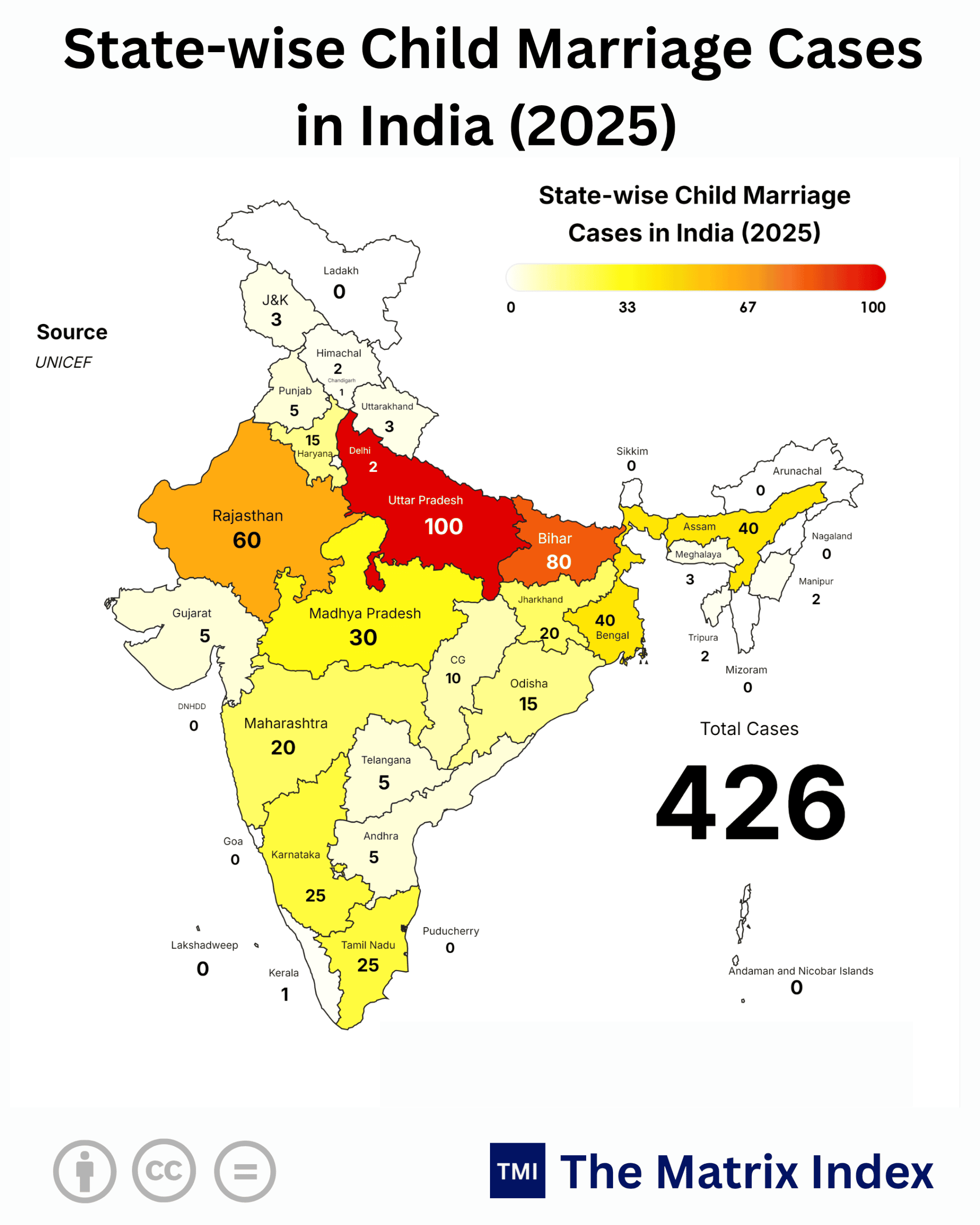
NEW DELHI, India — The official ledger reads like an exercise in bureaucratic gaslighting: exactly 426 reported cases of child marriage across a nation housing 1.45 billion people throughout the entire calendar year of 2025. To accept that figure at face value requires a suspension of disbelief bordering on institutional complicity. While North Block and policy think-tanks champion India’s supersonic sprint toward a $5 trillion and eventual $10 trillion economy, the administrative paper trail systematically blinds itself to a shadow economy of underage domestic servitude that permanently locks millions of young women out of the formal workforce.
This is not merely a human rights dilemma tucked away in the developmental sector’s tear-stained pamphlets. It is a severe macro-fiscal leak. Child marriage is an economic amputation.
When a girl is married off before the statutory age of 18, her personal human capital accumulation drops to zero. Her secondary education terminates overnight. Her lifetime earning capacity is crushed by an average of 80% to 90%, converting a potentially tax-paying, productivity-boosting human asset into an unpaid, undernourished domestic laborer. Multiply that micro-tragedy by reality not the ornamental figure of 426 state-recorded police reports, but the systemic reality uncovered by independent longitudinal demographic surveys and you confront the core reason why India’s female labor force participation rate (FLFPR) has historically languished in the dismal mid-twenties, trailing peers like Vietnam (68%), China (60%), and Brazil (54%).
We are burning human capital at the altar of caste preservation, rural poverty arbitrage, and policing lethargy. If we refuse to audit this subterranean balance sheet today, the grand dream of Viksit Bharat 2047 will arrive not as an economic juggernaut, but as an aging demographic dividend choked by generational stunting, unmanageable maternal morbidity, and an agrarian labor force fundamentally incapable of moving up the technological value chain.
The Statistical Fiction of 2025: Anatomy of an Administrative Cover-Up
Look closely at the official state-by-state compilation filed for 2025. The numbers do not document enforcement; they expose its complete, cowardly breakdown.
Consider the cognitive dissonance. Uttar Pradesh, a demographic colossus of roughly 240 million citizens, logged precisely 100 cases under the Prohibition of Child Marriage Act (PCMA). Bihar, with nearly 130 million residents and a historical National Family Health Survey (NFHS-5) child marriage incidence rate hovering near 40% in several aspirational districts, registered an absurd 80 cases. Rajasthan, the theater of well-documented mass Akshaya Tritiya nuptial pacts across the Marwar and Mewar belts, managed to report only 60 incidents.
To treat these figures as an accurate diagnostic of reality is economic insanity. If these numbers were genuine, child marriage would be statistically eradicated in the subcontinent, sitting comfortably below the structural margins of the United States (0.1%), Australia (0.01%), or the United Kingdom (<0.05%).
The systemic rot lies inside the Indian Penal Code (IPC) and PCMA operational mechanics. Local Thanas deliberately shy away from lodging First Information Reports (FIRs) for illegal child unions. The reason? Village Panchayats normalize the trade-off. An FIR destroys the administrative record of the local Sub-Divisional Magistrate (SDM) and tarnishes the district’s social development indices on national dashboards.
Instead of legal prevention, local officials broker informal compromises. The girl child is discreetly shipped across district borders under the radar of the local Child Development Project Officer (CDPO). The police register a case only when violent breakdown, dowry homicide, or inter-caste warfare erupts. The 426 recorded cases represent solely the catastrophic failures of rural hush-money diplomacy, not the actual prevalence of child marriage.
State-Level Dissection: Breaking Down the Ledger of Deception
The state-level data provided for 2025 is not just an empirical distortion; it is a structural mirror of uneven institutional will, selective policing, and regional state capacity.
(The Bitter Truth): This table reveals an institutional infrastructure that treats female child disempowerment not as a criminal infraction to be pursued, but as a cultural inconvenient truth best scrubbed off state blotters to preserve bureaucratic face.
The sheer statistical impossibility of Tripura a state with an NFHS child marriage index exceeding 40% logging only 2 cases, or Andhra Pradesh (with historically nearly 30% prevalence) recording 5 cases, confirms the absolute breakdown of local surveillance.
When an enforcement framework captures less than 0.05% of actual ground infractions, the legal architecture ceases to operate as a deterrent. It becomes an administrative prop.
The Economics of Child Marriage: Rural Poverty Arbitrage
To understand why a father in Murshidabad (West Bengal), Samastipur (Bihar), or Budaun (Uttar Pradesh) surreptitiously marries his 15-year-old daughter to a 26-year-old man, discard the moralizing preachiness of metropolitan seminars. The decision is rooted in desperate, calculated economic rationalization.
Child marriage in agrarian India operates as an economic liquidity event and risk-mitigation tool against catastrophic multi-dimensional poverty.
Three merciless economic levers power this engine:
1. The Dowry Age-Penalty Curve
The Indian dowry market functions on an aggressive inverse-age depreciation model. The younger the girl, the lower the dowry demanded by the groom’s household.
A 15-year-old bride can often be transferred with an asset settlement of ₹50,000 to ₹1,00,000 in gold, motorcycle equity, and cash. Allow that same girl to cross 18 years, permit her to finish higher secondary schooling, and the groom market prices in an aggressive “age penalty.”
Grooms demand an educated parity premium, elevating the required dowry to ₹3,00,000 to ₹8,00,000. To a landless farmer or debt-ridden tenant cultivator earning barely ₹10,000 a month via erratic agrarian labor and MGNREGA top-ups, waiting for a girl to hit legal adulthood is an act of fiscal suicide. The father cuts the deal early to avoid personal bankruptcy.
2. The Dependency Offloading Equation
In households operating at the razor’s edge of calorific survival, an adolescent daughter is viewed through an extractive patriarchal prism as Paraya Dhan (another’s asset) a net consumer of domestic resources who will not provide intergenerational elder care. Marrying her off reduces the household’s “food consumption units” by one.
Her exit transfers her caloric, medical, and shelter liabilities onto another family. It is a distress divestiture of human life engineered by chronic malnutrition, microfinance debt-traps, and recurring agrarian shocks.
3. Structural Lack of Secondary Educational Infrastructure
In states like Bihar, Madhya Pradesh, and Uttar Pradesh, the drop-off in educational infrastructure between middle schools (within walking distance) and secondary schools (requiring 5 to 12 kilometers of unprotected transit) is catastrophic.
When a girl hits puberty, the lack of secure transport, functional sanitary infrastructure, and the fear of sexual violence force parents to pull her out of school. Once she sits idle at home, she transitions immediately from an “investable educational profile” to an “untenable reputational risk.” Marriage becomes the immediate, culturally sanctioned warehouse for her physical containment.
The Macroeconomic Cost: How Underage Unions Bleed India’s GDP
The macroeconomic consequences of this practice are devastating. Economists and global institutional investors obsess over the nominal expansion of India’s working-age population. But they miss the structural rot inside the denominator.
The arithmetic of this macroeconomic loss is concrete:
1. Lost Lifetime Labor Output (The FLFPR Chasm)
When a girl marries early, she is permanently cordoned off into the informal care economy. The World Bank has consistently demonstrated that ending child marriage and early childbirth could generate over $500 billion globally in annual benefits through enhanced productivity and lifetime female earnings.
For India, removing this deadweight drag would instantly inject an estimated $56 billion annually into the economic engine. India’s female labor force participation rate has hovered around an unacceptable 32% to 37% (even after accounting for recent post-pandemic rural self-help group inflations), compared to over 65% in East Asian powerhouses. We are attempting to run a modern turbo-charged economy while structurally sidelining half our cerebral capacity.
2. The Intergenerational Stunting Surcharge on Human Capital
Girls married between the ages of 13 and 17 are physically, biologically, and nutritionally unequipped for gestation. The result is an unbroken biological feedback loop: anemic adolescent mothers give birth to low-birthweight, stunted, and wasted infants.
Per NFHS-5, over 35.5% of Indian children under five suffer from stunting, and 57% of women aged 15 to 49 are clinically anemic. A stunted child experiences irreversible cognitive deficits in the first 1,000 days of life.
These children grow up with lowered cognitive capacity, enter the primary school system unable to master basic literacy and numeracy, drop out before technical skill acquisition, and enter the labor force capable only of the lowest forms of un-mechanized physical manual labor. Child marriage is the biological transmission belt of national intellectual depreciation.
3. Public Health Budget Hemorrhage
The Indian public healthcare system carries an astronomical, avoidable fiscal burden directly tied to early pregnancies. Adolescent obstetric complications prolonged labor, obstetric fistula, eclampsia, and severe post-partum hemorrhage absorb billions of rupees in emergency tertiary care interventions.
These resources could otherwise be channeled into preventive primary healthcare, technological modernization, and industrial incubation. We spend precious state capital treating entirely preventable obstetric disasters engineered by our collective failure to enforce our own statutes.
The Ripple Effect: The “So What?” Factor
Why should an institutional investor sitting in Tokyo, Frankfurt, or a sovereign wealth desk in Abu Dhabi care about child marriage metrics in rural Darbhanga or Barmer?
Why should domestic corporate conglomerates pouring billions into consumer discretionary, EV ecosystems, and semiconductor fabrication care?
Because the 426-case fiction is an early indicator of severe macroeconomic fragility:
-
For Corporate Industry and Manufacturing: India’s manufacturing ambitions depend entirely on migrating rural agrarian labor into factory shop-floors. But modern manufacturing precision electronics, textiles, advanced assembly requires literate, trainable workers with secondary education and sustained physical stamina. When child marriage forces over 30% of young rural women out of secondary schools, half the potential high-precision manufacturing labor supply vanishes before it ever reaches an industrial training institute (ITI). Factory floors are starved of local female labor, a demographic asset that powered the export engines of Taiwan, South Korea, China, and modern Vietnam.
-
For Capital Markets and Consumption Vectors: The modern Indian consumption story relies on the transition of rural households from subsistence living to discretionary spending. A single-earner rural household, where the mother was married as an illiterate child and remains economically sidelined, boasts a fraction of the household disposable income of a dual-earner family. If young rural women entered the formal or semi-formal workforce even at entry-level blue-collar wages, Indian household disposable income in rural and semi-urban tiers would expand by an estimated 35% to 45%. Child marriage places a structural ceiling on India’s Domestic Consumption Index.
-
For the Sovereign Risk and ESG Allocator: Global capital allocation in the 2026–2030 window is tightly bound to structural ESG parameters and institutional governance credibility. Sovereign credit rating agencies and global institutional funds look directly through glossy bureaucratic presentations. When an emerging market records only 426 child marriages while national demographic surveys reveal millions of early unions, it flashes a red alert over administrative integrity, data transparency, and systemic policy enforcement.
Global Parallels: What Tier-1 and Tier-2 Economies Teach Us
India does not exist in an economic or sociological vacuum. A cross-jurisdictional audit reveals two vastly different historical trajectories for overcoming demographic friction:
The Heavy-Handed Administrative Model: China (1950)
Following the establishment of the People’s Republic, Beijing enacted the 1950 Marriage Law, immediately outlawing child marriage, concubinage, and arranged infant pacts with zero judicial leniency. The state treated violations not as private civil disputes, but as counter-revolutionary attacks on modern economic productivity.
Local cadres were evaluated, promoted, or purged based on the absolute eradication of underage unions within their communes. Within a single generation, China completely crushed child marriage.
This brutal social engineering unlocked the immense female workforce that powered the Pearl River Delta’s manufacturing revolution in the 1980s and 1990s.
The Educational Incentive Paradigm: Bangladesh’s Female Secondary School Stipend
Closer to home, Bangladesh confronted child marriage figures in the early 1990s that were significantly worse than India’s. Instead of relying solely on a corrupt police force, Dhaka launched the Female Secondary School Assistance Project (FSSAP).
The mechanism was simple, direct, and ruthlessly capitalistic: the state opened bank accounts directly in the names of adolescent girls and transferred recurring cash stipends under two strict conditions:
- The girl must maintain at least a 75% school attendance rate.
- She must remain unmarried until age 18.
The outcome transformed the nation’s social and economic fabric. Bangladesh’s secondary female school enrollment surged, systematically breaking the dowry age-penalty trap.
It laid the human-capital foundation for Bangladesh’s ready-made garment (RMG) export boom, pushing its female labor participation past India’s for nearly two decades.
The Western Industrial Precedent: UK, USA, and Continental Europe
The historical industrial transitions of the United Kingdom and the United States in the 19th and early 20th centuries prove that statutory age declarations alone do not end child marriage. Industrialization does.
When child labor laws merged with compulsory schooling up to the age of 16, the economic utility of early marriage collapsed. When an adolescent girl transitioned from being an economic liability at home to a potential high-wage formal worker in communications, clerical services, and light manufacturing, families voluntarily preserved their daughters’ legal status to capture their earning power.
India today tries to run the Western legal template (raising the legal marriage age via statutory decrees) without building Bangladesh’s direct conditional financial pipelines or unleashing China’s ironclad administrative enforcement. The result is the administrative farce recorded in the 2025 ledger.
Seasonality, Climate Shocks, and Anomaly Alerts
The official 426-case statistic treats child marriage as a static background reality. In practice, child marriage incidence in the subcontinent is highly volatile, driven by severe seasonal cycles and accelerating climate disruptions.
The Post-Harvest Liquidity Window (March–May)
There is an intense seasonal spike in child marriages during the pre-monsoon summer months. In rural Rajasthan, Madhya Pradesh, and Bundelkhand, this period coincides with two intersecting variables: the post-Rabi crop harvest (providing a brief window of disposable cash liquidity to fund wedding meals) and astrological mass-wedding calendar dates like Akshaya Tritiya.
District administrations routinely run ceremonial patrol cars through village centers during this period, generating performative media releases, while hundreds of underage unions occur undetected under nightfall in neighboring rural hamlets.
The Climate Refugee and Ecological Shock Anomaly
A dangerous, underreported driver of child marriage across modern India is climate stress. Look at the data from West Bengal (40 cases) and Odisha (15 cases). These formal figures hide an explosion of distress marriages in climate-ravaged zones like the Sundarbans and coastal Kendrapara.
When recurring super-cyclones destroy protective embankments and salinize multi-generational paddy fields, a rural family’s income goes to zero in a matter of hours. The male head of the household migrates to suburban Kolkata, Bengaluru, or Surat to work on construction sites. The adolescent daughter left behind is immediately married off often to a migrant laborer twice her age or to human trafficking networks posing as prospective grooms.
Child marriage has become an informal disaster adaptation strategy. It operates as an unwritten, illegal flood-insurance policy for families abandoned by institutional climate safety nets.
Two-Sided Risk Assessment: The Bull vs. Bear Case (2026–2035)
Any strategic assessment of this social crisis requires an unvarnished audit of its competing trajectories.
The Bull Case: The Structural Policy Leap
In the optimistic scenario, the central and state governments finally abandon the administrative fiction of low-case reporting and align their policy infrastructure:
-
The Scale-up of Direct Conditional Incentive Accounts: Expanding the model of programs like West Bengal’s Kanyashree Prakalpa and Madhya Pradesh’s Ladli Laxmi into a standardized, federally underwritten conditional cash transfer scheme. This framework deposits capital directly into a girl’s personal biometric bank account, graduating into an indexed wealth corpus of ₹2,00,000 to ₹3,00,000 payable only upon her reaching 21 years without marrying and having completed a professional ITI certification or college degree.
-
Algorithmic Enrollment Tracking: The national implementation of real-time student tracking frameworks like the Automated Permanent Academic Account Registry (APAAR), cross-referenced with village-level Anganwadi tracking tools. A red flag is instantly tripped whenever a female student between ages 12 and 18 misses school for 15 consecutive days, automatically dispatching child protection teams before a marriage can be finalized.
-
Labor Demand Shifting to Rural Peripheries: Rapid decentralization of light manufacturing, electronics testing, and agro-processing facilities into Tier-3 and Tier-4 semi-urban corridors. This shifts the perception of a daughter from an expensive domestic liability into a productive worker bringing home reliable monthly wages.
The Bear Case: Institutional Entrenchment and Underground Displacement
In the pessimistic projection, institutional complacency deepens:
-
The Pitfalls of Performative Legalism: The central state formally pushes the statutory marriage age for women from 18 to 21 years without fixing underlying rural poverty and dowry dynamics. Rather than eradicating underage unions, this legal shift simply expands the criminalized demographic pool. An informal market that previously targeted 14-to-17-year-olds expands to cover 18-to-20-year-olds, driving transactions further into administrative shadows.
-
Deteriorating Police-Community Trust: Increased penal crackdowns that disproportionately target poor young men and destitute fathers (as observed in specific administrative swoops) trigger a severe community backlash. Instead of ending the practice, families simply stop registering births altogether, evading civil identity networks and deepening the invisibility of young girls.
-
The Demographic Stunting Trap Manifests: By 2035, as India approaches the peak of its demographic dividend, millions of young men and women entering the workforce from the northern agrarian belts exhibit physical stunting and lower cognitive baselines. They cannot transition into knowledge, automation, or modern manufacturing roles, stranding millions in precarious informal gig-work and structural underemployment.
The Alternative Scenario: The Counter-Narrative of Sudden Enforcement
What happens if the Indian state, by executive decree, decides to break through this wall of administrative denial overnight?
Consider a hypothetical policy stress test:
Suppose the Ministry of Home Affairs issues a binding directive: any district reporting zero or single-digit child marriage cases in regions where NFHS indicators show double-digit prevalence will face immediate disciplinary action and budgetary freezes for the District Magistrate and Superintendent of Police.
Within 90 days, the facade would collapse. Official case counts would skyrocket from 426 to over 1.5 million cases annually.
The lower judiciary, already buried under an astronomical backlog of over 45 million cases, would buckle instantly under the avalanche of PCMA filings.
State-run shelter homes (Nari Niketans) often structurally unsafe, poorly funded, and understaffed would be swamped within forty-eight hours.
Mass incarcerations of destitute fathers and young grooms would decimate rural household balance sheets, triggering widespread agrarian unrest and drying up informal micro-credit markets.
This alternate scenario reveals why aggressive criminalization alone is a blunt, dangerous instrument.
You cannot arrest your way out of a systemic economic defense mechanism. Child marriage is an economic contract entered into by families trapped at the edge of survival.
If the state plans to invalidate that contract, it must provide a viable economic alternative: a guaranteed education-to-employment pipeline backed by immediate conditional liquidity.
The Strategic Policy Playbook: Dismantling the Shadow Matrix
To convert the official 426-case fiction into meaningful reform, the Indian policy matrix must deploy an aggressive, market-driven intervention playbook:
1. Launch the “Daughter Dividend” Conditional Cash Transfer (CCT)
Direct punitive measures must yield to direct financial incentives. The central government should roll out a unified national program modeled on the world’s most successful conditional cash transfer frameworks:
-
The Mechanism: An unconditional, inflation-indexed payment of ₹2,500 per month transferred directly to the Aadhaar-linked bank account of every rural and urban-slum female student between the ages of 12 and 18, subject to an independently audited 80% biometric school attendance record.
-
The Graduation Corpus: Upon completing Grade 12 unmarried, the state deposits a final asset tranche of ₹1,50,000 into a specialized sovereign infrastructure bond portfolio issued in her name, redeemable upon her 21st birthday for enterprise incubation, vocational training, or higher education.
-
The Cost-Benefit Math: The annual fiscal outgo would stand at roughly 0.6% of GDP a fraction of what India loses annually in unrealized female productivity and intergenerational health costs.
2. Universalize Rural Transit Corridors
Eliminate the safety deficit that pulls adolescent girls out of schools. State governments must guarantee free, monitored public bus networks and safe bicycle micro-mobility schemes connecting every single village with secondary educational institutes within a 15-kilometer radius.
Eliminating this spatial friction breaks the domestic safety panic that so often forces parents into the early marriage market.
3. Replace Police-Centric Reporting with Administrative Reverse-Audits
Decouple PCMA enforcement from local police blotters. Establish an independent Inspector General of Demographic Metrics tasked with running constant, random micro-surveys in aspirational districts.
If a district logs only 5 cases on its police blotter while high-frequency independent sampling uncovers thousands of underage cohabitations, the administrative team must face formal career penalties. We must punish the suppression of data, not the honest identification and remediation of child marriage cases.
The Structural Horizon: 2026, 2030, 2047
The trajectory of this challenge over the coming decades will dictate India’s macroeconomic future.
2026: The Reckoning of the Blotter
The data from 2025 is an urgent wake-up call for the state. If North Block continues to rubber-stamp state reports claiming that an entire subcontinent of 1.45 billion souls only uncovers 426 child marriages in 365 days, international data credibility will quietly collapse.
Institutional investors are already relying on alternative, high-frequency satellite, consumption, and biometric data proxies rather than state-curated social statistics. The reckoning begins with admitting the scale of the crisis.
2030: The Demographic Inflection Point
Between now and 2030, the window of India’s demographic dividend begins its irreversible countdown. The median age of the Indian population sits near its absolute sweet spot: 28 to 30 years.
If the adolescent girls of today the cohort trapped in the deceptive quiet of Uttar Pradesh’s 100 cases and Bihar’s 80 cases are not integrated into the formal economic engine within this four-year window, they will age into dependent, under-skilled, and medically vulnerable citizens.
By 2030, the option to casually harness female labor will have expired; India will face the rapid aging trends already gripping East Asia, but without the accumulated capital reserves of Japan, South Korea, or China.
2047: The Viksit Bharat Imperative
The official centenary of Indian independence cannot be built on a bifurcated society: a hyper-digitized metropolitan core floating on an ocean of stunted, marginalized, and disenfranchised rural women.
A nation cannot lay claim to developed-market leadership when millions of its daughters are legally invisible, biologically compromised before adulthood, and economically silenced behind domestic compound walls.
The benchmark for Viksit Bharat 2047 is not merely nominal GDP prints or stock index highs. The definitive metric is human agency: the day an Indian girl’s economic future is shaped by her ambition in a classroom, rather than an under-the-table transaction brokered in administrative silence.
Verdict: The Cost of Denial
The official ledger for 2025 is not an administrative report; it is an indictment of institutional denial.
Reporting 426 child marriages for a nation containing 60 million adolescent girls between the ages of 15 and 18 is worse than bureaucratic failure. It is an economic blind spot that hobbles India’s potential on the global stage.
We have a choice. We can continue to celebrate ornamental metrics that soothe political egos while starving our factories of productive labor, bloating our public health budgets, and locking an entire generation of girls into economic obscurity.
Or we can face the harsh reality of rural poverty, dismantle the dowry age-penalty curve with structural liquidity, and unleash the greatest untapped productive force on the planet today: the young women of India.
The window to make this transformation is closing fast. Every single year we trade the educational trajectory of a girl child for a manipulated state blotter, we shave billions off our economic future.
The arithmetic is relentless, it has no political agenda, and it will balance the books either through shared national wealth or through generational stagnation. The choice is ours, but the clock is ticking down.
GOOGLE ‘PEOPLE ALSO ASK’ FAQs
Q1: Which Indian state reported the highest communal violence incidents in 2025?
A: Madhya Pradesh recorded 75 incidents, representing 27.88% of the national total in 2025. This inland logistics hub led nationwide tallies, outpacing neighboring industrial corridors in reported public order disruptions.
Q2: How much of India’s communal unrest is concentrated in top states?
A: 70.63% of all recorded incidents occurred in just three states: Madhya Pradesh (75), Bihar (65), and Jharkhand (50). Together, these three contiguous regions accounted for 190 of the 269 nationwide disruptions.
Q3: How does sub-national civil unrest impact India’s GDP growth targets?
A: A 25 to 50 basis point surge in sovereign risk premiums can stall foreign direct investment flows required for Vision 2030. Localized transit halts trigger severe component shortages, inflating manufacturing operational expenditures by 3% to 5%.
Q4: Why did Uttar Pradesh register zero communal violence incidents in 2025?
A: 0 reported incidents reflect aggressive preventive policing, algorithmic surveillance, and potential statutory reclassification under general public order codes rather than communal violence sections. This administrative enforcement model prioritized uninterrupted expressway and industrial operations.
Q5: What is the primary supply chain risk linked to regional unrest?
A: ₹12-15 crore per shift is the estimated assembly downtime cost for major manufacturing plants when inland transit routes stall for 48 hours. Critical mining and agricultural freight delays quickly spark downstream urban inflation spikes.
Data Source:
- Ministry of Home Affairs (MHA)
- National Crime Records Bureau (NCRB)
- Institute for Economics and Peace (IEP)
Disclaimer: This report is for informational and analytical purposes only and does not constitute formal financial, investment, or policy advice.