The Law & Order Deficit: India’s Silent Security Shockwave and the Hidden Fiscal Drag on the $5 Trillion Dream
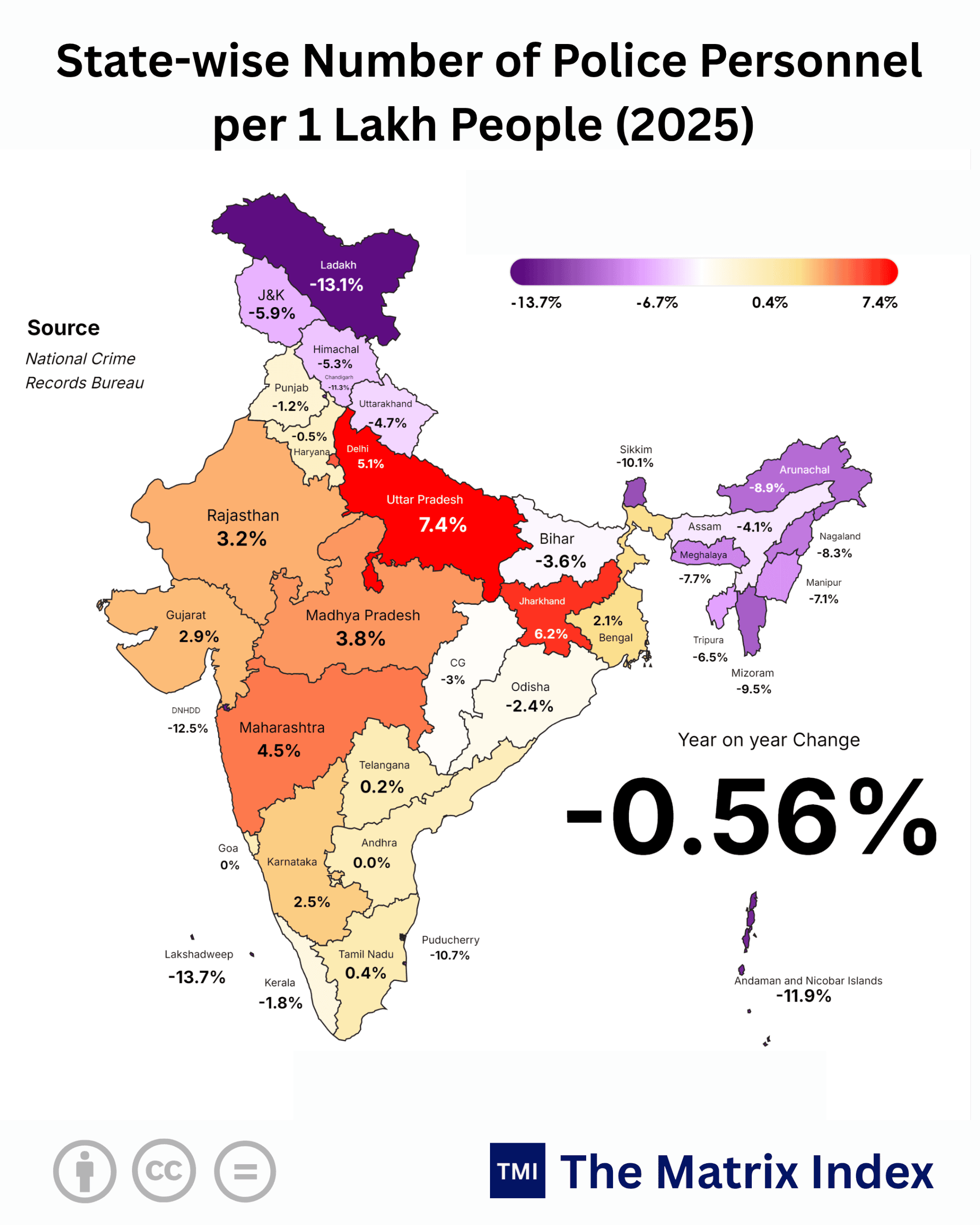
| State / Union Territory | Year-on-Year Change (Police Personnel per 1 Lakh People) |
| Uttar Pradesh |
7.4%
|
| Jharkhand |
6.2%
|
| Delhi |
5.1%
|
| Maharashtra |
4.5%
|
| Madhya Pradesh |
3.8%
|
| Rajasthan |
3.2%
|
| Gujarat |
2.9%
|
| Karnataka |
2.5%
|
| Bengal (West Bengal) |
2.1%
|
| Tamil Nadu |
0.4%
|
| Telangana |
0.2%
|
| Andhra Pradesh |
0.0%
|
| Goa |
0%
|
| Haryana |
-0.5%
|
| Punjab |
-1.2%
|
| Kerala |
-1.8%
|
| Odisha |
-2.4%
|
| Chhattisgarh (CG) |
-3.0%
|
| Bihar |
-3.6%
|
| Assam |
-4.1%
|
| Uttarakhand |
-4.7%
|
| Himachal Pradesh |
-5.3%
|
| J&K (Jammu & Kashmir) |
-5.9%
|
| Tripura |
-6.5%
|
| Manipur |
-7.1%
|
| Meghalaya |
-7.7%
|
| Nagaland |
-8.3%
|
| Arunachal Pradesh |
-8.9%
|
| Mizoram |
-9.5%
|
| Sikkim |
-10.1%
|
| Puducherry |
-10.7%
|
| Chandigarh |
-11.3%
|
| Andaman and Nicobar Islands |
-11.9%
|
| DNHDD (DNH and DD) |
-12.5%
|
| Ladakh |
-13.1%
|
| Lakshadweep |
-13.7%
|
| National Average (YoY Change) |
-0.56%
|
NEW DELHI, India (September 21, 2026 / IST) — Strip away the triumphalist GDP headlines, turn down the political rhetoric, and examine the bedrock upon which any modern economy rests: internal security, contract enforcement, and physical safety. Behind closed doors at North Block and state secretariats across India, senior administrators are wrestling with a chilling dataset. India’s national police-to-population ratio is not merely stagnant; it has officially contracted at -0.56% year-on-year. While Uttar Pradesh records an eye-catching recruitment expansion of +7.4%, and Jharkhand climbs +6.2%, more than half of the Union encompassing 23 states and Union Territories is actively bleeding law enforcement manpower relative to demographic expansion.
Let us be unequivocal. Capital does not allocate itself into chaos. When the rule of law fractures, the cost of capital surges, foreign direct investment slows to a crawl, and the invisible economic friction of an underpoliced nation cannibalizes productivity. You cannot construct a high-velocity, high-trust digital economy when your physical frontline policing is slipping into demographic deficit.
The Manpower-Demography Collision
Economic powerhouses and critical border territories alike are witnessing an attrition rate that should trigger alarm bells across global boardrooms.
The Great Sovereign Divergence
The headline numbers reveal two distinct Indias operating on opposing trajectories. On one side, the political heartland Uttar Pradesh (+7.4%), Jharkhand (+6.2%), Delhi (+5.1%), and Maharashtra (+4.5%) is injecting massive fiscal resources to push personnel numbers higher. On the other side, industrialized hubs and strategically sensitive regions are hollowed out by bureaucratic freeze, retirement bulges, and fiscal retrenchment.
The Widening UN Deficit Gap
Haryana (-0.5%), Punjab (-1.2%), Kerala (-1.8%), and Odisha (-2.4%) have crossed into negative territory. Even more catastrophic is the trendline in Bihar (-3.6%), Assam (-4.1%), and Uttarakhand (-4.7%). Across the strategic frontier, Jammu & Kashmir (-5.9%), Manipur (-7.1%), Nagaland (-8.3%), and Arunachal Pradesh (-8.9%) are experiencing systemic drops in beat-level density.
Consider the global standard. The United Nations systematically recommends a baseline of 222 police personnel per 100,000 citizens. In reality, India’s actual sanctioned deployment hovers around 150 to 155, while actual operational capacity in several states languishes below 110.
When advanced economies like Germany, Japan, the United States, the United Kingdom, and Australia maintain active, highly equipped forces between 250 and 320 officers per 100,000 citizens, India’s national contraction of -0.56% is an unsustainable operational hazard.
Institutional Density: India vs. Tier-1 & Tier-2 Powers
Economic strategists frequently make the mistake of treating policing as a purely sovereign, domestic obligation. That is naive. Institutional strength and internal safety are top-tier metrics scored by the World Bank, sovereign rating agencies, and cross-border institutional allocators.
First-World Protection Infrastructure
In Germany, localized public security is tied to the Bundespolizei and state Landespolizei models, maintaining an ironclad 298 officers per 100,000 people. In Japan, the renowned Kōban system guarantees that no citizen or commercial establishment is beyond the immediate physical reach of an officer, supporting 201 officers per 100,000 citizens despite exceptionally low violent crime rates.
Even peer emerging markets within the BRICS and Tier-2 developing economies including South Africa, Brazil, and Mexico maintain significantly higher tactical force-ratios than India, despite suffering their own structural frictions.
Cross-Border Capital Allocation Dynamics
When global institutional allocators in London, New York, or Singapore decide between building supply-chain clusters in India versus Vietnam, Mexico, or Poland, the calculus goes far beyond tax incentives and labor arbitrage. It centers on institutional risk. An overstretched, exhausted police force yields delayed FIR registrations, compromised crime scene management, slow forensic validation, and prolonged judicial pipelines.
The math is brutal: justice delayed by police delays is enterprise value destroyed.
Empirical Ledger: State-by-State Reckoning
Complete National Jurisdiction Audit
The following comprehensive breakdown details the structural shifts occurring across India’s states and territories.
(The Bitter Truth) The national average of -0.56% masks a catastrophic collapse in our strategic border outposts and critical manufacturing belts, threatening to paralyze the enforcement machinery necessary to sustain India’s long-term sovereign and economic integrity.
Micro-Economic Decoupling: Two Divergent Worlds
The Heartland Offensive vs. Industrial Stagnation
Look at the numbers through a balance sheet lens.
Uttar Pradesh’s massive expansion of +7.4% is not an accident of state largesse; it is a calculated political-economic decision. For decades, UP bore the ignominy of being India’s “BIMARU” core a territory where extortion gangs, land cartels, and organized syndicates levied a shadow tax on every rupee of investment.
By aggressively recruiting and deploying frontline civil police and armed constabularies, Lucknow sent a deliberate signal to corporate balance sheets: property rights will be defended, logistics corridors will be secured, and industrial estates in Noida, Greater Noida, and Kanpur will operate without criminal interference.
The Bihar Trap: Demographic Boom Without Institutional Shield
Now trace the counter-trajectory. Look at Bihar (-3.6%). Despite bearing one of the youngest and most rapidly expanding populations in the world, its police density is shrinking relative to demographic reality. This is institutional suicide. When you do not expand frontline police capacity alongside a surging youth cohort in an under-industrialized state, you create a combustible vacuum.
The immediate result is soaring petty crime, gang resurgence, land tenure volatility, and commercial evasion. Businesses in Patna, Muzaffarpur, and Gaya face a persistent security discount. Investors quietly pull back capital allocations, channeling funds toward Gujarat, Maharashtra, or Tamil Nadu.
The Southern Plateau: Living on Inherited Stability
Yet, even Tamil Nadu (+0.4%) and Telangana (+0.2%) are skirting disaster. They are running on the fumes of past infrastructure investments.
A state like Tamil Nadu which manufactures an enormous share of India’s automobiles, precision engineering, and electronics cannot sustain an economic super-cluster with a near-zero growth rate in policing manpower (+0.4%).
Industrial corridors create rapid urban migration. Megacities sprawl into ungoverned semi-urban belts. When beat constabularies fail to keep pace with migration, the inevitable byproduct is labor friction, localized racketeering, high road fatalities, and degraded supply chain stability.
Borderland Attrition: Geopolitical Shocks on the Perimeter
The Hollow Frontier
The most dangerous disclosures in this dataset do not come from the plains; they come from the perimeter.
Frontline Intelligence Decay
Look at those numbers:
-
Jammu & Kashmir: -5.9%
-
Manipur: -7.1%
-
Nagaland: -8.3%
-
Arunachal Pradesh: -8.9%
-
Ladakh: -13.1%
Let us dispense with pleasantries. In frontier zones, the local police force is the primary human interface of the Indian state. They are the eyes, the ears, and the localized intelligence grid that works in tandem with the Central Armed Police Forces (CAPF) and the Indian Army.
When you allow local police density in Ladakh to contract by -13.1%, or in Arunachal Pradesh to drop by -8.9%, you are systematically blinding your intelligence architecture.
In conflict zones like Manipur (-7.1%), a contracting police apparatus represents an operational surrender to ethnic warlords, narcotics syndicates, and insurgent splinter cells.
Paramilitary Distortion & Cost Externalities
When local law enforcement erodes, the central government is inevitably forced to deploy expensive, combat-trained paramilitary battalions to perform mundane civil policing duties.
This is an extraordinarily inefficient allocation of national security resources. Soldiers are trained for counter-insurgency and kinetic border defense; they are ill-suited to conduct local forensic investigations, negotiate community disputes, and build local community trust.
7. The “So What?” Transmission Mechanism
Micro-Economic Transmission Channels
What does a -0.56% national contraction actually mean for you the factory owner, the equity investor, the tech entrepreneur, and the everyday salaried taxpayer? It is not an abstract statistical metric. It hits your pocketbook in four direct, measurable ways.
Corporate Balance Sheet Taxes
Take the Private Security Surcharge. When you walk through Gurgaon, Bengaluru, or Chennai, observe who is guarding the IT parks, the distribution centers, and the manufacturing facilities. It is not state constables; it is private security agencies.
Indian enterprises spend an estimated $12+ Billion annually on private security infrastructure. That represents a multi-billion-dollar deadweight loss that could have been plowed into R&D, capital expenditures, or wage increases. It is a private tax paid to compensate for the sovereign failure to provide baseline public protection.
Gender Dividend Destruction
Take Women’s Labor Force Participation (LFPR). India cannot realistically target a $30 Trillion Viksit Bharat by 2047 when half its demographic dividend is physically deterred from participating in late-shift manufacturing, enterprise IT operations, and localized retail commerce due to inadequate public safety.
A single woman weighing a promotion that requires working past 9 PM in an underpoliced industrial corridor will consistently choose physical safety over economic mobility. When police density contracts by -0.5% to -4.0% across states like Haryana, Bihar, or Assam, the frontline victim is female labor mobility.
Root Cause Forensic: Administrative vs. Fiscal Decay
Dissecting the Structural Freeze
Apologists in government bureaucracies will argue that these figures reflect temporary administrative fluctuations. They point to the disruptions of the 2020-2022 pandemic period, delayed recruitment calendar notifications, and lengthy candidate background verifications.
Do not fall for that bureaucratic excuse.
This is not a temporary seasonal anomaly; this is a structural fiscal freeze.
Revenue Expenditure Chokeholds
States across the Indian federation are facing crushing revenue expenditure balances. Between mounting interest payments on legacy debt, ballooning pay commission commitments, and a non-negotiable wave of competitive electoral subsidies, the fiscal room for capital intensive police hiring has narrowed.
The Unwritten Shadow Austerity
When a state finance department searches for areas to quiet cut expenditures, civil police recruitment is invariably placed on the chopping block.
Unlike central defense allocations, state policing relies on discretionary state-level budgets. When older constables retire at age 60, finance bureaucrats intentionally leave the vacancies unfilled for three, four, or five consecutive budget cycles.
By freezing recruitment, the state saves billions in baseline salaries, gratuity outlays, and long-term pension liabilities. Meanwhile, population growth moves inexorably upward. The result is the exact structural contraction visible in our dataset: an escalating deficit disguised as administrative delay.
Scenario Modeling: Bull vs. Bear (2026–2035)
The Sovereign Strategic Divergence Matrix
The trajectory of India’s economic development over the next two decades depends fundamentally on whether policy makers treat this dataset as a routine bureaucratic update or as an urgent constitutional emergency.
(The Golden Opportunity) Transforming police forces into a modern, highly digitized, well-compensated institutional frontline offers India an immediate path to unlock multi-trillion-dollar economic efficiencies and propel female labor participation.
Trajectory A: The Modernization Pivot
Under the Bull Case, the Union Government links 16th Finance Commission tax devolution grants to strict, non-negotiable police modernization and recruitment quotas. States are rewarded with fiscal bonuses for closing police vacancy backlogs within 18 months.
Recruitment is radically depoliticized, transitioning to centralized, standardized digital testing pipelines that eliminate the rampant exam paper leaks and litigation cycles that currently paralyze hiring in northern and eastern states.
At the same time, states mirror the Uttar Pradesh (+7.4%) model by coupling personnel expansion with digital case-tracking, drone surveillance, and specialized cyber-crime wings. By elevating beat-level presence, street crime plummets, female workforce mobility surges, and institutional trust returns. Multinational manufacturers establish facilities outside protected mega-cities, driving development deep into the hinterlands of Madhya Pradesh, Odisha, and interior Maharashtra.
The resulting domestic security stability shaves 35 basis points off India’s institutional sovereign risk premium, lowering borrowing costs for the entire corporate sector.
Trajectory B: The Enclave Economy
Under the Bear Case, state governments double down on short-term electoral transfers, draining capital budgets to fund immediate welfare handouts.
Police hiring freezes harden into permanent policy. The national average drops further, contracting by -1.5% annually across the late 2020s.
As public security erodes, the Indian economy bifurcates sharply into a deeply unequal two-tier ecosystem:
-
The wealthy corporate elite, high-value tech services companies, and multinational factories retreat into self-funded, privately guarded “enclaves” heavily fortified tech campuses, private industrial corridors, and gated residential townships.
-
The broader public square, MSME hubs, and small-town enterprises are left to navigate underpoliced, informal, and volatile local environments where criminal networks, extortion syndicates, and localized intimidation fill the sovereign void.
Under this scenario, India’s broader industrialization drive fails to scale. Global supply-chain giants abandon ambitious plans for secondary and tertiary industrial nodes, retreating to Vietnam, Indonesia, or Eastern Europe. The dream of absorbing tens of millions of underemployed rural youth into formal manufacturing collapses under the weight of security-driven operational costs.
The Counter-Narrative: Technological Substitution
The Algorithmic Panacea Fallacy
There is, of course, an alternative perspective pushed by techno-utopians in government and the corporate sector: Do we truly need more physical police officers in the era of Artificial Intelligence, facial recognition algorithms, and ubiquitous drone surveillance?
The argument sounds seductive to budget-strapped finance ministers: instead of hiring 100,000 human constables with lifetime pensions, healthcare liabilities, and human training costs why not blanket urban corridors with 5 million AI-integrated high-definition cameras, automated license plate readers (ALPR), and real-time algorithmic dispatch systems?
Physical Interdiction Bottlenecks
This is an illusion. Technology is an institutional multiplier; it is not an institutional substitute.
A high-definition AI camera can capture an armed robbery, an industrial wildcat blockade, or an assault on a female worker with crystal clarity. But an algorithm cannot physically stop an attack in progress. An algorithm cannot conduct a legally sound, uncompromised crime-scene investigation. An algorithm cannot build empathetic community intelligence in a communally sensitive neighborhood or secure a violent riot perimeter.
The Crisis of Hollow Deterrence
Furthermore, an over-reliance on digital surveillance without physical human accountability breeds profound public cynicism. When citizens see omnipresent surveillance cameras issuing traffic tickets with ruthless efficiency, while local police stations remain visibly understaffed and unresponsive to violent crime, the legitimacy of the state crumbles.
A technology-first, human-last law enforcement strategy creates the shell of a high-tech state with none of its physical enforcement power.
Strategic Verdict: Roadmap to 2047
Institutional Imperatives for Viksit Bharat
The finding that India’s police personnel per capita is contracting at -0.56% year-on-year should not be treated as a peripheral administrative statistic. It represents a direct structural threat to India’s trajectory toward becoming a $30 Trillion developed economy by 2047.
Here is my direct verdict as an economic strategist: Economic growth cannot be decoupled from institutional security.
If the Republic of India genuinely intends to compete with the United States, Germany, and China as a world-class manufacturing superpower, it must urgently execute three fundamental policy interventions:
Actionable Mandates for Capital and Statecraft
To corporate business leaders and enterprise allocators: stop viewing corporate social responsibility (CSR) and capital expenditure as completely isolated from your localized policing ecosystem. Demand institutional governance and security metrics from state governments before committing mega-scale industrial investments. Reward states like Maharashtra and Uttar Pradesh that demonstrate the political will to expand their rule-of-law framework, and apply capital pressure on states that allow their security foundations to rust.
To our central and state policymakers: look at the ancient wisdom of governance. Chanakya warned millennia ago in the Arthashastra that when internal security falters, treasury wealth evaporates like water on a hot stone.
You can build high-speed expressways, launch semiconductor subsidies, and celebrate surging stock market indices. But if the frontline beat constable the foundational human brick of the sovereign state is stretched to exhaustion, demographic oblivion, and operational irrelevance, your economic edifice rests on sand.
It is time to end the fiscal freeze, staff the frontlines, and secure the foundation of the Republic before the demographic deficit becomes an economic catastrophe.
GOOGLE ‘PEOPLE ALSO ASK’ FAQs
Q1: What is the current year-on-year change in India’s police-to-population ratio?
A: A contraction of -0.56% defines India’s national police-to-population ratio year-on-year, driven by recruitment freezes across 23 states and union territories. This widens the gap with the United Nations baseline standard of 222 personnel per 100,000 citizens.
Q2: Which Indian states have the highest police personnel growth rates?
A: Uttar Pradesh leads nationwide expansion with a +7.4% year-on-year increase, closely followed by Jharkhand at +6.2%, Delhi at +5.1%, and Maharashtra at +4.5%. These states prioritized civil hiring to lower crime-related capital risk.
Q3: Which regions face the steepest decline in police density?
A: Lakshadweep recorded the worst decline at -13.7%, followed by Ladakh at -13.1%, Chandigarh at -11.3%, and Sikkim at -10.1%. Frontier border regions including Arunachal Pradesh (-8.9%) and Manipur (-7.1%) face critical manpower attrition.
Q4: How does India’s police density compare to global standards?
A: India operates at roughly 138 to 155 personnel per 100,000 citizens, trailing the UN-recommended benchmark of 222. In comparison, Germany maintains 298, Australia fields 264, the United States deploys 242, and Japan operates 201 officers.
Q5: How does a police personnel deficit impact India’s economic growth?
A: An estimated $12+ billion is drained annually into corporate private security to offset state policing shortages. This institutional deficit slows civil contract enforcement past 1,400 days, suppresses female labor participation, and increases the sovereign investment risk premium.
Data Source:
- Bureau of Police Research and Development (BPR&D)
- Ministry of Home Affairs (MHA)
- United Nations Office on Drugs and Crime (UNODC)
Disclaimer: This report is for informational and analytical purposes only and does not constitute formal financial, investment, or policy advice.