The Great Higher Education Insolvency: Dissecting America’s Structural Enrollment Collapse and the 2030-2047 Human Capital Reckoning
| State | College/University Enrollment Rate (2025) |
| New York |
67% |
| Pennsylvania |
65% |
| Maryland |
64% |
| California |
62% |
| Washington |
61% |
| Oregon |
60% |
| Minnesota |
59% |
| Wisconsin |
59% |
| Colorado |
58% |
| Maine |
58% |
| N.H. (New Hampshire) |
58% |
| Michigan |
56% |
| Virginia |
56% |
| Texas |
55% |
| N. Carolina |
54% |
| Florida |
54% |
| Indiana |
53% |
| Georgia |
53% |
| Ohio |
52% |
| Missouri |
51% |
| Tennessee |
51% |
| S. Carolina |
50% |
| Louisiana |
49% |
| Oklahoma |
48% |
| Alabama |
48% |
| Arkansas |
47% |
| Mississippi |
47% |
| W. Virginia |
46% |
| Kentucky |
45% |
| Kansas |
45% |
| North Dakota |
44% |
| South Dakota |
44% |
| Nebraska |
44% |
| Iowa |
44% |
| Delaware |
44% |
| Rhode Island |
44% |
| Utah |
43% |
| Arizona |
43% |
| Nevada |
42% |
| New Mexico |
42% |
| Montana |
41% |
| Idaho |
41% |
| Wyoming |
41% |
| Alaska |
40% |
| Hawaii |
39% |
| Massachusetts |
74% |
| New Jersey |
74% |
| Vermont |
70% |
| Connecticut |
72% |
| Illinois |
66% |
| National Average |
61% |
NEW DELHI, India (October 21, 2026 / IST) — The Western university apparatus is cannibalizing itself from the inside out, and the raw enrollment balance sheets from across the United States expose a staggering systemic fracture that global markets can no longer afford to ignore. Behind the ivy-covered stone facades and billion-dollar endowment marketing decks lies an escalating structural liquidation of human capital.
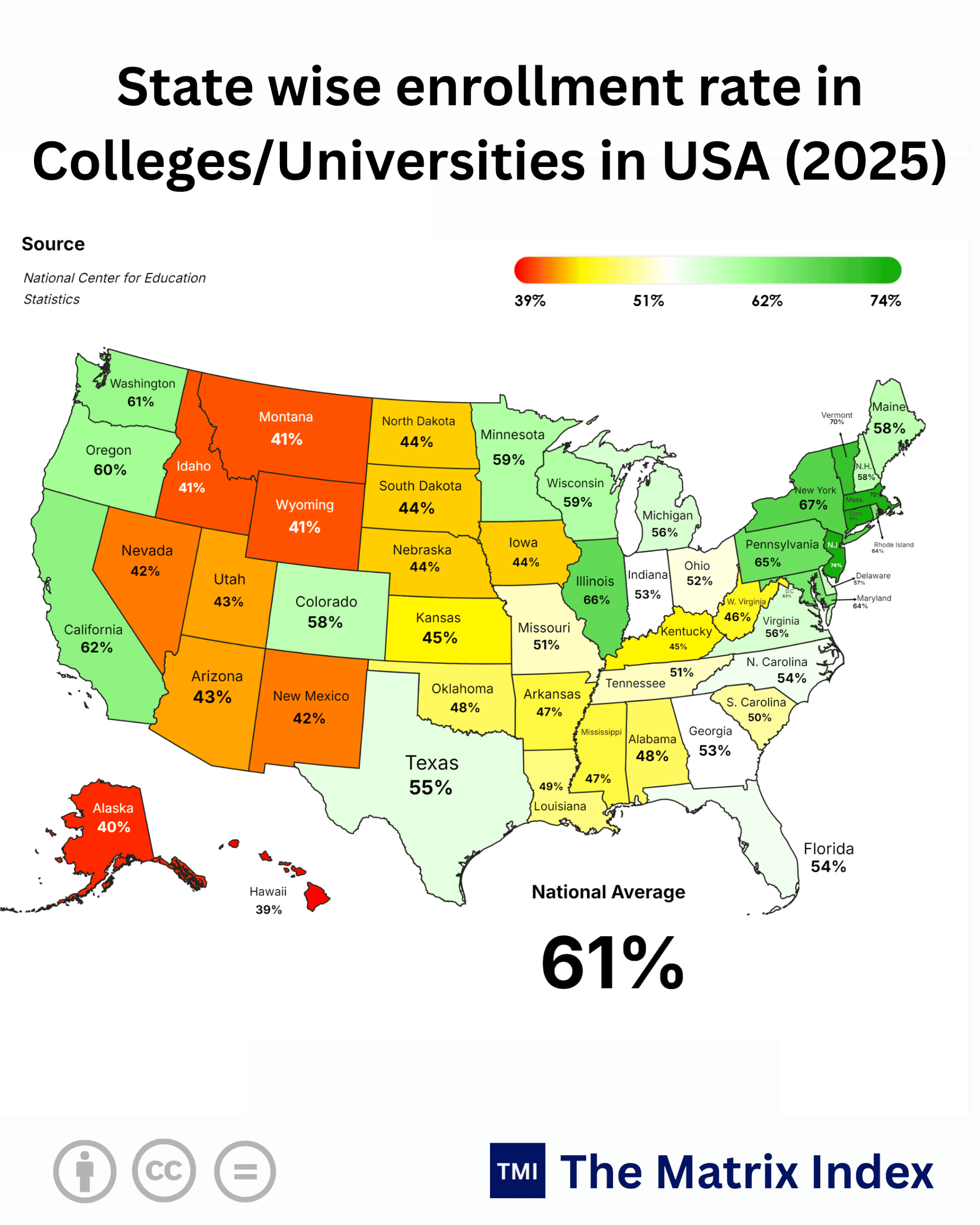
The latest nationwide audit reveals an unvarnished economic reality. While elite coastal corridors like Massachusetts (74%), New Jersey (74%), and Connecticut (72%) artificially prop up aggregate metrics, the vast industrial and agrarian underbelly of America has completely detached from higher education. Hawaii sits at an abysmal 39%, Alaska tracks at 40%, and resource-heavy frontier hubs like Montana, Idaho, and Wyoming hover lifelessly at 41%.
The heralded National Average of 61% is a mathematical illusion. It conceals an unprecedented 35-percentage-point chasm between elite knowledge capitals and the disaffected heartland. Families are voting with their feet and their wallets, walking away from a predatory credentialing complex that trades multi-generational debt for depreciating paper degrees.
The Illusion of Aggregate Stability: Coastal Fortresses vs. The Heartland Exodus
Look closely at how this breakdown operates across state lines. The Northeast corridor operates like an insulated sovereign economy. In Vermont (70%), New York (67%), and Pennsylvania (65%), entrenched corporate hierarchies, civil service rules, and legacy life-sciences ecosystems still enforce the college degree as a mandatory barrier to entry.
Step into the industrial and agricultural heartland, however, and that narrative falls apart instantly. In Michigan (56%), Ohio (52%), and Indiana (53%), industrial automation and the collapse of the white-collar wage premium have laid bare a harsh economic equation. Why shoulder $120,000 in debt for an entry-level desk role when precision manufacturing, digital trade logistics, or energy grid operations pay immediate starting wages of $75,000?
The disparity turns catastrophic once you cross into the Mountain West and the deep South. Arkansas (47%), Mississippi (47%), West Virginia (46%), and Kentucky (45%) are experiencing an educational freeze. In these regions, median family incomes cannot absorb ballooning tuition hikes, and local employers no longer treat a generalist Bachelor of Arts as a signal of workplace competence.
The Western interior paints an even bleaker operational picture. Utah and Arizona are pinned at 43%. Nevada and New Mexico scrape bottom at 42%. In frontier states like Wyoming, Idaho, and Montana, where enrollment hovers at 41%, young adults are bypassing four-year institutions to enter resource extraction, decentralized software development, or local infrastructure projects.
Dissecting the Enrollment Ledger: Regional Stratification and the Human Balance Sheet
To truly diagnose this structural failure, we must strip away university marketing rhetoric and analyze the hard geographic data. Higher education in the United States has split into three distinct, non-communicating operational tiers: the Hyper-Credentialed Corridor, the At-Risk Industrial Mid-Tier, and the Sub-45% Insolvency Perimeter.
State-by-State Higher Education Enrollment Ledger (2025 Audit)
| Geographic Tier | States Represented | Enrollment Rate (%) | Primary Economic Driver | Structural Threat Level |
| Tier 1: Hyper-Credentialed | MA, NJ, CT, VT, NY, IL, PA, MD | 64% – 74% | Financial Services, Biotech, Corporate Law, Public Admin | Low (Endowment-Buffered, High Density) |
| Tier 2: Pacific Knowledge Hubs | CA, WA, OR | 60% – 62% | Big Tech, Agritech, Aerospace, Green Infrastructure | Moderate (Extreme Living Costs, Emigration) |
| Tier 3: Upper Midwest Manufacturing | MN, WI, CO, ME, NH | 58% – 59% | Medical Technology, Advanced Agriculture, Services | Moderate (Demographic Aging, Brain Drain) |
| Tier 4: The Industrial & Sun Belt Core | MI, VA, TX, NC, FL, IN, GA | 53% – 56% | Logistics, Energy, Defense, Semiconductor Fabs | Elevated (Corporate Apprenticeship Cannibalization) |
| Tier 5: Rust Belt & Transition Zones | OH, MO, TN, SC, LA | 49% – 52% | Automotive Assembly, Freight Logistics, Healthcare Support | High (Wage Compression, Blue-Collar Pay Parity) |
| Tier 6: The Southern Rust/Resource Core | OK, AL, AR, MS, WV, KY | 45% – 48% | Mining, Heavy Industry, Agriculture, Traditional Trades | Severe (High Default Rates, Declining ROI) |
| Tier 7: The Plains & Marginal Hubs | KS, ND, SD, NE, IA, DE, RI | 44% – 45% | Commodity Agriculture, Regional Banking, Food Processing | Acute (Campus Consolidation, Liquidity Crunches) |
| Tier 8: The Mountain & Frontier Basin | UT, AZ, NV, NM, MT, ID, WY | 41% – 43% | Construction, Mineral Extraction, Tourism, Tech Satellites | Systemic (Generational Rejection of Degree Cartels) |
| Tier 9: The Disconnected Periphery | AK, HI | 39% – 40% | Military Infrastructure, Maritime Shipping, Hospitality | Critical (Severe Out-Migration, Geographic Isolation) |
(The Bitter Truth): Over 50% of American states now fail to cross the 50% enrollment threshold among their eligible young demographic. Outside the coastal corridors, the four-year university degree has officially transitioned from a default social escalator into an economically unjustified, high-risk financial liability.
The Global Echo Chamber: Benchmarking Against Tier-1 and Tier-2 Economies
This systemic breakdown cannot be viewed in isolation. When you benchmark America’s fractured 61% national average against peer global powers, the structural rot becomes obvious. The global talent race is undergoing a fundamental realignment, exposing the inefficiencies of the debt-driven Western credentialing model.
Consider Germany, the industrial pillar of Europe. Germany does not abandon half its youth to random market forces. Through its Duale Ausbildung (Dual Education System), more than 55% of secondary graduates transition into debt-free technical programs co-funded by private industry and federal ministries. The German worker arrives on the factory floor at age 21 with zero debt, advanced mastery of industrial robotics, and a clear career path.
Japan maintains a focused tertiary framework (64% enrollment) anchored directly to Monozukuri (the craft of making things). Japan’s technical institutions (Kosen) work in lockstep with corporate behemoths like Toyota, Mitsubishi, and Tokyo Electron to ensure curriculum matches real-world industrial needs.
Turn to the United Kingdom and Australia, and you see the exact same debt-fueled malaise that plagues America. The UK pushed aggressively for a 50% higher education target under Blair-era policies, only to create an underemployed graduate class burdened by income-contingent loans, while domestic trade shortages spiked to historic highs. Australia faces a parallel dilemma, relying heavily on international tuition fees to balance the operational books of cash-strapped domestic campuses.
Among Tier-2 economies, the divergence is starker:
-
China has systematically re-engineered its higher education landscape, pouring billions into elite STEM hubs while converting regional diploma mills into applied science polytechnics to dominate green supply chains and defense computing.
-
Brazil and South Africa remain trapped in dual-track economies: their elite institutions produce high-tier research, while regional colleges run high dropout rates and deliver low labor-market returns.
-
The United Arab Emirates has largely bypassed legacy university structures, directly subsidizing digital bootcamps, AI governance fellowships, and corporate apprenticeships.
The “So What?” Factor: The Ripple Effect on Pockets, Portfolios, and Balance Sheets
Macroeconomic charts mean nothing until they collide with kitchen-table realities. When enrollment rates in a state like Kentucky plunge to 45% or Nevada drops to 42%, the shockwaves ripple through every layer of the domestic and global economy.
1. The Everyday Citizen and Family Unit
The everyday citizen has run the numbers. When tuition costs surge 180% over two decades while entry-level wages grow less than 30% in real terms, the four-year university degree ceases to be an asset. It becomes a speculative financial trade.
In working-class communities across Ohio (52%) and Tennessee (51%), taking on an average debt load of $38,000 for an unaccredited marketing degree is no longer viewed as ambition. It is viewed as reckless financial gambling.
As a result, high school graduates are walking straight into apprenticeships, commercial logistics, digital freelancing, or the military. This shift protects them from immediate debt, but it also strips away the social safety nets traditionally tied to white-collar corporate employment.
2. Real Estate and the Municipal Bond Market
The collapse in regional enrollment directly threatens the higher education municipal bond market. Hundreds of private liberal arts colleges and regional state campuses across Iowa (44%), Kansas (45%), and Pennsylvania (65%) are operating on paper-thin operating margins.
When a regional college with an enrollment of 2,500 students experiences an 8% year-over-year enrollment drop, its cash flows plunge into the red. Dormitories sit half-empty. Dining contracts default.
Local college towns face collapsing property values, evaporating sales tax revenues, and credit downgrades on municipal debt. Institutional investors holding BBB-rated higher education debt are quietly offloading these assets before structural restructuring cycles take hold.
3. Corporate Enterprise and Industrial Operations
Corporate boardrooms face an acute human capital bottleneck. While millions of generalist degree-holders struggle with underemployment, enterprise leaders face chronic talent shortages in specialized fields:
-
Power grid engineering
-
Precision metal machining
-
Analog circuit design
-
Advanced clinical nursing
Because traditional universities were too slow and bureaucratic to update their curricula, corporate giants are taking talent development into their own hands. Companies like Amazon, Google, Siemens, and Caterpillar are bypassing academia entirely, establishing their own direct-to-hire academies and stripping universities of their historic monopoly over credentialing.
Seasonality, Structural Decay, or Demographic Cliff? Anomaly Alert
Pundits and university administrations frequently dismiss these dropping numbers as temporary noise. They point to post-pandemic friction, cyclical economic recoveries, or tempting entry-level wages in the gig economy. They are fundamentally mistaken.
       DEMOGRAPHIC FREE-FALL: THE U.S. HIGH SCHOOL GRADUATE CLIFF
3.8M +------------------------------------------------------------+
     |                                                            |
3.6M |                      /\  (2025 Peak Birth Crest)           |
     |                     /  \                                   |
3.4M |                    /    \                                  |
     |                   /      \                                 |
3.2M |                  /        \======> (Structural Decline)   |
     |                 /                                          |
3.0M +------------------------------------------------------------+
     2018   2020   2022   2024   2026   2028   2030   2032   2035
This is not a temporary seasonal dip. We are witnessing the front edge of the long-projected 2025–2026 Demographic Cliff.
The math is simple and unforgiving:
-
Birth rates across the United States collapsed during the Great Financial Crisis of 2008 and never recovered.
-
Roughly eighteen years later, the pipeline of domestic high school graduates has reached an absolute structural peak and is entering an extended down-cycle.
-
Between 2026 and 2035, the absolute pool of potential college entrants will drop by 10% to 15% nationwide.
In states like Maine (58%), Vermont (70%), and West Virginia (46%), where the median population age is already among the highest in the country, the local youth pool is drying up even faster. No amount of admissions marketing, DEI statements, or campus amenity spending can manufacture students who were never born.
The brief post-pandemic jump in nominal revenue was largely an illusion, driven by one-off federal stimulus funds and aggressive tuition hikes. Now that balance sheets must stand on their own feet, the tide has gone out. The coming wave of campus closures, program cuts, and institutional bankruptcies will be permanent.
The Two-Sided Ledger: Bull Case vs. Bear Case for the Knowledge Economy
To properly evaluate this shift, we must look past institutional panic and examine both sides of the economic ledger. The death of the traditional degree monopoly opens up distinct possibilities alongside real systemic hazards.
The Bull Case: Creative Destruction and the Rise of Practical Competence
-
The Return of Market Discipline: The collapse of the degree monopoly breaks the government-subsidized student lending cartel, forcing secondary schools to prove real economic return on investment (ROI) rather than trading on prestige.
-
Resurgence of Essential Vocational Capital: Young workers who bypass four-year generalist tracks enter the productive workforce four years earlier, generating real tax contributions, building practical trade equity, and addressing severe shortages in housing and infrastructure.
-
Disruption via Skills-Based Verification: High-signal technical assessments, open-source repositories, and modular credentials are replacing empty four-year degrees, driving merit-based hiring in tech, finance, and engineering.
-
Downside Pressure on Tuition Inflation: As enrollment dries up, non-elite universities will be forced to slash tuition fees, cut bloated administrative payrolls, and prioritize teaching over bureaucratic expansion.
The Bear Case: Structural De-Skilling and the Fracture of Innovation
-
Erosion of Deep Fundamental Research: Breakthrough discoveries in quantum physics, materials science, and biochemistry rely on long-term capital allocated to major research universities. Declining enrollment starves these institutions of foundational funding.
-
Widening Socioeconomic Stratification: Elite coastal networks (74% in Massachusetts) will continue consolidating high-margin jobs, while lower-enrollment states (41% in Montana) risk becoming under-educated, resource-dependent economic peripheries.
-
Critical Talent Bottlenecks: Skipping four-year university paths may solve blue-collar shortages, but it risks shrinking the domestic pipeline of doctors, researchers, structural engineers, and patent specialists over the next two decades.
-
Regional Financial Contagion: A wave of mid-tier university closures will trigger severe municipal defaults, stripping small-town economies of their primary employers, medical centers, and cultural anchors.
Comparative Matrix: The Economic Realities of State Credentialing
The wide enrollment disparities across states directly shape wages, student debt, and regional human capital pipelines.
Human Capital and Economic Trade-Offs Across Tiered State Frameworks
| Jurisdiction / Tier | 2025 Enrollment Rate | Median Graduate Debt (Est.) | Early Career Underemployment Rate | Top Vocational Alternative Track | Five-Year Regional Outlook |
| Massachusetts (Tier 1) | 74% | $34,500 | 28% | Corporate Fellowships, Biotech Labs | Sustained Growth (Venture & Health Cluster Dominated) |
| New Jersey (Tier 1) | 74% | $36,200 | 31% | Pharma Tech, FinTech Logistics | Stable (High Institutional Density & Wealth) |
| California (Tier 2) | 62% | $22,800 | 34% | Software Academies, Green Energy Trades | Highly Polarized (High-Tech Retains Wealth; Non-Tech Stagnates) |
| Texas (Tier 4) | 55% | $27,400 | 39% | Petrochemical Operations, Semiconductor Fabs | Ascendant (Massive Corporate In-Migration Offsets Lower Rates) |
| Ohio (Tier 5) | 52% | $31,100 | 44% | Advanced Machining, Automotive EV Re-tooling | Managed Contagion (Campus Mergers & Closures Accelerating) |
| Kentucky (Tier 6) | 45% | $28,900 | 47% | Logistics Operations, Commercial Construction | Stagnant (Severe Shortages in High-Tier Professional Talent) |
| Wyoming (Tier 8) | 41% | $19,500 | 32% | Heavy Mining Mechanics, Precision Agritech | Resource-Tied (Low Institutional Debt, Vulnerable to Energy Swings) |
| Hawaii (Tier 9) | 39% | $26,000 | 49% | Maritime Defense, Tourism Management | Critical Brain Drain (Skilled Labor Emigrating to Mainland) |
(The Golden Opportunity): States with lower baseline enrollment rates are unintentionally cultivating an agile, debt-free generation of precision trade specialists and independent entrepreneurs. Regions that pair these practical workers with targeted, short-cycle technical certifications will outcompete high-debt, hyper-credentialed zones in advanced manufacturing, energy, and aerospace.
The Alternative Scenario: What if the System Pivots Overnight?
Consider the counter-narrative. What happens if federal and state governments step in to reverse this trend?
Assume a sudden policy shift: the federal government introduces widespread student debt forgiveness, caps interest rates on educational loans at 1.0%, and offers direct cash grants to regional universities to freeze tuition hikes through 2030.
Would that rescue the traditional four-year college model? Not in the slightest.
Subsidizing a structurally broken model only masks its underlying flaws:
-
It treats an irrelevance problem like a liquidity problem.
-
If you flood higher education with cheap capital without overhauling its obsolete curricula, you simply trigger another wave of credential inflation.
-
Soon, entry-level corporate roles that once required a Bachelor’s degree would demand a Master’s degree, forcing young workers to spend more years out of the active workforce while accumulating debt under a different name.
The Real Strategic Hedge: The Corporate-Sovereign Alternative
The real systemic pivot will not come from legacy university administrators. It will come from joint corporate-sovereign partnerships.
If states like Texas (55%), Florida (54%), or North Carolina (54%) want to insulate their economies against the ongoing drop in college enrollment, they should divert public subsidies away from traditional four-year lecture halls and into modular technical academies run in partnership with industry leaders:
This model strips away bloated administrative overhead, lowers capital costs, and produces highly capable, debt-free technical specialists ready for the workplace by age 20.
Global Parallels and the Emerging Indian Benchmark
As the Western higher education model buckles under high debt and low real-world returns, the global center of gravity for human capital development is shifting toward the Global South, led decisively by India.
India’s trajectory under the National Education Policy (NEP) and the Vision 2047 (Viksit Bharat) roadmap presents a compelling contrast to Western stagnation. While the United States struggles with campus closures and an expensive credentialing bubble, India is systematically driving its Gross Enrollment Ratio (GER) from 28.4% toward 50% by 2035. More importantly, this expansion is anchored by a young demographic with a strong appetite for STEM disciplines, digital infrastructure, and scalable technology frameworks.
The Western academic establishment historically viewed developing economies merely as pools for outbound international student tuition to prop up domestic budgets. That dynamic is rapidly unraveling.
-
Digital Public Infrastructure (DPI) as an Educational Equalizer:
India has leveraged platforms like SWAYAM, Diksha, and open-source learning systems to distribute high-level technical education at near-zero marginal cost, bypassing the expensive physical campus models that bankrupt Western households.
-
STEM Density vs. Generalist Dilution:
Over 30% of Indian tertiary graduates complete programs in STEM disciplines, compared to less than 20% across many Western nations. In a global economy reshaped by generative intelligence, automated defense systems, and clean energy tech, raw numbers of technically trained graduates dictate national competitiveness.
-
The Reverse Brain Drain:
As Western nations pull back on work visas and hike tuition fees for international students, high-tier Indian talent is increasingly staying home. Backed by expanding venture capital ecosystems, booming semiconductor investments, and Global Capability Centers (GCCs) moving up the value chain, India is building an ecosystem that retains high-caliber technical minds.
For Western policymakers, the lesson is clear: credentialing without competence is an expensive dead end. If the West continues to price its own working class out of useful skills while loading them with debt, it will surrender its technological and industrial edge to emerging economies that treat practical education as a core pillar of national resilience.
Strategic Verdict: The 2026, 2030, and 2047 Horizon
The data from all 50 states confirms a structural transformation that cannot be papered over. The four-year residential university model, as built in the late twentieth century, has run out of road.
1. By 2026: The Reckoning of Mid-Tier Academia
The demographic cliff is no longer a distant modeling exercise. Over the next twelve to twenty-four months, expect a sharp wave of mergers, campus downsizings, and outright liquidations among non-endowed, tuition-dependent private colleges across the Midwest and Northeast. Corporate America will accelerate its roll-back of four-year degree mandates for technical and mid-tier management positions, formalizing skills-based and competency-verified hiring frameworks.
2. By 2030: The Fractured Landscape and Modular Rise
By 2030, the traditional American college network will split into two distinct tiers:
-
An untouchable cohort of roughly 50 to 75 elite, heavily endowed private universities and flagship state systems (like Harvard, MIT, Stanford, and UC Berkeley) catering to global elites and funded by venture capital, sovereign wealth, and legacy endowments.
-
A broader network of hundreds of regional, debt-burdened campuses that will either close their doors, be absorbed into state community college systems, or transform into specialized vocational training centers.
The primary vehicle for upward mobility will shift from the four-year university diploma to modular, industry-backed technical certifications, micro-degrees, and corporate residencies.
3. By 2047: The Geopolitical Talent Realignment
Looking out to 2047, the centenary of Indian independence and the midpoint of the Asian century, the global balance of human capital will have fully shifted. The countries that lead the international order will not be those that built the most bloated educational lending schemes or preserved the highest volume of legacy degree programs.
Dominance will belong to the nations that build low-cost, high-yield talent pipelines capable of adapting in real time to automated industrial workflows, decentralized computation, and deep STEM innovation. The United States will either dismantle its broken higher education model and rebuild it around affordable, skills-based training, or watch its economic productivity erode in the face of faster, hungrier, and debt-free global competitors.
Your Strategic Playbook: The Immediate Call-to-Action
Stop treating a generic university degree as an automatic ticket to economic stability. The market has reassessed this credential, and its valuation is dropping.
-
For Parents and Students: Treat higher education as an investment portfolio, not a social consumption habit. Calculate the strict, unvarnished Return on Investment (ROI) before signing a single promissory note. If the total debt incurred exceeds the realistic, after-tax starting salary of your field in year one, walk away. Prioritize high-signal STEM degrees, direct corporate residencies, or licensed technical trades over debt-laden, generalist credentials.
-
For Institutional Investors and Asset Managers: Review exposure to municipal bonds, regional real estate holdings, and debt securities tied to tuition-dependent private colleges and second-tier state schools. The demographic cliff is locked in. The coming wave of campus closures and asset liquidations is not a matter of if, but when.
-
For Corporate Leaders and HR Executives: Eliminate the “Bachelor’s Degree Required” filter from your talent acquisition pipelines immediately. It is an outdated corporate habit that blinds your organization to exceptional, self-taught, high-drive talent while inflating your compensation overhead. Build internal training pipelines, sponsor early apprenticeships, and measure demonstrated competency over pedigree.
-
For Policymakers and State Leaders: Stop pouring public funds into legacy institutional administrative overhead. Follow the data. Divert public investments into high-velocity trade academies, polytechnic hubs, and public-private apprenticeships that equip the next generation with real-world skills, zero debt, and a tangible stake in the future.
The writing is on the wall, etched into the enrollment balance sheets of all 50 states. Adapt your human capital strategy to reality, or bear the full economic cost of obsolete institutions.
GOOGLE ‘PEOPLE ALSO ASK’ FAQs
Q1: What is the average US college enrollment rate in 2025?
A: 61% marks the national average, yet it masks a severe 35-percentage-point regional divide. While Massachusetts leads at 74%, Hawaii and Alaska have plummeted to 39% and 40%, leaving over half of states below the 50% threshold.
Q2: Why are US university enrollment rates collapsing outside coastal states?
A: $1.78 trillion in national student debt and stagnant starting salaries have destroyed the four-year degree’s economic return. High school graduates increasingly favor $75,000 debt-free vocational, logistics, and tech roles over unaccredited degree pathways.
Q3: What is the 2025–2026 higher education demographic cliff?
A: 2008’s birth rate collapse triggers an unavoidable 10% to 15% contraction in eligible college entrants beginning nationwide in 2026. This birth decline permanently deprives tuition-dependent regional private and state colleges of sustainable operational headcounts.
Q4: Which US states have the lowest higher education enrollment rates?
A: 39% in Hawaii and 40% in Alaska represent the lowest US enrollment rates, closely trailed by Montana, Idaho, and Wyoming at 41%. These frontier and resource-heavy economies are systematically bypassing universities for direct trade employment.
Q5: How will the global human capital balance shift by 2030 and 2047?
A: 2030 will trigger the closure of over 500 tuition-dependent US institutions, while modular skills challenge legacy degrees. By 2047, productivity will decisively pivot toward nations like India that produce debt-free, scaled STEM talent rather than financialized diplomas.
Data Source:
- U.S. Department of Education (NCES)
- National Student Clearinghouse Research Center
- Bureau of Labor Statistics (BLS)
Disclaimer: This report is for informational and analytical purposes only and does not constitute formal financial, investment, or policy advice.