The Anatomy of a Digital Syndicate: Dissecting India’s 8,500 Breach Nexus and the Phantom Underbelly of the $1 Trillion Digital Dream
NEW DELHI, India — The illusion of security in modern high-velocity economies is a mathematical vanity, and the latest 2025 ledger of registered identity theft and systemic data compromises across Indian states proves it with vicious clarity. While policymakers relentlessly tout a $1 Trillion digital economy pipeline running toward the ambitious target of Vision 2030, a cold, calculated shadow economy is operating at warp speed right beneath the country’s digitized infrastructure. We are bearing witness not to erratic petty crime or teenage hacker vandalism, but to industrial-grade systemic pillaging, where citizen credentials have morphed into liquid collateral traded on distributed transnational black markets.
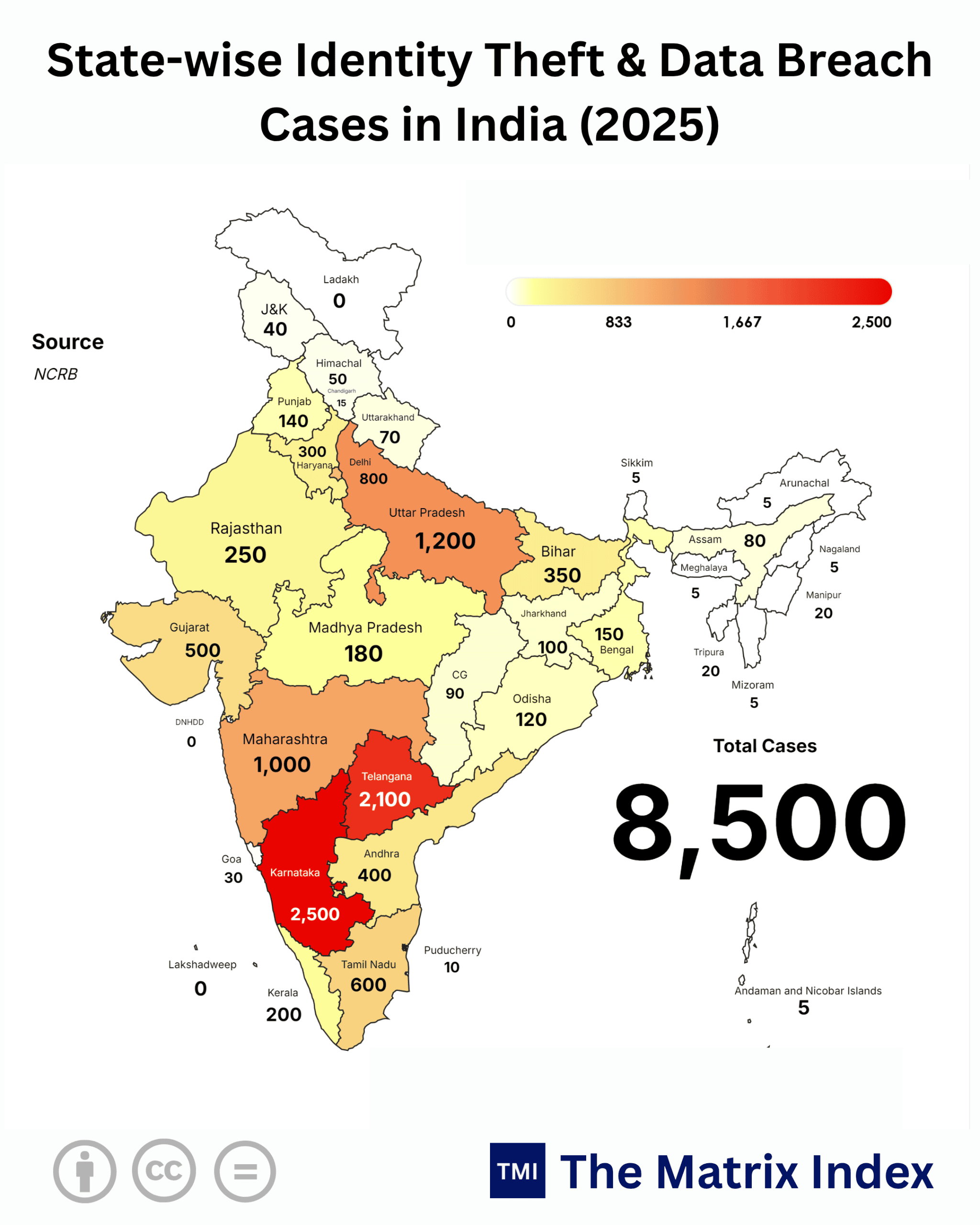
The aggregate balance sheet from 2025 confirms 8,500 officially registered identity theft and data breach cases across the territory of India. But let us strip away the official sanitized varnish immediately: any street-smart forensic investigator or seasoned chief information security officer knows that official registries capture only the clumsiest fraction of actual hostile infiltrations. In cybersecurity, what gets logged by law enforcement is merely the tip of a submerged continental shelf; what remains unlogged is an ocean of corporate cover-ups, unregistered breaches, quietly settled ransomware ransoms, and silent exfiltrations. The real story does not lie solely within the macro tally of 8,500 cases; it burns through the jagged, asymmetrical fault lines running across state borders, economic clusters, and governance jurisdictions.
Behind these raw digits sits a deeply unsettling pattern of institutional rot, cognitive dissonance among retail consumers, and profound asymmetric cyber warfare. The digital vault has been breached from within, and the keys are being sold in broad daylight.
The Silicon Siege: Why the Tech Corridors Turned Into Premier Kill Zones
Look closely at the top of the ledger. Karnataka stands crippled under 2,500 reported incidents, accounting single-handedly for 29.41% of the entire national footprint. Its immediate geographic and economic competitor, Telangana, clocks an alarming 2,100 cases, representing 24.71% of the total count.
Do the simple math: these two southern innovation corridors combined swallow 4,600 cases an astounding 54.12% of all data breaches and identity hijackings officially recorded across the entire Indian subcontinent in 2025.
Why is the beating heart of India’s enterprise SaaS, fintech innovation, software development, and deep-tech incubation suffering the most savage compromise?
The explanation is not that engineers down in Bengaluru’s Whitefield or Hyderabad’s HITEC City are suddenly technically incompetent. The foundational reality is far more cynical: value density and organizational bloat.
Over the past decade, these twin tech metropolises built towering, labyrinthine digital estates without establishing unified, zero-trust cryptographic moats. In financial operations, capital chases velocity, and velocity inevitably breeds structural compromise. Startups, scale-ups, and legacy IT conglomerates aggressively sprinted toward cloud microservices, software-defined networks, and porous third-party Application Programming Interfaces (APIs). They left backdoors cracked open in public cloud buckets, staging environments, and undocumented internal vendor test servers.
Furthermore, these states host the highest density of enterprise API endpoints and corporate credentials per square kilometer in South Asia. When an identity broker in Bucharest, Shenzhen, or Rawalpindi looks for industrial leverage, they do not scan barren rural networks. They systematically deploy brute-force harvesting, spear-phishing campaigns, and credential-stuffing scripts against the tech employees of Outer Ring Road and Gachibowli.
The human vector in these corridors is completely burned out. Exhausted dev-ops teams, mid-level managers drowning in continuous delivery sprints, and transient gig-economy contractors routinely bypass basic authentication hygiene to hit impossible software delivery deadlines. The result is catastrophic: one out of every two national breaches occurs within the economic engine rooms of Bengaluru and Hyderabad.
The Granular Breakdown: National Data Breach and Identity Theft Registry (2025)
The table below catalogs the absolute distribution of officially registered identity theft and data breach incidents across every administrative jurisdiction of India for the annual cycle of 2025, complete with structural vulnerability diagnostics:
(The Bitter Truth): This distribution proves that 89.41% of India’s aggregate identity compromises are clustered inside just 5 states and 1 union territory. This is not an equalized national cyber-risk; it is a hyper-targeted asymmetric assault against regions that generate over 45% of India’s direct taxes and national GDP.
The Northern-Western Corridor: Industrial Espionage and the Mass Biometric Bazaar
Pivot away from the software developers of Bengaluru and train your sights on the Hindi heartland and the western financial coast. Uttar Pradesh, clocking 1,200 cases (14.12%), presents a radically different threat pathology compared to Karnataka.
In Uttar Pradesh, breaches are not sophisticated attacks on complex distributed cloud stacks. Instead, they represent ruthless, street-level weaponization of the Aadhaar-Enabled Payment System (AePS) and the predatory spoofing of digital land records. This is the industrialization of identity theft targeting common citizens. High-resolution silicone fingerprint moulds, rogue Point-of-Sale (PoS) terminals in peri-urban cash-out points, and compromised telecommunications vendor portals have turned ordinary citizen records into digital trading cards. A villager’s demographic identity in Gorakhpur or Meerut is routinely purchased for as little as ₹50 on illicit Telegram networks, packaged with cloned biometrics, and used to drain direct benefit transfers (DBTs) before the victim even realizes their digital self has been duplicated.
Meanwhile, Maharashtra, logging 1,000 cases (7.06%), houses Mumbai the financial fortress of the Reserve Bank of India, Dalal Street, and corporate balance sheets. In Maharashtra, identity theft abandons the volume-play of the north and morphs into surgical, high-stakes corporate warfare.
We are tracking sophisticated corporate spear-phishing, Business Email Compromise (BEC) strikes that divert multi-million rupee trade lines, and inside-job data exfiltrations from non-banking financial companies (NBFCs). The hackers hitting Maharashtra are not after small welfare payouts. They are after the verified database of ultra-high-net-worth portfolios, privileged trading credentials, and real-time RTGS clearance conduits.
Then comes the National Capital Territory: Delhi, with 800 incidents (9.41%). The seat of political power is suffering from an endemic crisis of sovereign impersonation. Phishing campaigns targeting senior bureaucrats, military pension infrastructure breaches, and social-engineering rings operating out of surrounding satellite districts demonstrate that geographic proximity to power offers precisely zero cryptographic safety.
Notice the pattern: Karnataka, Telangana, UP, Maharashtra, and Delhi represent 7,600 of the 8,500 cases an overwhelming 89.41% concentration of India’s breach profile.
The Global Ledger: Where Does India Really Stand Against the Global Powers?
We must smash the naive myth that India is fighting this war in a vacuum. Let us bench-test India’s 2025 identity theft and data breach performance against the top Tier-1 and Tier-2 sovereign frameworks across the world:
The United States (Tier-1 Benchmark)
The United States processes tens of thousands of reported breaches annually, but their legislative structure operates with an iron fist. Under stringent Securities and Exchange Commission (SEC) regulations, public companies have an unforgiving 4-day window to disclose material cybersecurity breaches.
Federal bodies like the Cybersecurity and Infrastructure Security Agency (CISA) impose massive balance-sheet penalties on negligent corporate boards. If an American bank or cloud provider leaks 100,000 identities, shareholder lawsuits and institutional class actions hammer its equity market cap within hours.
In India, corporate breaches are persistently swept under the rug. Management boards consistently classify catastrophic structural leaks as “unauthorized server anomalies,” quietly paying off extortionists or relying on corporate non-disclosure agreements to evade scrutiny.
Germany and the European Union (Tier-1 Benchmark)
The German Federal Office for Information Security (BSI) enforces the European Union’s General Data Protection Regulation (GDPR) and the NIS2 Directive with mechanical precision. In Germany, failure to protect customer personal identifying information (PII) triggers statutory fines of up to €20 million or 4% of total worldwide annual turnover.
More importantly, the German standard demands sovereign cryptographic data sovereignty. They mandate end-to-end hardware-level security modules (HSM) for critical industrial and financial data.
India’s Digital Personal Data Protection Act (DPDP Act), while finally legislated, still battles regulatory inertia, slow setup of adjudication bodies, and an endemic enforcement deficit. Indian data fiduciaries still treat data compliance as an irritating administrative checklist rather than an existential architectural mandate.
Japan (Tier-1 Benchmark)
Japan’s National Center of Incident Readiness and Strategy for Cybersecurity (NISC) operates on structural air-gapping and zero-trust verification across its supply chains. While Japan battles an aging workforce, its industrial operational technology (OT) networks are among the most heavily defended on earth.
India’s manufacturing belts in Tamil Nadu (600 cases) and Gujarat (500 cases) are rapidly integrating modern Internet-of-Things (IoT) devices straight onto unsegmented public networks, leaving production lines and proprietary manufacturing designs wide open to foreign Advanced Persistent Threat (APT) units.
China (Tier-2 Benchmark)
Across the border, China approaches data security with an authoritarian mandate under its Data Security Law (DSL) and Personal Information Protection Law (PIPL). The Cyberspace Administration of China (CAC) classifies corporate data as an extension of state security.
If a Chinese tech executive allows an enterprise database to leak, the consequence is not a modest fine; it is immediate state detention, revocation of operational licenses, and the forced nationalization of digital assets. While Western democracies rightly reject that draconian police model, the operational takeaway is undeniable: Chinese tech platforms construct their digital architectures knowing that failure brings immediate, existential consequences.
Brazil and the UAE (Tier-2 Benchmarks)
Brazil’s LGPD has instituted sweeping class-action litigation cultures across South America. Meanwhile, the United Arab Emirates (UAE) has deployed state-backed sovereign cryptographic fabrics across Dubai and Abu Dhabi, penalizing identity spoofing with immediate asset freezing, passport cancellation, and swift deportation.
India sits caught in between: boasting the digital transaction volumes of the Tier-1 developed world, yet saddled with the enforcement mechanisms and judicial backlogs of an overwhelmed developing state.
The “So What?” Factor: The Brutal Macroeconomic Cascade
What does an ordinary citizen, an equity portfolio manager, or a factory owner care if Karnataka registers 2,500 breaches and Telangana clocks 2,100?
Let us trace the economic chain reaction. When an individual’s identity is harvested, it does not disappear into a vacuum. That identity is synthesized into synthetic profiles. In the modern fintech lending boom, unregulated digital loan apps and aggressive shadow-banking platforms use automated underwriting algorithms that issue loans in under 180 seconds.
Using a stolen Aadhaar number, a scraped PAN card, and a synthetic profile, illicit operators pull down instant credit lines. The innocent citizen only discovers their “default” when recovery agents descend upon their doorstep or their CIBIL credit score collapses by 200 points overnight.
Now scale that up from an isolated individual to systemic corporate exposure.
When 8,500 distinct entities are breached in a single year, the systemic cost of capital increases across the board. Banks, spooked by escalating digital fraud and non-performing asset (NPA) write-offs spawned by identity theft, raise the risk-premia on consumer retail loans. Enterprise cyber insurance premiums in India surged by double digits in the 2024–2026 cycle alone.
Who pays for that? The end-user does. Every digital onboarding, every insurance policy, every banking transaction quietly incorporates a hidden “cyber-risk surcharge.”
For the investor, the ripple effect is even more toxic. If a mid-tier IT vendor or fintech unicorn based in Hyderabad experiences an undisclosed data breach, its enterprise value is living on borrowed time. The moment a critical vulnerability is flagged by institutional overseas clients, Western enterprise contracts are canceled without warning under stringent foreign compliance covenants.
Data breaches are no longer trivial IT incidents; they are direct balance-sheet landmines that can wipe out corporate valuations overnight.
Seasonality & Anomaly Alert: The Holiday Surge and the Zero-Breach Fallacy
A forensic analysis of the 2025 data reveals that digital breach activity is neither flat nor random across the calendar year. There are explicit seasonal anomalies that drive these spikes:
Breach incidents do not surge evenly. They hit a critical, sustained crescendo between September and December the golden Indian festive quarter.
During this window, consumer spending spikes dramatically. Digital transaction velocity skyrockets across Unified Payments Interface (UPI) gateways, buy-now-pay-later (BNPL) rails, and e-commerce platforms.
Corporate cyber defenses are deliberately relaxed to avoid transaction drops, and customer verification friction is minimized to chase top-line revenue. Criminal syndicates know this operational blind spot intimately. They save their most potent, automated credential-stuffing botnets for the Diwali and year-end sales corridors, turning operational velocity into wholesale compromise.
Now, examine the anomalous tail of the table: Ladakh (0), Dadra and Nagar Haveli and Daman and Diu (0), and Lakshadweep (0).
Do not celebrate these zeros. In forensic analytics, a zero is rarely evidence of absolute safety; it is almost always proof of systemic blindness.
These regions operate with negligible local cyber forensic infrastructure, fragmented police technical wings, and minimal institutional reporting pipelines. Breaches occur, but they go completely undetected, unclassified, and unrecorded.
To mistake an absence of measurement for an absence of crime is the most dangerous error an economic strategist can commit.
The Bull vs. Bear Case: India’s Cyber Security Horizon (2026–2030)
The choices made by regulators, corporate boards, and institutional investors today will dictate India’s digital trajectory through the end of the decade. There are two distinct paths ahead:
The Bull Case: The Cryptographic Fortress
In this trajectory, the Data Protection Board of India (DPBI) shifts from a prolonged administrative incubation phase into aggressive, unsparing enforcement by late 2026.
Fines of ₹250 Crore are leveled against negligent banks, irresponsible cloud operators, and non-compliant fintech firms without political favoritism. This regulatory discipline forces a rapid corporate transition: boards stop spending pennies on outdated antivirus software and invest heavily in enterprise Zero Trust Architecture (ZTA), hardware-level data tokenization, and decentralized biometric hashing.
Under this scenario, India’s cybersecurity industry blossoms into a $25 Billion sovereign vertical by 2030. Global institutional funds, looking to derisk from autocratic regimes, view India not merely as a high-volume market, but as a cryptographically resilient, high-trust digital sanctuary.
Reported breach figures may initially spike as reporting compliance becomes mandatory, but real financial losses and identity weaponization crater.
The Bear Case: The Digital Wild West
In the alternative scenario, regulatory capture takes hold. The DPDP Act continues to be diluted through broad exemptions, protracted legal stays, and hollow enforcement decrees.
Corporations treat cybersecurity as an annoying public relations risk rather than a core infrastructure imperative. The dark-web syndicates operating out of Eastern Europe, Southeast Asian cyber compounds, and domestic hubs like Jamtara and Mewat modernize exponentially faster than local law enforcement can keep up.
By 2028, identity theft incidents surge past 25,000 cases annually, bleeding billions in retail deposits and commercial intellectual property. As a direct result, Western multinational corporations, citing unmitigated enterprise contagion risks, freeze the flow of sensitive software architecture and analytics pipelines to Indian outsourcing hubs, gutting tech export earnings and damaging employment in Bengaluru, Hyderabad, and Pune.
Strategic Counter-Narrative: What If the Machine Fails?
Let us play devil’s advocate. What happens if our entire fundamental framework of digital onboarding is fatally flawed?
What if the global cybersecurity paradigm of the last fifteen years centralized digital IDs, continuous cloud consolidation, dynamic KYC, and continuous API connectivity is an inherently compromised strategy?
Consider a plausible alternative scenario: a critical vulnerability is weaponized within national central authentication repositories, or quantum-computing breakthroughs crack standard asymmetric public-key cryptography (RSA/ECC) ahead of institutional post-quantum migration schedules. Overnight, every registered Aadhaar-linked verification, every centralized bank database, and every commercial digital footprint is compromised.
What is the operational backup plan?
If policies or market realities shift suddenly toward this catastrophic outcome, the current institutional focus on cloud-native identity becomes an active vulnerability.
The backup plan requires an immediate, strategic pivot toward decentralized, verifiable credentials (DVCs) stored locally on encrypted hardware tokens, entirely disconnected from a continuous, centralized state registry. It would necessitate a return to air-gapped cryptographic hardware ledgers for institutional settlement, and zero-knowledge proofs (ZKPs) where zero identifiable citizen data is ever retained by private fiduciaries.
If this paradigm shift strikes, the capital currently being poured into traditional, monolithic cloud architectures will become a stranded asset overnight.
Comprehensive Cyber-Sovereignty Action Matrix
To pull the nation back from this precipice, corporate executives, board directors, and policy strategists must stop issuing empty public relations memos and enforce ruthless operational accountability across their systems:
(The Golden Opportunity): The nations that successfully solve the identity integrity crisis will secure global institutional capital for the next half-century. If India acts decisively, it can turn this domestic vulnerability into an unmatched competitive advantage, building an exportable, post-quantum cyber defense industry for the entire Global South.
My Verdict: The Long March to 2030 and Vision 2047
Look around you: an entire generation of Indian citizens has been onboarded onto the digital highway at breakneck speed, handed high-speed telecom connectivity, digital banking apps, and centralized identification, but given precisely zero cryptographic self-defense education.
We handed Ferraris to millions of people who were never taught how the brakes work, and we are now acting surprised that the roadside is littered with wreckage.
Old Indian wisdom reminds us: The truth stands plainly before us, requiring no clever rationalization. The 2025 ledger of 8,500 data breaches is not a series of isolated digital infractions. It is an unvarnished indictment of an institutional framework that has pursued digital growth while treating cybersecurity as an afterthought.
If India is to preserve its ambitious march toward Vision 2030 and achieve the status of a developed nation by Vision 2047, this systemic vulnerability must be aggressively eradicated.
You cannot build a $30 Trillion sovereign economic superstructure upon a foundation of rotting cryptographic sand.
My Direct Call-to-Action
-
For Enterprise Leaders and Boards: Terminate the practice of quiet settlements and internal data cover-ups. Transition every legacy application to Zero-Trust Architecture and mandate continuous, red-team penetration testing. Treat citizen data with the same rigorous fiduciary care you give to sovereign treasury reserves.
-
For the Regulatory Apparatus: Activate the full punitive powers of the Data Protection Board. Issue landmark fines that force corporate boardrooms to take cybersecurity seriously.
-
For the Everyday Consumer: Strip away the comfortable delusion that your digital identity is private. Revoke unnecessary application permissions, freeze dormant credit lines, mandate multi-factor hardware keys on all primary financial accounts, and assume your static credentials are already out in the wild.
The clock is ticking down. The phantom underbelly of our digital revolution is growing bolder with every transaction. Either we dismantle the architecture of this systemic vulnerability today, or we resign ourselves to living in a digital ecosystem where our digital identities are completely co-opted.
GOOGLE ‘PEOPLE ALSO ASK’ FAQs
Which Indian states recorded the highest identity theft and data breach cases in 2025? 54.12% of India’s 8,500 registered breaches in 2025 were concentrated in Karnataka (2,500) and Telangana (2,100). Uttar Pradesh followed with 1,200 incidents, while Maharashtra logged 1,000 cases and Delhi registered 800.
Why do Karnataka and Telangana account for over half of India’s cyber breaches? 4,600 of 8,500 national incidents strike these two innovation corridors due to hyper-dense enterprise API endpoints, rapid cloud deployment, and severe third-party vendor bloat. High-value software ecosystems make Bengaluru and Hyderabad primary targets for international credential-stuffing cartels.
How does systemic identity theft directly affect ordinary retail consumers? ₹50 buys cloned demographic and biometric profiles on dark web channels, enabling illicit syndicates to draw instant 180-second fintech loans. Victims face sudden 200-point CIBIL credit score collapses and predatory recovery actions before discovering their credentials were duplicated.
What financial penalties does the DPDP Act impose on non-compliant Indian enterprises? ₹250 Crore represents the statutory maximum penalty per major breach under India’s Digital Personal Data Protection Act framework. Regulatory enforcement penalizes corporate boards that fail to maintain zero-trust security architecture or conceal systemic personal data compromises.
What is the projected economic loss if India fails to curb data breaches by 2030? 25,000 annual identity compromises are projected by 2028 under a failure scenario, threatening India’s $1 Trillion digital economy roadmap toward Vision 2030. Escalating enterprise contagion risks could trigger global corporate contract cancellations and inflate systemic banking credit costs.
Data Source:
- Indian Computer Emergency Response Team (CERT-In)
- Ministry of Home Affairs
- Indian Cybercrime Coordination Centre
- National Crime Records Bureau (NCRB)
- Data Protection Board of India (DPBI).
Disclaimer: This report is for informational and analytical purposes only and does not constitute formal financial, investment, or policy advice.