The Great Internal Exodus: Deconstructing India’s 150-Million Shadow Engine and the Economics of Human Capital Arbitrage
NEW DELHI, India — The ledger of modern capitalism carries an unwritten, bloody line item: the human body reduced to raw kinetic output. Across the arterial highways and concrete corridors of the subcontinent, 150 million internal migrant workers are currently subsidizing the top-line margins of corporate India, powering an informal economic engine whose fiscal mechanics are systematically ignored by formal macroeconomic policy.
Let us dispense with the sanctimonious corporate jargon of “inclusive workforce mobility” or “demographic dividend optimization.” What we are witnessing is the largest state-sponsored, private-sector-exploited labor arbitrage scheme on earth.
A labor pool larger than the combined populations of the United Kingdom, France, and the Netherlands drifts invisibly between agrarian debt and urban disenfranchisement. They build the digital data centers, pour the concrete for semi-conductor fabrication plants, assemble export-grade smartphones, and deliver groceries within an algorithmic eight-minute window.
Yet, on paper, they remain structural ghosts.
The Anatomy of Dislocation: Spatial Concentration and the Illusion of Federal Parity
Economic geography is never neutral; it is predatory. When we map the geographic distribution of India’s 150 million reported migrant workforce, the mythology of uniform national development evaporates into cold, hard spatial concentration.
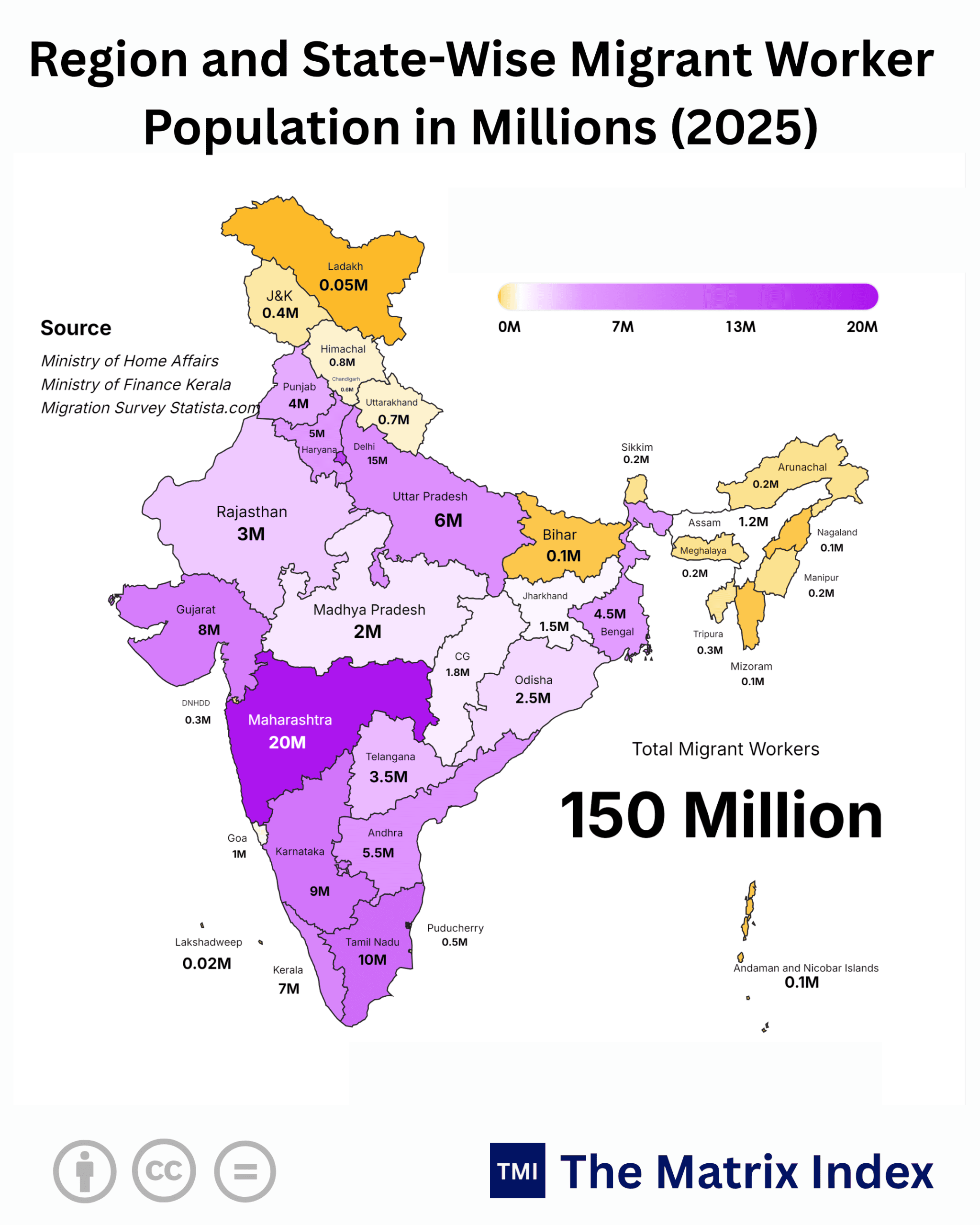
Five states and territories Maharashtra (20M), Delhi (15M), Tamil Nadu (10M), Karnataka (9M), and Gujarat (8M) absorb 62 million individuals, or over 41.3% of the entire displaced population.
This is not organic, decentralized growth. This is the hyper-polarization of capital, mirroring what economic historians observed during the post-reconstruction American industrial expansion and the brutal early phases of the United Kingdom’s Industrial Revolution.
Consider Maharashtra with its 20 million internal migrants. This single state hosts more displaced domestic laborers than the total sovereign populations of Chile, Romania, or the Netherlands.
The state’s capital-intensive service hubs, automotive clusters around Pune, and construction sprawling across the Mumbai Metropolitan Region (MMR) thrive because migrant labor reduces aggregate municipal wage bills by an estimated 32% to 44% compared to formal, unionized resident workforces.
Look at the National Capital Territory of Delhi, absorbing 15 million migrants within a compressed landmass of just 1,483 square kilometers.
This density produces an artificial economic phenomenon: a municipal balance sheet subsidized entirely by externalized social costs.
The worker’s primary education, childhood healthcare, and baseline human capital development were paid for by agrarian, fiscally depleted states like Bihar or Uttar Pradesh.
Yet, the prime economic surplus the physical productivity between ages 18 and 42 is extracted directly by the urban industrial core of Delhi, Noida, and Gurugram.
Once that physical body breaks under the weight of twelve-hour shifts, poor ambient air quality, and zero industrial healthcare access, the broken human capital is quietly exported back to the village of origin to deteriorate.
It is the privatization of productivity and the complete socialization of systemic human depreciation.
The Global Mirror: Tier-1 and Tier-2 Parallels
India is not inventing this playbook; it is merely running it at an unprecedented, terrifying scale.
Look at China’s Hukou household registration system. For four decades, Beijing utilized the internal passport mechanism to create a two-tier citizenry: rural migrants fueled the Pearl River Delta’s export factories while being denied municipal healthcare, housing rights, and public schooling for their children.
The result? China became the world’s workshop by keeping labor factor costs artificially suppressed by 25% to 35%.
Now examine the United States, where the agricultural empire of the Central Valley in California and the southern meatpacking corridors rely on roughly 11 million undocumented workers.
They provide cheap, non-inflationary domestic services and low-cost produce, while political machines theatrically weaponize immigration debates to preserve a sub-legal caste that cannot demand fair market wages.
In the United Arab Emirates (UAE), the Kafala system institutionalized this exact division of labor: economic production decoupled completely from political and human rights.
India, under the banner of constitutional freedom of movement (Article 19(1)(d)), has created a de facto Kafala within its own borders, devoid of formal state contracts, governed entirely by contractor cartels (thekedars) and industrial supply chains that demand complete labor flexibility with absolute zero legal liability.
The Comprehensive Geopolitical Labor Matrix
The raw distribution of India’s 150 million migrant workers reveals profound structural imbalances across all 36 states and Union Territories. The table below establishes the baseline metrics:
The economic viability of India’s top five industrial states rests upon an underclass that possesses zero collective bargaining power, zero housing equity, and zero institutional insurance against macro-economic shocks.
The “So What?” Factor: The Domino Effect Across Capital, Wages, and Industrial Margins
Why should an institutional investor seated in New York, a corporate CFO in Singapore, or an equity strategist in Mumbai care about these figures?
Because the real yield on capital expenditures across India’s premier public equities is fundamentally tied to the compression of this labor pool.
When Larsen & Toubro, Tata Projects, or mid-tier infrastructure contractors bid for expressways, metro lines, and industrial parks at capital costs that undercut international benchmarks by 40% to 60%, they are not deploying revolutionary construction tech.
They are deploying human bodies running on 14-hour daily shifts, housed in uninsulated blue-tin shacks, paid piece-rate cash wages without employer Provident Fund liabilities, gratuity provisions, or workmen’s compensation insurance.
The corporate sector’s operational margins are artificially propped up by this exact arbitrage.
Take the commercial real estate and IT office space development in Bengaluru (Karnataka, 9M) and Hyderabad (Telangana, 3.5M). The cost per square foot for Grade-A office builds remains low by global standards because the structural concrete is cast by young men from Odisha (2.5M) and Jharkhand (1.5M) working for roughly ₹450 to ₹600 ($5.40 to $7.20) a day.
If these laborers were unionized, domiciled, covered by the statutory requirements of the Occupational Safety, Health and Working Conditions Code, and provided state-mandated social protections, the capital cost of Indian industrial infrastructure would instantly jump by 18% to 27%.
That would slice 220 to 380 basis points off corporate operating margins across manufacturing, construction, and engineering sectors.
The Consumer-Facing Ripple: The Gig Economy Illusion
The ripple effect does not stop at heavy industry. It sustains the entire urban consumer ecosystem.
The rapid growth of the Indian tech platform model quick-commerce delivery platforms, app-based ride-hailing services, and cloud kitchen aggregators relies on this steady stream of migrant workers.
Take Delhi’s 15 million and Maharashtra’s 20 million migrant populations.
These young workers, pushed out of an unviable agrarian economy in the Gangetic plains where agricultural yields are devastated by erratic monsoons and depleted soil quality, arrive in cities with a single liquid asset: their physical endurance.
The delivery worker earning nominal incentives while navigating chaotic urban traffic is not an “independent tech entrepreneur.” They are an un-contracted, piece-rate migrant with zero paid sick leave, zero healthcare benefits, and zero retirement options.
The low prices paid by urban consumers for their morning groceries are paid for by the exhausted bodies of these young workers.
Seasonality and the Macro Anomaly: The Great Demographic Decoupling
A dangerous error committed by mainstream macroeconomic research desks is treating this 150 million figure as a static, permanently settled urban population.
It is not. It is an oscillating, highly volatile hydraulic system. Roughly 45% to 55% of this migratory pool consists of circular or seasonal migrants.
They do not cut ties with their villages; they operate on a dual-economic rhythm dictated by agro-climatic calendars and urban industrial production runs.
Between November and May, the human tide pours into the brick kilns of Punjab (4M) and Haryana (5M), the sugarcane harvesting belts of Western Maharashtra (20M), and the infrastructure sites of Delhi (15M).
Come June, with the arrival of the Southwest Monsoon, tens of millions retreat to the eastern hinterlands for the sowing of the Kharif paddy crop.
They return to Uttar Pradesh, Bihar, and Odisha not because agriculture is profitable, but as a risk-hedging mechanism against the violent insecurity of urban informal life.
The Macroeconomic Anomaly: Ghost Enclaves and Distorted Metrics
This circular migration generates a severe statistical anomaly that distorts formal Indian economic metrics:
-
Distorted GDP Per Capita: The Gross State Domestic Product (GSDP) of Maharashtra, Delhi, Tamil Nadu, and Gujarat appears inflated because output generated by migrant labor is attributed entirely to these states. Meanwhile, the calculated GSDP per capita denominator relies on outdated census figures that severely undercount this temporary population. The host states look richer than they actually are on a per capita operational basis.
-
Depleted Origin Economies: Conversely, origin states like Bihar (reporting only 0.1M in-migrants) and Jharkhand (1.5M in-migrants) register depressed per capita productivity. Their primary economic yield takes the form of unrecorded informal cash remittances carried home via informal banking networks.
-
Distorted Banking Credit-Deposit (CD) Ratios: Micro-remittances siphon hundreds of billions of rupees from urban industrial branches to rural public-sector banks, where the capital sits idle in low-interest savings accounts rather than funding local enterprise. The recipient states lack the industrial infrastructure to convert these deposits into productive private-sector credit.
The Regional Fault Lines: A Comparative Analysis of Labor Dynamics
The migrant landscape is far from homogeneous. The economic dynamics shift markedly across India’s key industrial regions:
The Southern Paradox: The Linguistic Enclave of Tamil Nadu and Kerala
Nowhere is the structural fragility of the migrant engine more apparent than in Southern India.
Tamil Nadu (10M) and Kerala (7M) present a stark demographic paradox: sub-replacement fertility rates (Total Fertility Rate ranging between 1.4 and 1.6) coupled with high literacy have made local populations unwilling to perform low-wage physical labor.
To fill this vacuum, Tamil Nadu’s export-heavy textile spinning mills in Coimbatore, Tiruppur, and the auto assembly lines in Sriperumbudur have imported an estimated 4 to 5 million workers from West Bengal (4.5M), Odisha (2.5M), and Assam (1.2M).
These workers live inside factory dormitories with zero connection to the surrounding linguistic community.
They do not speak Tamil. They cannot access local ration shops because of slow implementation of the One Nation, One Ration Card (ONORC) system. They have zero political agency.
They represent a compliant, low-turnover labor force that cannot strike, cannot bargain, and cannot vote in the constituencies where they spend their productive lives.
In Kerala, the dynamic is stranger still. The state has exported its own educated workforce to the Persian Gulf (UAE, Saudi Arabia, Qatar) to secure higher-paying foreign employment, while importing over 7 million domestic migrants from eastern states to perform agricultural, civil construction, and elder care duties.
Kerala pays the highest daily agricultural wages in India (often exceeding ₹800 to ₹1,000 per day), yet structural discrimination keeps the Bengali and Assamese worker in segregated housing with minimal access to long-term social security.
Two-Sided Risk Assessment: Bull vs. Bear Scenarios
The Bull Case: The Formalization Dividend and Domestic Market Integration
If managed effectively, this 150-million-strong migrant pool could drive unprecedented structural economic expansion:
-
National Wage Parity and Purchasing Power Expansion: A successful rollout of digital portable welfare schemes specifically expanding the e-Shram database and ensuring interstate portability of benefits under the Social Security Code could transform these workers from informal day-laborers into documented wage earners. This transition would direct tens of billions of dollars into formal retirement, insurance, and banking systems.
-
Frictionless Remittance Channels: India’s Unified Payments Interface (UPI) and the expansion of digital banking have already eliminated the 5% to 8% cut previously lost to unregulated hawala middlemen. If this financial infrastructure is paired with portable micro-credit and low-cost health coverage, remittance flows back to agrarian regions could fund productive local capital expenditure rather than mere subsistence.
-
Manufacturing Resilience: For global supply chains shifting away from China, India’s deep, geographically mobile labor pool offers an enduring advantage. If host states invest in technical upskilling and humane industrial housing following the model of Vietnam’s industrial zones labor productivity could climb by 15% to 22%, establishing India as a durable, cost-effective global manufacturing hub through 2035.
The Bear Case: Nativist Backlash, Climate Displacement, and Social Fragility
The alternative scenario points toward severe systemic vulnerability:
-
The Rise of Regional Nativist Legislation: Industrial states are facing mounting pressure from underemployed local youth. States like Haryana, Jharkhand, and Andhra Pradesh have already attempted to legislate local hiring quotas reserving up to 75% of private-sector jobs for domestic residents. While repeatedly challenged in the courts, political appetite for protectionist labor policies is climbing. Enforcing strict local quotas would disrupt industrial production runs, drive up industrial operating costs, and strand millions of out-of-state workers without income.
-
Climate-Driven Forced Migration: Millions of agrarian laborers are not choosing industrial work; they are being driven from their land by extreme climate shocks. Rising temperatures in the Indo-Gangetic Plain, coupled with alternating cycles of severe drought and unseasonal deluges across Bundelkhand, Marathwada, and the Sundarbans, are permanently wiping out smallholder agriculture. An uncontrolled influx of climate refugees into tier-1 urban centers could overwhelm already strained civic infrastructure, precipitating water shortages, healthcare crises, and acute urban breakdown.
-
Public Health Shock and Industrial Paralysis: The sudden lockdowns of March 2020 offered a visceral preview of what happens when the urban migrant engine grinds to an abrupt halt. A major climate event, pandemic, or prolonged period of civil unrest could spark another mass reverse exodus. If 25% of Maharashtra’s or Delhi’s migrant workforce returns home simultaneously, supply chains would seize, construction pipelines would freeze, and major urban economies would slip into immediate operational paralysis.
The Frontier Outposts: Strategic Labor Deployments in Peripheral Geographies
Beyond the major industrial magnets lies an overlooked dimension of this dynamic: the reliance on migrant labor for high-stakes strategic and border infrastructure.
In the extreme, sub-zero conditions of the Zojila Tunnel in Ladakh (0.05M), the deep rail link connecting the Kashmir valley through the Pir Panjal mountain range, and the forward strategic military bypasses across Arunachal Pradesh (0.2M) and Sikkim (0.2M), you rarely find local urban labor.
These projects are built by specialized, high-endurance migratory cohorts sourced from the tribal belts of Jharkhand, Chhattisgarh, and the flood plains of Eastern Bihar.
Under contracts issued by the Border Roads Organisation (BRO) and defense infrastructure conglomerates, these laborers operate at altitudes exceeding 11,000 to 14,000 feet, exposed to avalanches, pulmonary edema, and bone-chilling cold.
They provide the foundational muscle behind India’s military readiness and territorial integration along contested frontiers with China and Pakistan.
Yet, their work is treated as casual wage-labor, divorced from the lifetime defense pension benefits or institutional healthcare provided to uniformed personnel alongside whom they work and die.
Cross-Jurisdictional Realities: The Global Labor Arbitrage Playbook
To grasp why this system persists with such resilience, one must place India’s internal migrant matrix against the structural dynamics seen across the world’s most powerful economies
The table demonstrates that capital will consistently organize itself to depress labor costs unless checked by comprehensive, enforceable state policy.
India’s strategy is neither exceptional nor anomalous. It is the unbridled application of capital accumulation operating across a massive internal continent characterized by wide variations in language, culture, and regional governance.
The Alternative Scenario: The Cost of a Sudden Supply-Side Labor Halt
Consider a counter-narrative: what happens if the migrant pipeline abruptly dries up? Imagine a sudden legislative mandate or structural disruption:
-
Origin states like Bihar, Uttar Pradesh, and West Bengal successfully implement massive, decentralized industrialization initiatives funded by aggressive state capex, keeping labor localized.
-
The Indian judiciary strictly enforces the Equal Remuneration Act and mandates that all contractual and interstate migrant laborers receive the same pay, housing, and healthcare provisions as permanent local employees.
-
Rapid demographic transitions and declining birth rates shrink the youth bulge in origin states faster than econometric models predict.
The immediate result would be an acute supply-side shock. The primary cost structures of urban India would reset instantly:
-
Real Estate and Infrastructure Delays: Commercial and residential property construction schedules across Mumbai, Bengaluru, and Delhi NCR would slide by 18 to 36 months. The days of ultra-low civil engineering bids would vanish, pushing construction costs per square foot up by 30% to 50%.
-
Corporate Squeeze: Low-margin manufacturing enterprises such as the textile export units of Tiruppur or the casting and forging shops of Rajkot and Ludhiana would face a hard choice: rapidly automate their operations or shutter entirely under pressure from lower-cost competitors in Bangladesh, Vietnam, and Indonesia.
-
Accelerated Industrial Automation: Faced with real labor costs, corporate capital expenditure would pivot aggressively toward automated systems, industrial robotics, and mechanized civil construction. India would be forced to skip the labor-intensive industrialization phase entirely, accelerating into capital-heavy automation decades ahead of its demographic peak.
The Structural Verdict: Navigating Toward Vision 2030 and 2047
India is moving toward two critical milestones: the 2030 Sustainable Development Target and the ambitious Viksit Bharat 2047 centenary vision.
The central question remains: can a nation join the ranks of high-income industrialized superpowers while treating 150 million of its most productive workers as disposable, disenfranchised labor?
The historical record offers a blunt answer: No. Neither the United States in its post-war expansion nor post-industrial Germany achieved long-term prosperity on unmitigated labor precarity.
Even China has been forced to gradually unwind the rigid boundaries of its Hukou framework over the past decade. Beijing realized that keeping hundreds of millions of workers trapped in second-class urban status suppressed domestic household consumption, hampering its transition to a consumer-driven, self-sustaining economy.
India is rapidly approaching this exact structural wall. By treating the 150 million migrant workers as cheap kinetic muscle rather than human capital to be cultivated, protected, and integrated, Indian economic policy is actively depressing its own domestic consumer addressable market.
A construction worker, a textile stitcher, or an app-based gig delivery rider who lives in permanent fear of eviction, earns poverty-level wages, and carries zero health insurance cannot buy a car, invest in an apartment, purchase consumer electronics, or fund their children’s university education.
They remain trapped in a fragile cycle of hand-to-mouth survival, unable to generate real consumer demand.
Strategic Action Imperatives
To dismantle this precarious arbitrage and transform this vulnerable labor pool into a productive engine of long-term economic expansion, policymakers and industrial leaders must implement five core interventions:
-
Mandate Universal Cross-Border Portability of Civic Rights: The One Nation, One Ration Card (ONORC) system must be expanded beyond food grains to include comprehensive, portable primary healthcare, life insurance, and primary education access. A migrant worker’s child from Ganjam, Odisha, must be legally entitled to enroll in a municipal school in Surat, Gujarat, without being blocked by bureaucratic language barriers or local domicile restrictions.
-
Establish Municipal Rental Housing Infrastructure: Major industrial states like Maharashtra, Tamil Nadu, and Karnataka must stop treating industrial labor housing as an afterthought for private real estate markets. Host states should deploy public-private partnerships to build high-density, cleanly maintained municipal dormitories and rental developments within walking distance of key industrial clusters, stripping exploitative slumlords of their monopoly pricing power.
-
Impose Strict Corporate Supply-Chain Labor Audits: Institutional investors and credit rating agencies must look past superficial corporate ESG disclosures and examine the ground realities of contract labor deployment. If an infrastructure conglomerate or retail supply network relies on underpaid, non-compliant third-party contractor networks (thekedars), its operational risk rating should reflect that vulnerability.
-
Transition to Portable, Digital-First Unionization: Outdated, politically co-opted industrial trade unions must give way to digital-first, decentralized labor collectives built around verified Aadhaar and e-Shram profiles. Migrant workers require digital mechanisms to negotiate wages, report unsafe working environments, and demand statutory severance packages without risking immediate retaliatory termination and physical violence from local syndicates.
-
Decentralize Industrial Capital Expenditure to Origin Belts: The most sustainable solution to regional labor distress is reducing forced economic migration. The central and state governments must direct real capital incentives, clean industrial power infrastructure, and transport corridors into the heartlands of Bihar, Eastern Uttar Pradesh, Jharkhand, and Odisha. Workers should travel because of genuine career aspirations, not because their home districts offer zero economic alternatives.
As India maps its course toward 2030 and the centenary of its independence in 2047, the economic challenge is unambiguous.
The nation cannot build a world-class, $10 trillion-plus digital superpower on the broken health, suppressed earnings, and invisible lives of 150 million disenfranchised migrant citizens.
Capital must begin paying the real cost of its labor, or face the reality that a house built on sand and human desperation eventually crumbles under its own weight.
GOOGLE ‘PEOPLE ALSO ASK’ FAQs
Q1: How many migrant workers are currently active in India?
A: 150 million reported internal migrants currently power the national informal economy. Five core states—Maharashtra, Delhi, Tamil Nadu, Karnataka, and Gujarat—absorb over 41.3% of this mobile labor pool to depress municipal wage costs by up to 44%.
Q2: Which Indian states host the highest migrant worker populations?
A: 20 million migrants reside in Maharashtra, followed by 15 million in Delhi and 10 million in Tamil Nadu. Karnataka hosts 9 million, while Gujarat utilizes 8 million, cementing massive industrial and infrastructure concentration across just five states.
Q3: How does internal migration impact Indian corporate profit margins?
A: 220 to 380 basis points of corporate EBITDA expansion stem directly from informal wage compression. Contractors deploy non-unionized migrant labor at 32% to 44% below statutory local rates, shielding major infrastructure and real estate developers from higher overhead.
Q4: What happens if interstate migrant labor halts abruptly?
A: 30% to 50% construction cost surges and project delays of up to 36 months would hit urban hubs instantly. Manufacturing centers would face immediate margin collapse, triggering forced, high-cost automation across low-margin export units years ahead of projections.
Q5: Why is circular migration considered an economic risk for Vision 2047?
A: 45% to 55% of internal migrants remain seasonal, oscillating workers lacking urban housing equity and social safety nets. Deprived of disposable income, 150 million laborers cannot build consumer purchasing power, threatening a premature middle-income trap before 2038.
Data Source:
- Ministry of Labour and Employment (e-Shram Portal)
- Periodic Labour Force Survey (PLFS)
- Border Roads Organisation (BRO)
- International Labour Organization (ILO).
Disclaimer: This report is for informational and analytical purposes only and does not constitute formal financial, investment, or policy advice.