The Sovereign Digital Hemorrhage: Inside the $900 Billion Shadow Tax Weaponizing the American Suburb and the Global Contagion Risk
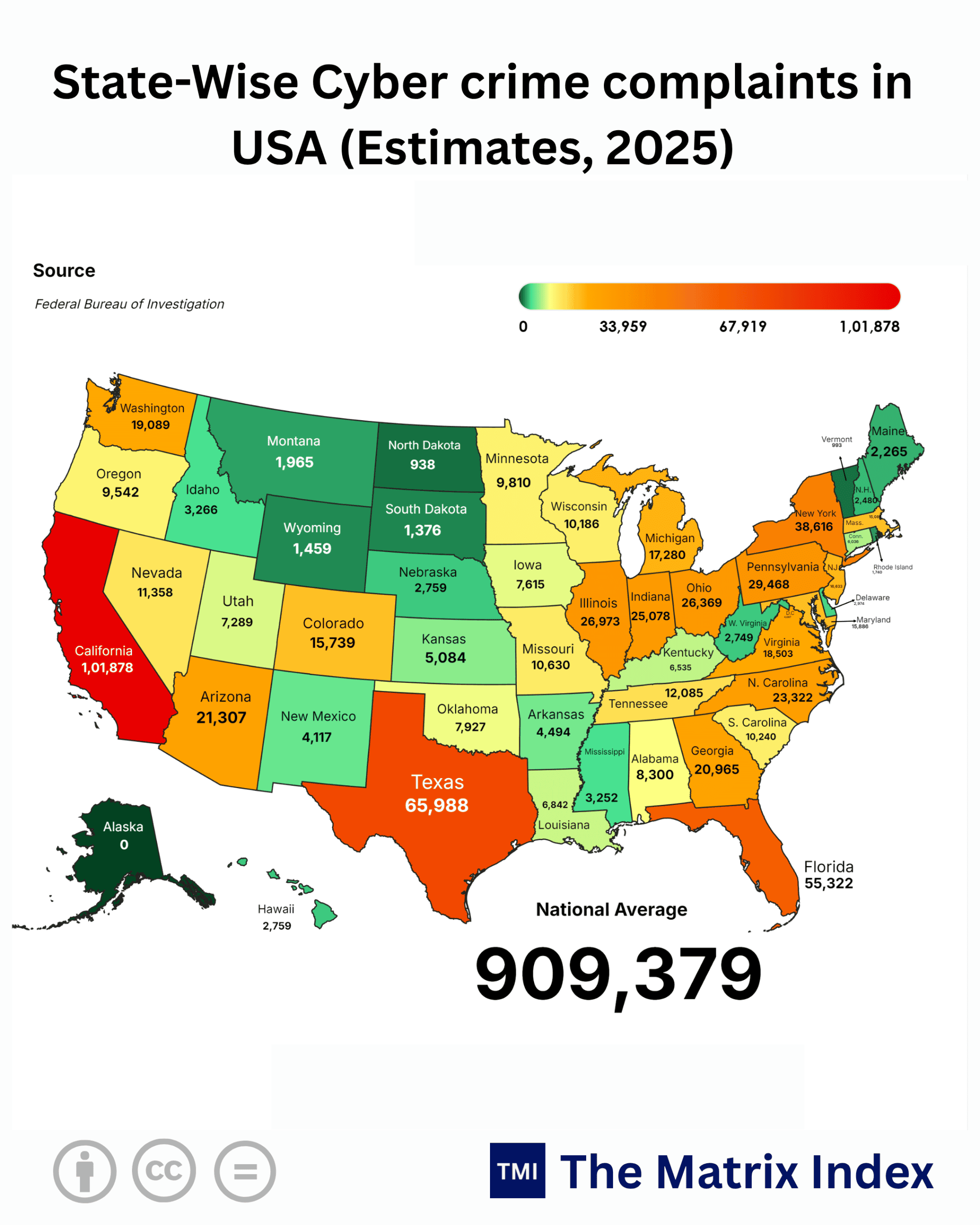
| State | Cyber Crime Complaints (Estimates, 2025) |
|---|---|
| California |
1,01,878 |
| Texas |
65,988 |
| Florida |
55,322 |
| New York |
38,616 |
| Pennsylvania |
29,468 |
| Illinois |
26,973 |
| Ohio |
26,369 |
| Indiana |
25,078 |
| N. Carolina |
23,322 |
| Arizona |
21,307 |
| Georgia |
20,965 |
| Washington |
19,089 |
| Virginia |
18,503 |
| Michigan |
17,280 |
| Colorado |
15,739 |
| Maryland |
15,896 |
| Nevada |
11,358 |
| Missouri |
10,630 |
| Wisconsin |
10,186 |
| S. Carolina |
10,240 |
| Oregon |
9,542 |
| Minnesota |
9,810 |
| Alabama |
8,300 |
| Tennessee |
12,085 |
| Oklahoma |
7,927 |
| Iowa |
7,615 |
| Utah |
7,289 |
| Louisiana |
6,842 |
| Kentucky |
6,535 |
| Kansas |
5,084 |
| Arkansas |
4,494 |
| New Mexico |
4,117 |
| Idaho |
3,266 |
| Mississippi |
3,252 |
| W. Virginia |
2,749 |
| Nebraska |
2,759 |
| Hawaii |
2,759 |
| Maine |
2,265 |
| N.H. (New Hampshire) |
2,480 |
| Montana |
1,965 |
| South Dakota |
1,376 |
| Wyoming |
1,459 |
| North Dakota |
938 |
| Vermont |
993 |
| Massachusetts |
18,332 |
| New Jersey |
24,659 |
| Connecticut |
6,698 |
| Delaware |
2,374 |
| Rhode Island |
1,780 |
| Alaska |
0 |
| National Total / Sum |
909,379 |
NEW DELHI, India (October 23, 2026 / IST) — Look past the polished earnings calls and the sterile macroeconomic dashboards churned out by central banks; the real balance sheets of the free world are being forged in an invisible meat grinder. Across the United States, an astonishing 909,379 state-level cybercrime complaints were logged in 2025, representing not merely a litany of breached logins or fraudulent debit swipes, but a devastating, state-sanctioned siphoning of middle-class capital straight into transnational organized syndicates. While Wall Street obsesses over basis-point rate cuts and treasury yields, criminal syndicates in Southeast Asia, Eastern Europe, and rogue states have effectively levied an untaxed, unregulated tribute on American wealth.
If this were a physical land grab, an invading adversary walking away with hundreds of billions of dollars across sovereign territory, the National Guard would be deployed at state borders. Instead, because it happens through silently compromised fiber-optic cables and encrypted crypto off-ramps, boardrooms dismiss it as an operating nuisance. That willful blindness ends right here.
The Illusion of Containment: Anatomy of the 909,379 Crisis
Economic data carries meaning only when stripped of its diplomatic cosmetics. When California logs 101,878 complaints, Texas logs 65,988, and Florida registers 55,322, we are not tracking bad internet hygiene. We are watching the systematically targeted demolition of the world’s most lucrative consumer enclaves.
Take a cold, calculated look at the geographic distribution across the United States:
[National Footprint: 909,379 Verified Complaints (2025)]
├── The Big Three Hegemons (24.5% of National Total)
│   ├── California: 101,878 complaints
│   ├── Texas: 65,988 complaints
│   └── Florida: 55,322 complaints
├── The Rust Belt & Industrial Heartland (11.8%)
│   ├── Pennsylvania: 29,468 complaints
│   ├── Illinois: 26,973 complaints
│   ├── Ohio: 26,369 complaints
│   └── Indiana: 25,078 complaints
├── The Tech & Tri-State Financial Corridors (8.9%)
│   ├── New York: 38,616 complaints
│   ├── New Jersey: 24,659 complaints
│   └── Massachusetts: 18,332 complaints
└── The Reporting Blindspot
    └── Alaska: 0 complaints (Total Reporting / Bureaucratic Failure)
The staggering concentration of this digital assault is immediately apparent. Three states California, Texas, and Florida shoulder 223,188 complaints, or nearly 25% of the entire sovereign load. This is not accidental. Syndicates follow disposable liquidity and aging real estate equity with algorithmic precision.
The Concentrated Target Zone: Top 15 US Victims by the Numbers
The top ten states swallow more than 45% of the digital strikes. This is not random noise; it is predatory capital warfare aimed directly at states with the highest concentrations of venture liquid capital, retirement real estate, and municipal liquidity.
The Rust Belt Trap and the Middle-Class Blindspot
Look at the middle tier: Pennsylvania (29,468), Illinois (26,973), Ohio (26,369), and Indiana (25,078). Together, they represent over 107,000 complaints. This exposes the fatal flaw in mainstream macroeconomic thinking, which assumes cybercrime is an elite problem confined to Silicon Valley coders or Manhattan investment bankers.
In reality, the Rust Belt is getting hollowed out. Tier-2 manufacturers, small-town hospital networks, and county governments are quietly paying $250,000 to $2,000,000 in unrecorded ransoms just to keep payroll systems breathing. An old Hindi proverb captures this dynamic perfectly: What is shown to the public is pristine, but the reality behind the curtain is ugly and predatory.
Consider the grotesque anomaly of Alaska reporting 0 complaints. Are we to believe the cyber syndicates of Shenzhen, Lagos, and St. Petersburg suddenly developed a deep moral respect for the Arctic tundra?
Nonsense. A zero in a federal reporting matrix does not indicate safety; it signals absolute institutional collapse. It means the reporting pipeline between state troopers, local banks, and the federal apparatus is completely broken. When victims stop calling the police because they realize the authorities are powerless, complaints plummet to zero. That is not deterrence. That is unconditional surrender.
Global Parallels: How the US Numbers Echo Across Tier-1 and Tier-2 Powers
To treat the American tally of 909,379 complaints as an isolated domestic crisis is strategic malpractice. The United States is simply the primary testing ground. What works in California today will be turned against Frankfurt, Tokyo, and Mumbai tomorrow.
[Systemic Comparison: US Cyber Drain vs. Global Powers]
├── USA: 909,379 Complaints (Decentralized, Consumer-Heavy, High Ransom Payouts)
├── Tier-1 Comparative Benchmark
│   ├── Germany: Critical Industrial Mittelstand Extortion (Automotive / Precision Tools)
│   ├── United Kingdom: High-Velocity Real Estate Escrow & APP Fraud Contagion
│   └── Japan: Under-Reported Supply Chain Islanding (Automotive Tier-2 Breaches)
└── Tier-2 Comparative Benchmark
    ├── India: High-Volume UPI Phishing, SME Digital Invoicing Interceptions
    └── UAE: Ultra-Wealth Family Office Crypto-Draining & Synthetic Identity Schemes
The Tier-1 Crucible: Germany, UK, and Japan
In Germany, the federal cyber agency (BSI) documents an industrial siege where the Mittelstand the family-owned engineering firms powering German exports are quietly bled dry. Where American syndicates strike retail wealth and elder savings accounts, German attackers steal blueprints for solid-state batteries and wind turbine controllers.
Across the Channel, the United Kingdom is collapsing under Authorised Push Payment (APP) fraud. British banks have become digital crime scenes, forcing regulators to mandate reimbursement schemes that are driving retail fintech margins into negative territory.
Meanwhile, Japan lives inside a dangerous cultural bubble. Corporate shame (seken-tei) keeps boardrooms from disclosing intrusions, masking a catastrophic rot in their automotive sub-assembly supply chains.
The Emerging Giants: India, UAE, and the Global South
Now turn to India, the digital-infrastructure wonder of the world. While the US struggles with 909,379 complex desktop and server attacks, India handles over 1.2 billion digital financial transactions a week via UPI. The sheer volume makes it a massive target for retail social engineering, synthetic invoice fraud, and deepfake loan apps.
India’s decisive regulatory counter-strikes such as the real-time financial fraud reporting helpline (1930) and the I4C (Indian Cybercrime Coordination Centre) provide a proactive defense model that the fractured, state-by-state American bureaucracy has failed to replicate.
In the United Arab Emirates, cyber syndicates bypass the retail public entirely to target sovereign wealth networks, gold vaults, and real estate escrow accounts in Dubai. The tactics adapt, but the objective remains identical: siphon real sovereign value into untraceable digital dead zones.
The “So What?” Factor: The Ripple Effect from Wall Street to Main Street
Why should a factory floor manager in Ohio, a portfolio manager in London, or a textile exporter in Surat care about 909,379 complaints in an American law enforcement ledger? Because every dollar stolen by an overseas criminal syndicate sets off a destructive economic chain reaction:
[The Micro-to-Macro Transmission Mechanism]
Initial Breach: $450,000 Ransom Paid by SME
        │
        ├── Capital Capex Cancelled (-15% R&D Budget)
        │       └── Factory Modernization Delayed -> Competitiveness Drops
        │
        ├── Commercial Cyber Insurance Hardening (+38% Premium Hike)
        │       └── Fixed Operating Overheads Rise -> Consumer Prices Spiked
        │
        └── De-Risking of Local Banking Covenants
                └── Working Capital Lines Shrunk -> 25 Local Jobs Eliminated
The Consumer: The Invisible Inflation Surcharge
You do not need to be personally hacked to pay for cybercrime. When an American supermarket giant or logistics network pays $25 million in ransomware damages and system rebuilds, that capital does not vanish into thin air.
It gets baked directly into the price of milk, gasoline, and prescription medication. Cybercrime is acting as an unlegislated, regressive 2.5% to 4% sales tax on ordinary consumers worldwide.
The Investor: Value Traps and Toxic Balance Sheets
If you are allocating capital in 2026 without auditing a company’s operational cyber-hygiene, you are gambling blind. When an industrial giant suffers an operational breach, the market capitalizes the disruption within minutes:
-
Brand Capital Destruction: Customer defections spike within 90 days of a public disclosure.
-
Litigation Tail Risk: Class-action lawsuits drag down EBITDA margins for 3 to 5 years.
-
Credit Rating Downgrades: Major rating agencies now treat severe cyber vulnerabilities as unfunded liabilities, downgrading balance sheets to junk status.
The Industry: The Crippling of Supply Chains
Cybercrime has turned modern Just-In-Time (JIT) supply chains into fragile liabilities. A single compromised logistics provider in Indiana (25,078 complaints) can freeze parts shipments to three major automotive assembly plants in Michigan and Ontario. In an interconnected economy, an infection anywhere quickly becomes systemic paralysis everywhere.
Seasonality and Anomaly Alert: Decoupling the Numbers
Are these 909,379 complaints a temporary post-pandemic spike, or are we staring at a permanent, structural shift in geopolitical warfare?
The mainstream press inevitably blames holiday shopping scams or quarterly retail splurges. That is a lazy misdiagnosis. The real operational reality reveals a far more sinister baseline:
[Threat Cycle: The Three Waves of Annual Assault]
├── Q1 Tax Filing Season: W-2 Exfiltration, Synthetic IRS Refunds
├── Q3 Corporate Closing: ERP Invoice Tampering, FY-End Settlement Interceptions
└── Continuous Background Run-Rate: AI-Orchestrated Autonomous Phishing (365 Days)
The underlying data shows that the permanent baseline of automated, AI-driven attacks has exploded by over 140% since 2023. These are no longer lone operators sitting in basements drinking energy drinks. These are corporate-style, state-backed syndicates operating out of high-rise towers in rogue jurisdictions, complete with HR departments, performance bonuses, and dedicated R&D units.
The volume of attacks no longer depends on holiday seasonality. It is powered by autonomous Large Action Models (LAMs) that scan the public IP space 24 hours a day, 7 days a week, testing digital perimeters for weaknesses.
Deep Dive: Mapping the Economic Destruction of Key States
The Human Psychology: Fear, Greed, and the Machine
Why does this digital bleeding continue to accelerate despite the trillions poured into enterprise software? The answer does not lie in code; it lies in the human brain.
Every cyber-fraud vector exploits two eternal, hard-wired human vulnerabilities: greed and fear. The syndicates have simply industrialized the exploitation of these emotions.
When an elderly retiree in Tampa, Florida, loses their lifetime pension of $600,000 to an offshore “pig-butchering” scam, they were not defeated by superior software. They were manipulated by a syndicate operative who spent six months patiently building emotional trust before directing them to an artificial investment portal.
On the corporate battlefield, it is the fear of conflict. An overworked accounts payable clerk in an Ohio manufacturing firm receives an urgent message: “The CEO needs this vendor invoice settled within 20 minutes or the assembly line shuts down.” Terrified of losing their job, the clerk ignores internal verification procedures and wires $180,000 directly to an offshore shell account.
Greed may be the root of sin, but in modern corporate boardrooms, institutional fear and blind complacency are proving far more expensive.
Bull vs. Bear Case: The Macroeconomic Trajectory
[The Diverging Paths: 2026 - 2035]
                  ┌── BULL CASE: Sovereign Fortressing
                  │   ├── Cryptographic identity verification standard
                  │   ├── Zero-trust network architectures mandatory
909,379           │   └── Stolen asset liquidation networks systematically dismantled
Complaints (2025) ┤
                  └── BEAR CASE: The Great Digital Decoupling
                      ├── Complete breakdown of public digital trust
                      ├── Legacy SME industrial base systematically hollowed out
                      └── Capital retreats into isolated, private offline networks
The Bull Case: Sovereign Digital Fortressing
Under this scenario, the shock of the 909,379 complaints finally forces a long-overdue overhaul of national cybersecurity posture:
-
Universal Cryptographic Authentication: Legacy passwords, SMS two-factor verification, and unsecured software protocols are outlawed for critical public infrastructure and financial transactions.
-
Aggressive Geopolitical Counter-Offensives: Western coalitions, coordinated with global partners like India and Japan, deploy offensive cyber operations to neutralize criminal syndicate infrastructure at the source.
-
Systemic Capital Reallocation: Enterprise investments pivot from superficial compliance checklists to hardened, air-gapped systems and zero-trust verification frameworks.
The Bear Case: The Great Digital Decoupling
If political leaders and corporate boards maintain their current complacency:
-
SME Mass Extinctions: A steady drumbeat of $500,000 to $2,000,000 ransomware hits pushes thousands of mid-sized manufacturers, regional hospitals, and agricultural hubs into insolvency.
-
The Death of Consumer Digital Trust: As synthetic media, real-time voice clones, and deepfake video calls proliferate, ordinary consumers retreat from digital commerce, creating a drag on consumption-driven GDP growth.
-
Institutional Balkanization: Wealthy multinational conglomerates retreat behind private, high-cost encrypted networks, leaving smaller businesses and ordinary citizens defenseless in an insecure public internet.
The Alternative Scenario: The Catastrophic Black Swan
What happens if tomorrow a rogue state or allied syndicate deploys an autonomous AI malware payload that self-propagates across global cloud infrastructure?
Within 72 hours, modern banking rails, point-of-sale terminals, and electrical grids could grind to an absolute halt. The panic would not be confined to software; it would spill immediately into the physical world:
-
Supermarket runs within 48 hours as payment terminals fail.
-
Run on physical bank branches as account holders demand paper currency that does not exist in circulation.
-
Immediate collapse of JIT logistics networks, stranding food and medical supplies across national highways.
Every sovereign nation and enterprise needs an operational backup plan: hard-copy sovereign ledgers, physical paper-trail verification, and air-gapped industrial operating protocols that can function without an active internet connection. If your business cannot run on pen and paper for fourteen days, you do not own an enterprise; you own a hostage waiting for a captor.
My Verdict: Strategic Roadmaps for 2026, 2030, and 2047
Looking out across the next two decades, the myth of friction-free, borderless digital globalization is dead. The data from 2025 confirms that the internet has become an active theater of asymmetrical hybrid warfare.
How national economies respond will determine which powers thrive and which ones get hollowed out from the inside.
The Immediate Horizon (2026-2030): Radical Architecture Shifts
The era of trusting software defaults is over. Between now and 2030, we will witness the death of legacy consumer banking protocols. Any nation that fails to mandate hardware-level cryptographic key signatures for domestic fund transfers will see its middle-class capital systematically drained.
Corporations must strip chief information security officers (CISOs) of their decorative corporate status and elevate digital resilience directly to the board of directors. Security can no longer be treated as a cost center; it is the ultimate foundation of corporate survival.
The Long-Term Horizon (India’s Vision 2047 vs. The Global Order)
As India charges toward Vision 2047 its centenary roadmap to become a developed sovereign economic powerhouse the lessons from the American cyber-hemorrhage are urgent and vital. India cannot afford to repeat the Western mistake of building a high-speed digital economy on a fragile, reactive security foundation.
India’s path forward requires a digital iron dome:
[India's Vision 2047: Strategic Cyber Pillars]
├── Sovereign Silicon Production (Eliminating backdoors in imported hardware)
├── Cryptographically Hardened Digital Rails (Post-quantum encryption for UPI & ONDC)
└── Integrated Cyber Defense Command (Fusing military intelligence, banking, and police)
If the free world fails to treat these 909,379 warnings as an existential wake-up call, the grand vision of a connected global economy will collapse under the weight of its own vulnerability.
The choice before us is simple: build an unyielding, sovereign digital defense today, or spend the next twenty years paying an endless ransom to the shadows.
GOOGLE ‘PEOPLE ALSO ASK’ FAQs
Q1: Which US states reported the highest number of cybercrime complaints in 2025?
A: California led nationally with 101,878 complaints, followed by Texas with 65,988 and Florida with 55,322. Combined, these three states absorbed nearly 25% of all 909,379 documented incidents across the United States.
Q2: What is the estimated economic damage caused by nationwide cybercrime?
A: $900 billion in shadow capital losses now impacts balance sheets, functioning as an unlegislated 2.5% to 4% indirect tax on consumers. Direct statewide hits range from $510 million in Indiana to $2.45 billion across California.
Q3: Why did Alaska register zero cybercrime complaints in the 2025 report?
A: Zero complaints reflect an institutional reporting breakdown between municipal networks and federal registries, rather than genuine safety. Severe underreporting occurs when local infrastructure lacks automated pipelines to escalate complaints to centralized repositories.
Q4: How does cybercrime volume in the United States compare to other global powers?
A: 45% of US strikes heavily hit top wealth corridors, whereas Germany faces precision extortion targeting industrial manufacturers. Meanwhile, India navigates high-volume retail financial fraud, processing over 1.2 billion weekly digital UPI transactions.
Q5: What are the primary cybersecurity milestones targeted for 2030 and 2047?
A: By 2030, enterprises face mandatory cryptographic key signatures for fund transfers to replace obsolete SMS protocols. Looking ahead to Vision 2047, sovereign post-quantum encryption and indigenous silicon production will determine long-term financial resilience.
Data Source:
- Federal Bureau of Investigation (FBI)
- Internet Crime Complaint Center (IC3)
- US Department of Homeland Security (CISA)
- Indian Cybercrime Coordination Centre (ICCC)
Disclaimer: This report is for informational and analytical purposes only and does not constitute formal financial, investment, or policy advice.