The Great Equity Illusion: How the Mirage of Homeownership Is Masking a Global Wealth Schism
| State | Homeownership Rate (2025) |
|---|---|
| West Virginia |
76.5% |
| Maine |
74.5% |
| Mississippi |
74.2% |
| Vermont |
73.8% |
| South Dakota |
73.2% |
| Minnesota |
73.0% |
| Wyoming |
72.8% |
| Michigan |
72.5% |
| Indiana |
72.2% |
| Ohio |
72.0% |
| Iowa |
71.8% |
| Pennsylvania |
71.5% |
| Wisconsin |
71.2% |
| Nebraska |
71.0% |
| Kentucky |
70.8% |
| Oklahoma |
70.5% |
| North Dakota |
69.5% |
| Louisiana |
69.2% |
| Missouri |
69.0% |
| South Carolina |
68.8% |
| Montana |
68.2% |
| Idaho |
68.0% |
| New Hampshire |
67.8% |
| Illinois |
67.0% |
| North Carolina |
67.2% |
| Georgia |
67.5% |
| Delaware |
67.3% |
| Virginia |
66.8% |
| Oregon |
66.2% |
| Alaska |
66.5% |
| Utah |
65.8% |
| Texas |
65.2% |
| Maryland |
65.0% |
| Nevada |
64.5% |
| Arizona |
64.2% |
| Colorado |
64.8% |
| New Jersey |
64.3% |
| Florida |
64.0% |
| New Mexico |
63.5% |
| Washington |
63.0% |
| Connecticut |
63.2% |
| Massachusetts |
62.0% |
| Hawaii |
60.5% |
| California |
55.5% |
| New York |
53.0% |
| National Average |
67.5% |
NEW DELHI, India (October 15, 2026 / IST) — If you still believe that a high homeownership rate is the hallmark of a prosperous, equitable economy, you are falling for the oldest sleight-of-hand in modern capitalism. Look at the balance sheet of the world’s most dominant economy: West Virginia posts a staggering 76.5% homeownership rate, while the economic powerhouse of California languishes at 55.5% and New York sinks to 53.0%. Let that sink in.
Does anyone genuinely believe that an Appalachian coal county is generating more generational wealth or financial resilience than Silicon Valley or Manhattan?
Of course not. What we are witnessing across the United States in 2025–2026 is not an ownership triumph; it is a geographic and demographic trap. It is a mathematical paradox where impoverished, rural, and aging populations hold title deeds to illiquid, depreciating timber and brick, while the real engine of 21st-century equity creation belongs to institutional asset aggregators, sovereign wealth funds, and private equity syndicates.
As a strategist who has spent decades dissecting macroeconomic balance sheets from Frankfurt to Mumbai, I tell you plainly: the American Dream has become a liquidity straitjacket. And if developing economic giants like India, Brazil, or Indonesia copy this mid-century debt-financed model without interrogating its systemic rot, they will walk blindfolded into the exact same quicksand.
1. The Anatomy of a Distortion: Dissecting the State-by-State Ledger
Strip away the political speeches, and raw economic data never lies. It simply waits for someone brave enough to stop flattering the status quo.
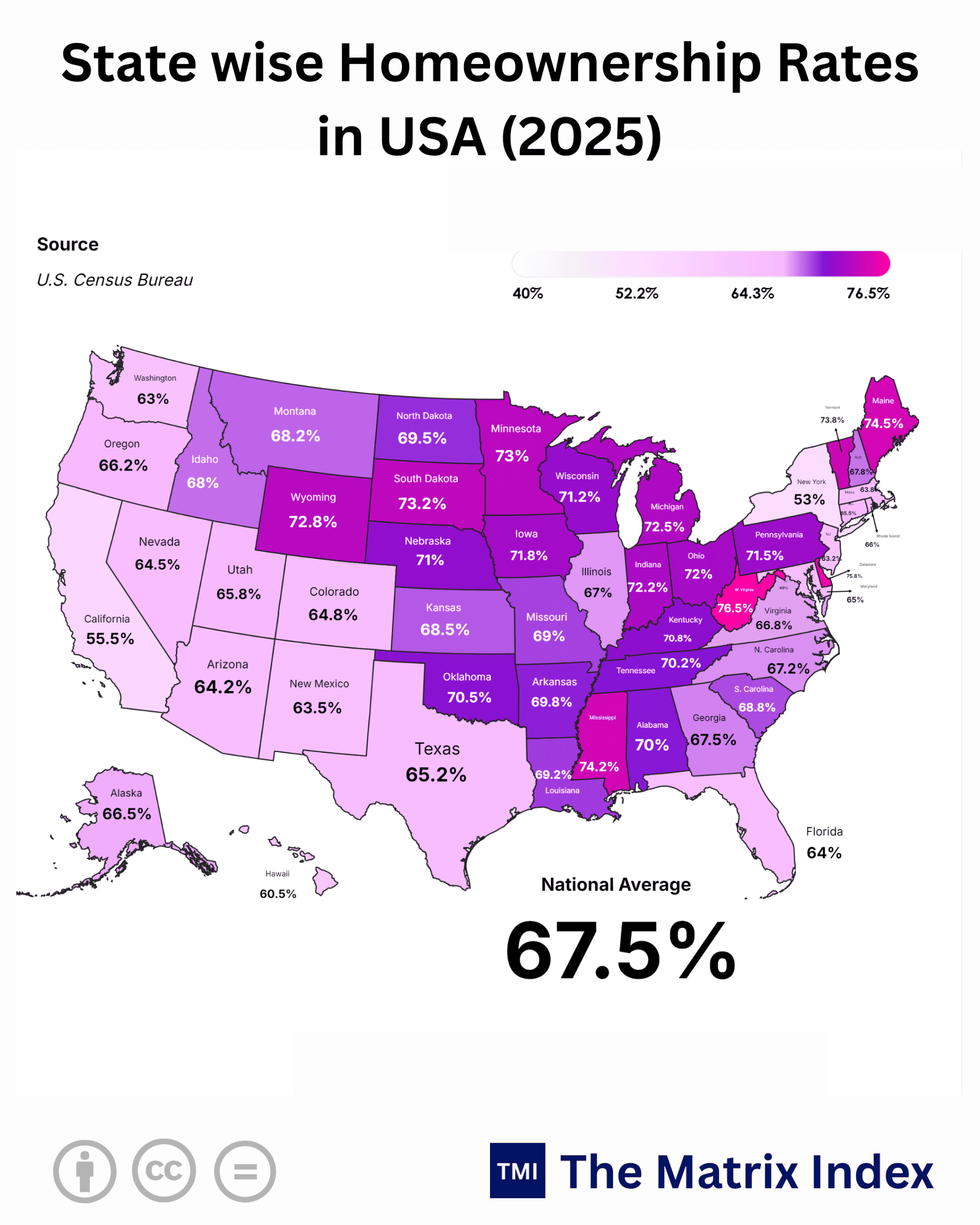
Let us examine the empirical ledger of 2025 US state homeownership rates. At the top of the pyramid sits West Virginia at 76.5%, flanked by Maine (74.5%), Mississippi (74.2%), Vermont (73.8%), and South Dakota (73.2%).
Now gaze down toward the floor of the ranking. You find Massachusetts at 62.0%, Hawaii at 60.5%, California at 55.5%, and New York bringing up the rear at 53.0%. The overall National Average hovers deceptively at 67.5%.
Notice the pattern? The states with the highest rates of homeownership are consistently those with older median populations, slower GDP growth, collapsing industrial bases, and the lowest real estate capital appreciation in nominal and inflation-adjusted terms. Conversely, the jurisdictions generating double-digit wage growth, hyper-productive tech clusters, and outsized patent filings exhibit catastrophic affordability barriers that have driven owner-occupancy rates down to historic lows.
Cross-Sectional Macro Ledger: US State Homeownership Rates (2025)
(The Bitter Truth) — High nominal homeownership correlates inversely with economic vitality and wage growth across sub-sovereign borders.
The old Hindi proverb cuts straight through the noise: (An elephant’s tusks are for show; its real teeth are hidden inside). The headline numbers are a cosmetic trophy; the economic reality grinding underneath is brutal.
2. Global Anchoring: How the World Structures the Roof Over Its Head
To understand why this metric is broken, we must look beyond American borders. The global economy is fractured into distinct housing doctrines, and the divergences reveal how modern capital truly functions.
Consider the Tier-1 Economies:
-
Germany: The undisputed manufacturing powerhouse of Europe operates with a homeownership rate of just under 47%. In cities like Berlin or Frankfurt, renting is neither a social stigma nor a temporary stepping-stone; it is an economically rational choice supported by long-term tenure protections, strict rent control, and balanced municipal landlord regulations. Germans channel their capital into liquid equities, private vocational businesses (Mittelstand), and state-guaranteed pensions. Does the German worker suffer compared to a homeowner in rural Appalachia? The question answers itself.
-
Japan: Tokyo stands as the world’s ultimate counter-argument to the Western housing crisis. Following the apocalyptic crash of their real estate bubble in 1991, Japan radically reformed its national zoning laws in 2002. The central government stripped local municipalities of the power to block development. As a consequence, private builders construct more homes in Tokyo alone in a single year than in the entire state of California or the whole of England. Japanese homes depreciate like cars over a 30-year lifecycle, decoupling residential housing from speculative investment and stabilizing ownership at roughly 61%.
-
Switzerland: The wealthiest per-capita economy on earth maintains a homeownership rate of roughly 42%. Swiss citizens recognize that over-allocating personal balance sheets to high-leverage illiquid residential property destroys entrepreneurial risk-taking and locks up personal mobility.
-
Australia & The United Kingdom: Both nations followed the Anglo-American addiction to leveraged homeownership, posting rates between 65% and 67%. The consequence? A catastrophic misallocation of private bank credit. Australian and British banks function essentially as residential mortgage brokers with small corporate lending arms attached, choking capital access for productive industry and venture enterprise.
Now pivot to Tier-2 and Emerging Powerhouses:
-
China: The Middle Kingdom achieved an astonishing urban homeownership rate exceeding 85%, largely because urbanites viewed residential concrete as their sole permissible wealth-preservation vehicle. The result was the greatest asset bubble in human history, culminating in the protracted implosion of developers like Evergrande and Country Garden, erasing trillions in middle-class paper wealth between 2021 and 2026.
-
India: Here lies the critical warning. India boasts a self-reported homeownership rate north of 80%, yet this figure is structurally misleading. Millions of these units represent informal, un-titled rural dwellings, ancestral multi-generational compounds, or slum dwellings lacking clean property titles, liquidity, or bankable collateral value. In dynamic urban engines like Mumbai, Bengaluru, and the National Capital Region (NCR), affordable housing is practically non-existent. A junior software engineer or financial analyst must pledge 15 to 25 times their annual salary to secure a two-bedroom matchbox in a peripheral suburb, suffocating domestic consumer spending.
When you look at this global board, the lesson is unassailable: high homeownership rates in developing or declining regions are an indicator of economic immobility, not financial sovereignty.
3. The “So What?” Factor: The Ripple Effect Across the Real Economy
Macroeconomic statistics mean nothing until they collide with the kitchen table. When the cost of shelter detaches from median wages, the ripple effects tear through every layer of the socio-economic fabric.
For the Common Citizen: The Mortgage Serfdom
Consider an average middle-class family navigating this terrain in 2026. They are told by banking institutions, financial influencers, and well-meaning elders that renting is “throwing money away.”
So they sign on the dotted line. They lock themselves into a 30-year fixed mortgage at 6.5% or 7.2%, committing 40% to 50% of their net disposable monthly income to debt service, property taxes, structural insurance, and relentless maintenance.
What happens to that human being? Their risk tolerance collapses. They cannot quit a toxic corporate job to launch an innovative enterprise. They cannot relocate to another state or city where wages are growing 15% faster, because selling their house incurs a 6% to 8% transaction friction, and buying in the new location means surrendering a locked-in legacy rate. They become what the late economist Thorstein Veblen warned against: geographically immobilized economic units tethered to a debt obligation.
As the old saying goes: (No sooner did he shave his head than hailstones began to fall). Families stretch their last rupee or dollar to step onto the property ladder, only to be struck down by surging local property taxes, escalating home insurance premiums, and crushing deferred maintenance costs.
For Industry and Innovation: The Capital Vacuum
Where does capital flow in an economy addicted to residential real estate? It does not flow into deep tech, quantum computing, domestic manufacturing supply chains, or renewable energy infrastructure.
It flows into dirt and drywall.
When regional commercial banks park 60% of their loan books in single-family residential mortgages, they starve small and medium-sized enterprises (SMEs) of working capital. Why would a loan officer underwrite a high-risk manufacturing startup generating a 12% return on invested capital (ROIC) when they can originate a mortgage, collect loan-origination fees, and dump the risk onto government-backed secondary mortgage entities?
Residential real estate financialization is an innovation vampire. It sucks the risk capital out of productive industry and locks it into inert, non-productive square footage.
For Institutional Investors: The Landlord of Last Resort
While the retail public struggles with high borrowing costs, institutional asset managers—BlackRock, Blackstone, Invitation Homes, and massive foreign sovereign wealth funds—have systematically exploited the affordability crisis.
In low-ownership, high-growth states like Texas (65.2%), Georgia (67.5%), North Carolina (67.2%), and Arizona (64.2%), institutions stepped in with deep cash reserves during every market dip. They bought whole subdivisions directly from homebuilders, turning single-family suburbs into build-to-rent (BTR) feudal estates. The retail citizen is not competing with their neighbor; they are competing with a multi-billion-dollar algorithmic balance sheet capable of borrowing debt at institutional institutional rates.
4. Seasonality and Anomaly Alert: Structural Fracture vs. Temporary Wobble
Wall Street economists love to dismiss current inventory bottlenecks as a temporary supply-chain hangover or a short-term rate cycle aberration. They tell you that as central banks loosen monetary policy, everything will revert to the easy-money mean of the 2010s.
They are peddling pure fiction.
What we are witnessing is not a seasonal lull; it is a structural supply-side sclerosis driven by three converging tectonic forces:
-
The Golden Handcuffs Anomaly: During the monetary panic of 2020–2021, millions of US homeowners refinanced into historic 2.5% to 3.5% fixed-rate mortgages. Those homeowners are never selling. To trade a 3% mortgage for a 6.5% mortgage on a lateral property would require a doubling of monthly debt payments for zero upgrade in utility. This has effectively frozen secondary market inventory for an entire decade.
-
The Climate Insurance Fracture: In states like Florida (64.0%), Louisiana (69.2%), and California (55.5%), property insurance is undergoing an existential breakdown. Major private underwriters (State Farm, Allstate, Farmers) have either capped exposure, non-renewed hundreds of thousands of policies, or exited entire postcodes altogether. Uninsured or underinsured ownership renders homes un-mortgageable. This is an ecological repricing of physical assets, not a standard business cycle.
-
Hyper-Restrictive NIMBY Zoning: In the most productive economic basins—the Bay Area, the Boston-Cambridge corridor, Seattle, and Southern California—local municipal zoning laws make it virtually illegal to build multi-family density by right. When supply is legally capped while global capital and high-earning human talent flood in, the price of real estate decouples entirely from local median wages.
Do not mistake this for a cyclical dip that can be patched over by a 25-basis-point rate cut from the Federal Reserve or the Reserve Bank of India. The traditional transmission mechanisms of residential housing are broken.
5. Comparative Economic Paradigms: The Structural Divergence
To comprehend the full scale of this imbalance, let us dissect how housing models behave under distinct institutional architectures. The divergence between low-affordability growth engines and high-ownership stagnation hubs paints a striking picture of contemporary political economy.
Structural Divergence Matrix: Housing Systems Across Core Global Paradigms
(Golden Opportunity) — Transitioning from an ideological ownership mandate to an open, zoning-deregulated rental ecosystem unlocks dynamic human capital and entrepreneurial risk-taking.
The contrast could not be clearer. When an economy treats shelter as an untouchable financial asset to be pumped by policy, it cannibalizes the productivity of its youth to pad the paper net worth of its retirees.
6. The Two-Sided Risk Assessment: Bull Case vs. Bear Case
Any analyst who gives you a one-sided prediction is either incompetent or selling you an asset. Every systemic shift contains structural opportunities and fatal vulnerabilities. Let us lay them bare without emotional hedging.
The Bull Case: The Re-Industrialization & Sunbelt Resurgence
In this scenario, the geographic shifts indicated by the 2025 data represent a healthy, self-correcting decentralization of the global economy:
-
The Secondary-City Dividend: As high prices in California (55.5%) and New York (53.0%) push skilled workers out, states like North Carolina (67.2%), Georgia (67.5%), and Texas (65.2%) absorb human capital, building diversified tech-industrial corridors that are far more cost-competitive on the world stage.
-
Home Equity as an Unshakable Balance Sheet: The trillions of dollars in locked-in home equity accrued since 2020 provide an unprecedented buffer for the middle class. Defaults and foreclosures remain near historic lows because homeowners have massive equity cushions and fixed-rate liabilities. Even if real wages soften, the consumer continues to spend, insulating the economy from severe depression.
-
Supply-Side Technology Leap: Modular construction, 3D printing of structural concrete, and artificial-intelligence-driven permitting software radically reduce the cost of delivering new units. Pro-development states streamline construction, enabling housing starts to finally outpace population growth and restoring historical affordability over a rolling 7-to-10-year cycle.
The Bear Case: The Neo-Feudal Trap & Systemic Liquidity Freeze
In this scenario, the current equilibrium collapses under its own contradictions:
-
The Generational Disenfranchisement Shock: By locking out Gen Z and Millennials from homeownership in high-opportunity urban centers, Western and developing societies sever the primary engine of middle-class wealth creation. This fuels political extremism, populist tax revolts, and aggressive wealth-redistribution policies that spook international investors and dry up venture formation.
-
The Municipal Death Spiral: In legacy high-ownership, low-growth states (West Virginia, Mississippi, parts of the Rust Belt), aging populations will soon pass away, flooding markets with millions of obsolete, dilapidated properties in communities with zero job opportunities. Property values will crater, triggering local municipal bond defaults, cuts to basic services, and deep regional insolvency.
-
The Institutional Landlord Monopoly: As individual buyers are completely priced out, institutional capital consolidates an unassailable monopoly over single-family rentals across the Sunbelt. Rent extraction increases faster than wage growth, permanently suppressing the savings rate of the workforce and transforming whole nations into captive tenant-consumer economies.
7. The Alternative Scenario: The Radical Counter-Narrative
What if the consensus assumptions underlying the housing conversation are completely inverted?
Suppose the future does not belong to single-family suburban sprawl or traditional mega-cities at all. Consider what happens if these three counter-trends accelerate simultaneously between 2026 and 2035:
1. The Autonomous Spatial Revolution
Autonomous transport corridors, high-speed rail integration, and hyper-reliable low-earth-orbit satellite internet permanently sever the link between where an individual works and where they must sleep.
If a professional can step into an autonomous pod or train and commute 150 kilometers in 40 minutes while sleeping or working, the real estate premium commanded by dense urban centers like New York or San Francisco will suffer a massive, structural haircut.
Land that is currently priced at agricultural rates 80 kilometers outside metropolitan zones will instantly become viable residential land, triggering a colossal repricing of legacy suburban and urban assets.
2. The Great Demographic Reversal
Every major economic model today assumes sustained population growth or immigration-driven household formation. But global fertility rates are collapsing off a cliff—not just in Japan (1.2) and South Korea (0.72), but across Europe (1.4), the United States (1.6), and even India, which has slipped below the replacement threshold to 2.0.
By 2035–2040, the conversation will not be about housing shortages; it will be about structural surplus. Vast swathes of suburban developments constructed in the 2020s will stand half-empty, mimicking the current ghost towns of rural Italy and provincial Japan.
Anyone who bought property at peak valuations under the assumption of perpetual population expansion will be holding an asset with negative real maintenance returns.
3. State-Level Capital Confiscation
Faced with escalating sovereign debt burdens and underfunded municipal pensions, cash-strapped governments will inevitably target illiquid real estate for revenue extraction.
Unlike liquid stocks, gold, or private business interests, you cannot move a four-bedroom house into an offshore account or an encrypted digital vault. It is physical, visible, and easily taxed. Expect land-value taxes, non-resident property surcharges, and vacant-home levies to surge globally.
The homeowner who thought they “owned” their home debt-free will discover that the municipal tax collector is a permanent landlord who never renegotiates rent down.
8. Strategic Blueprint & Actionable Directives
Enough theoretical diagnosis. Let us lay down precise, unambiguous directives for the individuals, investors, and policymakers navigating this structural minefield.
For the Individual Retail Investor: Stop Romanticizing Concrete
-
Kill the Emotional Sacred Cow: Stop viewing a primary residence as your primary investment vehicle. If your total monthly cost of ownership (mortgage interest + property taxes + insurance + HOA + 1.5% annual maintenance reserve) exceeds local market rent by more than 25%, you are not building equity; you are incinerating liquidity.
-
Prioritize Balance Sheet Velocity: In an economy undergoing rapid technological transformation, the most valuable financial asset you possess is geographical and professional mobility. Rent where you must to maximize your human capital earnings; invest your surplus capital in liquid, productive assets: global equities, high-yield sovereign notes, hard commodities, and direct equity in innovative businesses.
-
Beware the Rural Yield Trap: Do not be lured by the optically cheap properties in states like West Virginia (76.5%) or Mississippi (74.2%). A home priced at $120,000 with no local job growth, a shrinking tax base, and zero inbound capital will yield negative inflation-adjusted returns after accounting for maintenance and local taxes. Cheap does not mean undervalued; often, cheap means dying.
For Institutional Asset Managers and Allocators
-
Pivot to Build-to-Rent (BTR) Densification: The era of sweeping up disparate secondary single-family homes is drawing to an operational close. Portfolio maintenance costs and regional political backlash make this strategy inefficient. Capital must flow into purpose-built, high-density, professionally managed build-to-rent communities situated near transit and modern manufacturing hubs.
-
Hedge for the Climate Insurance Reset: Audit your physical asset portfolios today against forward-looking climate risk models. Divest aggressively from coastal and flood-prone assets where insurance costs are outstripping net operating income (NOI) growth. The yield on a Miami or New Orleans apartment building is an accounting fiction if property insurance costs jump 35% year-over-year.
For National Policymakers (The Indian and Global South Blueprint)
If developing economic leaders in New Delhi, Jakarta, or Brasília want to avoid the economic sclerosis strangling the West, they must enact structural reforms before their real estate markets freeze into un-mortgageable monopolies:
-
Codify Clean Land Titling & Digital Registry: Accelerate complete cadastral digitalization. Millions of citizens hold informal assets that cannot be monetized, pledged, or traded efficiently.
-
Deregulate Urban FSI (Floor Space Index) / FAR (Floor Area Ratio): Stop artificially suppressing vertical density in metropolitan cores. Restrictive height and density limits enrich incumbent land speculators while forcing the young workforce into grueling, two-hour commutes from distant, unserviced suburbs.
-
Incentivize Institutional Rental Frameworks: Create a transparent, legally enforceable institutional tenancy regime. Protecting tenant rights while guaranteeing rapid, streamlined evictions for default will entice sovereign wealth funds to build large-scale, high-quality rental infrastructure, preserving workforce mobility and keeping capital productive.
9. My Verdict: 2026, 2030, and the Road to 2047
Let us strip away every remaining layer of corporate caution and state the raw truth.
The global financial system has spent the last forty years running an unsustainable experiment: transforming a basic human biological necessity—shelter—into a leveraged speculative instrument designed to deliver equity market returns with zero underlying operational risk.
That experiment has run out of runway.
The Immediate Horizon (2026–2030)
Between now and 2030, we will witness a brutal bifurcation. The headline homeownership metric will continue to look deceptively stable in the aggregate, but beneath the hood, mobility will plummet to historic lows.
The United States will split irrevocably into two castes: a locked-in class of aging homeowners with low-rate legacy debt who cannot afford to leave, and a disenfranchised generation of younger workers priced out of building traditional equity in the cities where their skills are most valuable.
This tension will manifest not as a single dramatic 2008-style crash, but as a slow, corrosive stagnation of productivity, dropping birth rates, and violent localized political battles over rent control and zoning overrides.
The Decadal Horizon: Toward 2047 (The Indian Centenary)
By 2047—the centenary of Indian independence and the year India targets full developed-nation status (Viksit Bharat)—the Western housing model will be remembered as a profound structural mistake of the late 20th century.
Nations that triumph in the second half of this century will not be those that brag about an 80% homeownership rate built on low-productivity, illiquid personal debt.
The global champions will be the nations that mastered housing liquidity: economies where housing is treated as affordable, modular, and dynamic infrastructure designed to facilitate the rapid movement of human talent toward wherever new value, new technology, and new industrial breakthroughs are taking place.
If India falls into the trap of financializing its residential land to create short-term paper billionaires among real estate developers, it will choke off its demographic dividend, saddling its young engineers and workers with crippling debt burdens that crush domestic demand.
Conversely, if policymakers have the strategic courage to build dense, accessible, transit-oriented rental and ownership ecosystems, they will liberate hundreds of billions of dollars in productive risk capital, fueling real innovation and securing true geopolitical supremacy.
The choice is stark. You can protect the paper valuation of old bricks, or you can unlock the kinetic potential of your living workforce. You cannot do both.
The time for sentimental attachment to the myth of the suburban deed is over. Adapt your balance sheet to the realities of capital velocity, or prepare to watch your wealth slowly turn to dust inside the walls of your own home.
GOOGLE ‘PEOPLE ALSO ASK’ FAQs
Q1: Which US state has the highest homeownership rate?
A: 76.5% of households in West Virginia hold property deeds, anchoring the highest homeownership rate nationwide ahead of Maine at 74.5%. However, this high concentration coincides with stagnant wage growth and severe demographic outflow.
Q2: Why do California and New York have the lowest homeownership rates?
A: 55.5% in California and 53.0% in New York represent historic affordability floors driven by restrictive zoning, institutional buying, and high land costs. These supply caps force hyper-productive workers into lifelong rental tenures.
Q3: How does the US homeownership rate compare globally?
A: 67.5% marks the US national average, sitting far above Germany (47%) and Switzerland (42%), yet trailing China’s urban rate of over 85%. High homeownership frequently signals geographic immobility rather than superior household liquidity.
Q4: Is renting financially smarter than buying a home through 2030?
A: 25% higher monthly ownership costs versus local rent make buying an active drag on liquidity under 6.5% to 7.2% mortgage rates. Renting preserves capital velocity, freeing surplus cash for liquid equities and inflation-hedged assets.
Q5: What is the long-term economic risk of high homeownership by 2047?
A: 2047 economic dominance will belong to mobile economies rather than balance sheets tied to illiquid residential concrete. Over-subsidizing debt-financed housing starves productive industrial innovation, leaving aging regions exposed to municipal insolvency as demographics shrink.
Data Source:
- U.S. Census Bureau (Housing Vacancies and Homeownership Survey – CPS/HVS)
- Federal Reserve Economic Data (FRED)
- OECD Housing Database
Disclaimer: This report is for informational and analytical purposes only and does not constitute formal financial, investment, or policy advice.