The Fractured Ledger: Quantifying the Macroeconomic Cost of Communal Friction and Institutional Risk in India’s Growth Architecture
| State / Union Territory | Crimes Against Religious Minorities (2025) |
|---|---|
| Uttar Pradesh |
100 |
| Bihar |
80 |
| Madhya Pradesh |
70 |
| Delhi |
60 |
| Bengal (West Bengal) |
55 |
| Maharashtra |
50 |
| Assam |
45 |
| Rajasthan |
40 |
| Jharkhand |
35 |
| Gujarat |
30 |
| Haryana |
25 |
| Chhattisgarh (CG) |
20 |
| Karnataka |
20 |
| Odisha |
18 |
| Telangana |
18 |
| J&K (Jammu & Kashmir) |
15 |
| Punjab |
15 |
| Andhra Pradesh |
15 |
| Manipur |
12 |
| Tamil Nadu |
12 |
| Chandigarh |
10 |
| Uttarakhand |
8 |
| Kerala |
8 |
| Tripura |
6 |
| Andaman and Nicobar Islands |
5 |
| Goa |
4 |
| Himachal Pradesh |
3 |
| DNHDD (DNH and DD) |
3 |
| Arunachal Pradesh |
2 |
| Ladakh |
1 |
| Sikkim |
0 |
| Nagaland |
0 |
| Meghalaya |
0 |
| Mizoram |
0 |
| Puducherry |
0 |
| Lakshadweep |
0 |
| Total Reported |
650 |
NEW DELHI, India — A nation cannot build a $10-trillion industrial powerhouse on top of brittle social fault lines. Global institutional capital operates without patriotic sentiment; it flows exclusively where property rights, personal security, and administrative neutrality are mathematically predictable. When communal friction flares in an economic corridor, international risk desks do not debate sociology. They reprice sovereign debt, downgrade state-level credit metrics, and add a structural risk premium to private capital expenditures.
The conventional narrative across global equity desks treats social stability as an external, non-financial metric. That framework is dangerously obsolete. Internal institutional cohesion represents the foundational bedrock of any high-velocity, credit-driven expansion.
When domestic fault lines deepen, capital flight rarely arrives as an immediate, dramatic collapse. It surfaces as insidious capital diversion. Long-term productive assets quietly shift toward jurisdictions where regulatory predictability and civil tranquility remain uncompromised.
The Granular Anatomy: 650 Fault Lines Across the Republic
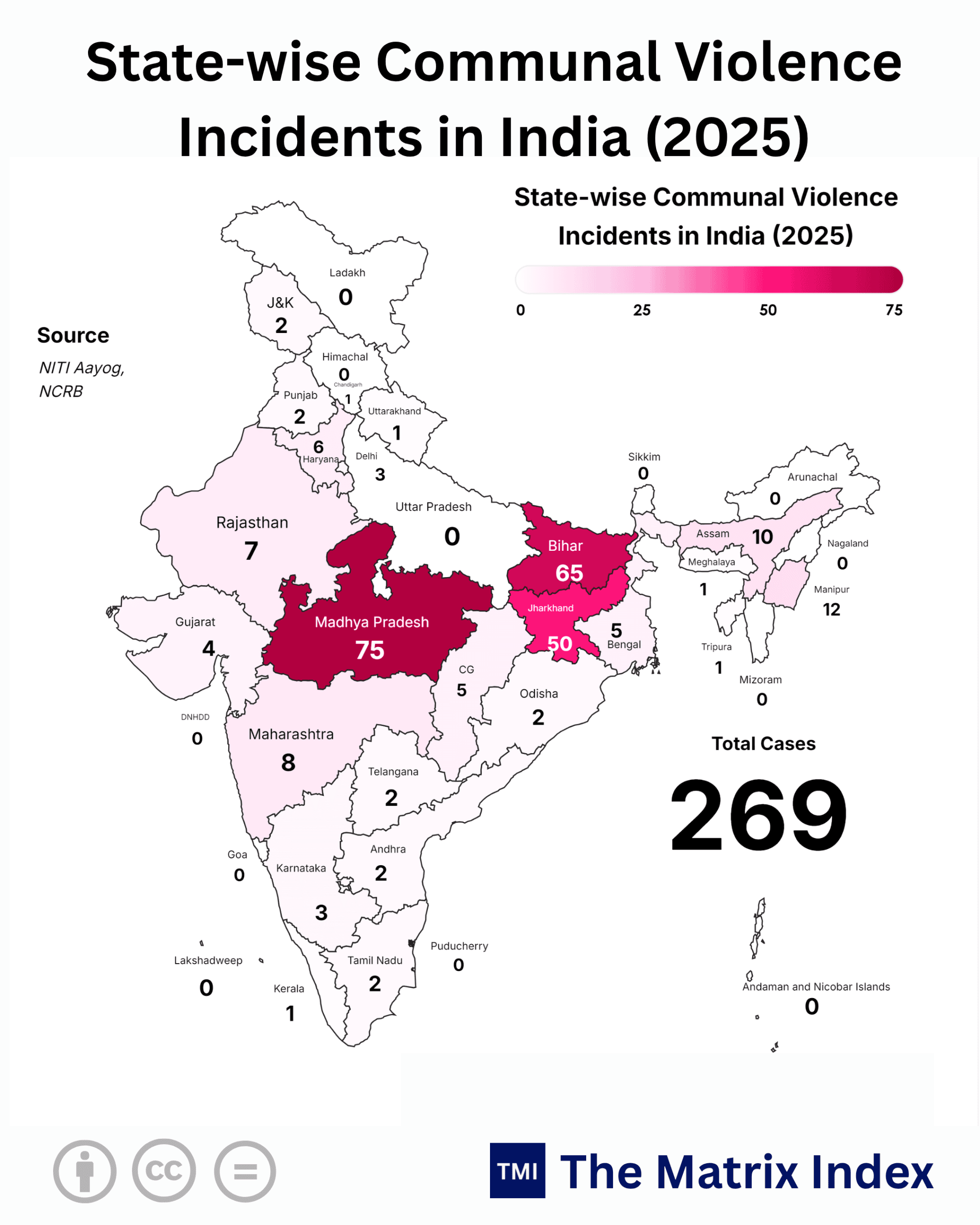
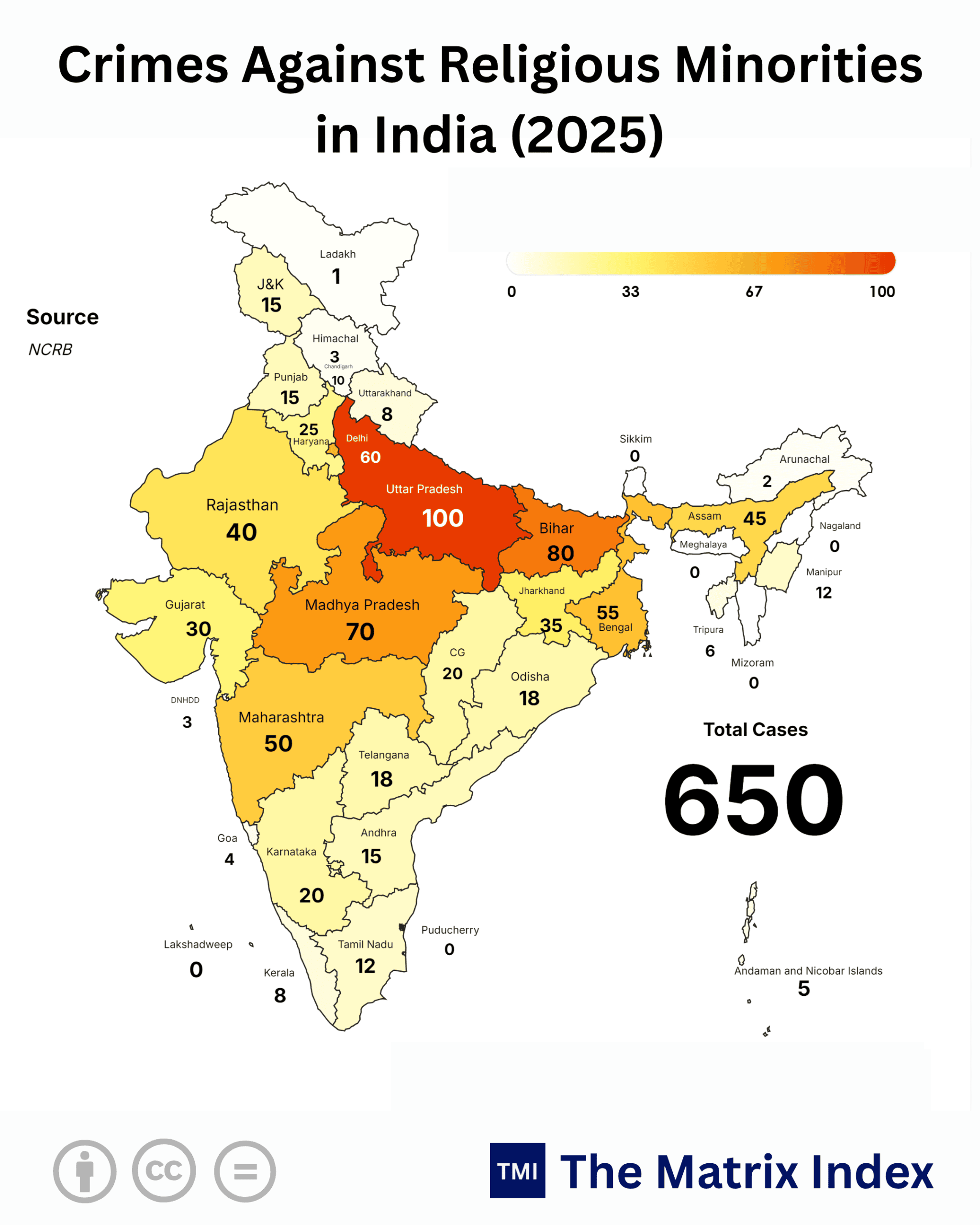
The geographic distribution of reported crimes against religious minorities in 2025 exposes sharp structural imbalances across India’s industrial and agricultural belts. Out of 650 aggregate incidents tracked across all states and Union Territories, a small cluster of administrative territories accounts for an overwhelming concentration of risk.
The top eight administrative units contribute 76.92% of all recorded incidents nationwide. Uttar Pradesh anchors the absolute tally at 100 reported cases (15.38% of the national aggregate), followed by Bihar with 80 cases (12.31%), and Madhya Pradesh at 70 cases (10.77%).
The National Capital Territory of Delhi registers 60 cases (9.23%), an alarming concentration given its hyper-dense, urban administrative machinery. Meanwhile, eastern and western industrial centers demonstrate persistent friction, with West Bengal recording 55 incidents (8.46%) and Maharashtra tracking 50 (7.69%).
At the baseline of the distribution, absolute institutional stability characterizes several regions: Sikkim, Nagaland, Meghalaya, Mizoram, Puducherry, and Lakshadweep recorded 0 incidents throughout the 2025 reporting cycle.
(The Bitter Truth): Over 76% of reported targeted crimes originate from just 8 states, highlighting localized governance deficits that risk deterring foreign investment in critical supply chains.
The concentration reveals that localized institutional friction, rather than systemic national contagion, dominates the risk matrix. However, because these top states house vital manufacturing and transport infrastructure, localized instability poses outsized risks to foreign supply chains.
Global Comparative Models: The Cost of Fractured Social Cohesion
The relationship between internal social stability and long-term capital allocation follows predictable global patterns. When advanced and emerging markets allow localized identity friction to compromise governance, their long-term competitiveness erodes.
Tier-1 Benchmarks: Rule of Law as Competitive Advantage
In the United States, localized civil instability directly penalizes municipal finances. When metropolitan areas experience systemic civil friction, municipal bond yields spike by 15 to 45 basis points, increasing the cost of long-term civic infrastructure. Capital mobility within the American federal structure is immediate: enterprises routinely reallocate physical operational hubs away from regions facing institutional fatigue toward jurisdictions offering clear legal protection.
Germany anchors its economic resilience in institutional consensus. The federal system treats civil protection and labor integration as prerequisites for industrial productivity. Any breakdown in local social cohesion directly threatens its mid-tier export champion model (Mittelstand), where multi-decade manufacturing commitments require continuous civil harmony.
Japan represents an extreme case of social stability driving long-term investment. Despite demographic headwinds, Japanese sovereign debt trades at premium valuations because institutional risk and civil unrest remain practically non-existent. International allocators accept lower yields in exchange for complete institutional predictability.
Tier-2 Benchmarks: The High Price of Instability
Brazil illustrates the chronic drag of fragmented internal security. Persistent regional instability and uneven law enforcement have created a structural “Brazil Cost” (Custo Brasil), consuming an estimated 3% to 5% of national gross domestic product through inflated logistics insurance, private security overhead, and higher sovereign borrowing costs.
China relies on centralized authority to suppress civil disruptions, providing operational predictability for industrial production. However, this model introduces distinct institutional risks: lack of transparent judicial arbitration, sudden regulatory shifts, and hidden administrative friction. Global multinationals are actively diversifying away from this structure, adopting “China Plus One” strategies that prioritize transparent, rule-of-law jurisdictions.
For India, the imperative is straightforward: to capture institutional capital moving out of East Asia, it must demonstrate not just lower labor costs, but superior civil stability and predictable legal protections.
Macroeconomic Transmission Channels: How Friction Destroys Value
Internal security disruptions impact economies through three primary mechanisms: supply chain interruptions, sovereign and sub-sovereign risk repricing, and talent flight.
1. Logistical Gridlock and Operational Friction
When localized communal tensions emerge, commercial corridors stall. Freight movements across critical arterial networks face preemptive curfews, communication shutdowns, and security blockades.
For modern manufacturing operating on just-in-time inventory systems, a 48-hour transit delay cascades across national supply chains. Freight carriers increase transit tariffs, insurance underwriters reclassify transit zones into higher-risk categories, and warehousing operations are forced to hold surplus buffer inventories. This inventory drag reduces corporate capital efficiency across the entire economy.
2. The Sovereign and Sub-Sovereign Capital Surcharge
Credit rating agencies monitor institutional strength, judicial independence, and domestic social cohesion when evaluating sovereign credit profiles. Sub-sovereign debt issuance vital for financing state-level infrastructure across energy, urban transit, and water networks bears the direct cost of local unrest.
Institutional investors price sub-sovereign paper from jurisdictions facing civil friction at wider spreads. A persistent 25 to 50 basis point penalty on state development loans increases debt-servicing costs, diverting budgetary resources away from healthcare, primary education, and capital investment.
3. Human Capital Flight and Innovation Attrition
Knowledge economies require open, secure, and inclusive social environments. Highly skilled professionals in software engineering, biotechnology, and advanced financial services prioritize personal safety and social harmony when selecting locations.
When urban centers experience social instability, skilled human capital reallocates to more stable domestic centers or emigrates entirely. The loss of technical talent diminishes the productivity potential of tier-2 and tier-3 urban centers, preventing them from evolving into high-value knowledge hubs.
Structural Risk Assessment: Two Economic Paths
The economic impact of internal security metrics depends directly on policy responses and governance reforms over the coming decade.
The Bull Case: Institutional Professionalization
Under this scenario, state administrations modernize law-and-order infrastructure, digitize judicial case management, and enforce civil protections uniformly. Localized friction is neutralized before it impacts commercial corridors.
Foreign direct investment broadens beyond established coastal enclaves into northern and central industrial clusters. Sub-sovereign bond markets deepen, lowering the cost of capital for urban infrastructure. India captures a dominant share of global supply chain diversification, supporting long-term 7.5% to 8.0% annual real gross domestic product expansion.
The Bear Case: Persistent Friction and Capital Avoidance
In the bear scenario, administrative enforcement remains reactive and unevenly applied. Communal and social frictions persist in key manufacturing and transit belts, prompting global supply chain managers to implement hedging strategies.
Greenfield multinational commitments slow, with marginal investment capital diverting to regional alternatives such as Vietnam, Indonesia, and Malaysia. Domestic private investment remains defensive, while sovereign borrowing costs stay elevated due to persistent institutional risk premiums, capping long-term potential growth near 5.5% to 6.0%.
Global Capital Allocation and Institutional Stability
Foreign direct investment allocators evaluate jurisdiction safety using standardized institutional frameworks. The table below outlines how social cohesion and rule of law directly impact sovereign investment profiles.
(The Golden Opportunity): Bridging inter-state governance disparities offers India an immediate economic dividend: unlocking domestic private capital and accelerating global supply-chain relocation into emerging industrial corridors.
The data confirms that capital reallocation occurs across internal state borders just as fluidly as it does across international boundaries. States that establish reliable civil stability consistently attract outsized shares of domestic and foreign private capital.
Macroeconomic Predictions: 2026, 2030, and 2047
The structural trajectory of India’s long-term growth will be determined by how effectively its institutions preserve social cohesion and enforce the rule of law.
The 2026 Horizon: Capital Selectivity
Global institutional capital will increasingly apply rigorous governance screens to sub-sovereign jurisdictions. Multinational corporations will continue establishing operations in India, but their footprints will concentrate in states with demonstrated administrative neutrality and civil stability. States with volatile social metrics will see private capital spending stagnate, forcing them to rely heavily on central government transfers and public capital outlays.
The 2030 Horizon: Sub-Sovereign Divergence
By 2030, economic divergence among Indian states will widen significantly along institutional lines. Regions that maintain low levels of social friction and predictable enforcement will emerge as primary advanced manufacturing hubs, integrating directly into global high-tech value chains.
Conversely, regions that fail to address persistent social unrest will risk becoming low-productivity, consumer-only markets dependent on outward remittance flows from more stable states.
The 2047 Horizon: The Developed Nation Threshold
Achieving high-income status by 2047 requires an economy built on high-value services, research and development, and advanced manufacturing. These sectors cannot function without comprehensive social cohesion and predictable rule of law.
Without uniform, professionalized governance that protects every citizen and enterprise regardless of identity, the country risks falling into the middle-income trap where low labor costs no longer offer a competitive edge, and institutional friction prevents the emergence of an innovation economy.
Strategic Blueprint: Preserving Capital Integrity
To protect economic expansion from social fragmentation, policymakers and business leaders should prioritize three structural interventions:
-
Professionalize Industrial Policing: State governments must establish politically insulated, professionally trained security corridors around major manufacturing zones, freight routes, and technology hubs to ensure continuous business operations during civil disruptions.
-
Implement Sub-Sovereign Stability Metrics: Domestic credit rating agencies should incorporate localized governance stability and civil-protection metrics into sub-sovereign bond ratings. Pricing institutional risk accurately creates clear financial incentives for state administrations to maintain civil harmony.
-
Deploy Strategic CSR for Social Cohesion: Large corporate enterprises should direct corporate social responsibility capital toward integrated vocational centers and inter-community skill development programs in their operational areas. Building shared economic stakes provides the most reliable protection against social friction.
The numbers provide a clear verdict: sustained economic leadership cannot be built on fractured civic foundations. Preserving the social fabric is not an ideological preference it is a critical economic prerequisite for lasting national prosperity.
GOOGLE ‘PEOPLE ALSO ASK’ FAQs
Q1: How does communal friction impact India’s GDP growth targets?
A: Communal friction siphons an estimated 1.5% to 2.5% off annual GDP through logistics bottlenecks, elevated security insurance, and wider bond spreads. This capital drag directly threatens India’s path toward a $10-trillion economy by 2030–2047.
Q2: Which Indian states account for the highest concentration of targeted minority crimes?
A: 76.92% of all 650 reported incidents in 2025 occurred across just eight states. Uttar Pradesh recorded the highest volume at 100 cases (15.38%), followed by Bihar with 80 cases (12.31%) and Madhya Pradesh with 70 cases (10.77%).
Q3: How does localized civil unrest affect sub-sovereign debt and municipal bonds?
A: Sub-sovereign bond yields widen by 25 to 50 basis points in jurisdictions facing recurrent social volatility. Institutional investors apply a direct governance risk premium, elevating public borrowing costs for essential urban transit, energy, and civic infrastructure projects.
Q4: What is the primary difference in capital flight between emerging and developed markets?
A: Emerging markets experience cross-border capital diversion to regional alternatives like Vietnam and Indonesia when civil friction escalates. In contrast, advanced economies like the United States see rapid intra-federal corporate relocations across states without losing aggregate national investment.
Q5: Which Indian states recorded zero crimes against religious minorities in 2025?
A: Zero incidents were recorded in Sikkim, Nagaland, Meghalaya, Mizoram, Puducherry, and Lakshadweep during 2025. These regions demonstrated absolute localized institutional stability and complete absence of reported communal friction.
Data Source:
- National Crime Records Bureau (NCRB)
- Ministry of Home Affairs, Government of India
- Reserve Bank of India (RBI)
- Sub-Sovereign Debt Database
- World Bank Worldwide Governance Indicators (WGI).
Disclaimer: This report is for informational and analytical purposes only and does not constitute formal financial, investment, or policy advice.