The Smart Cities Autopsy: Ground Realities, Capital Concentration, and the Fractured Blueprint of Urban India
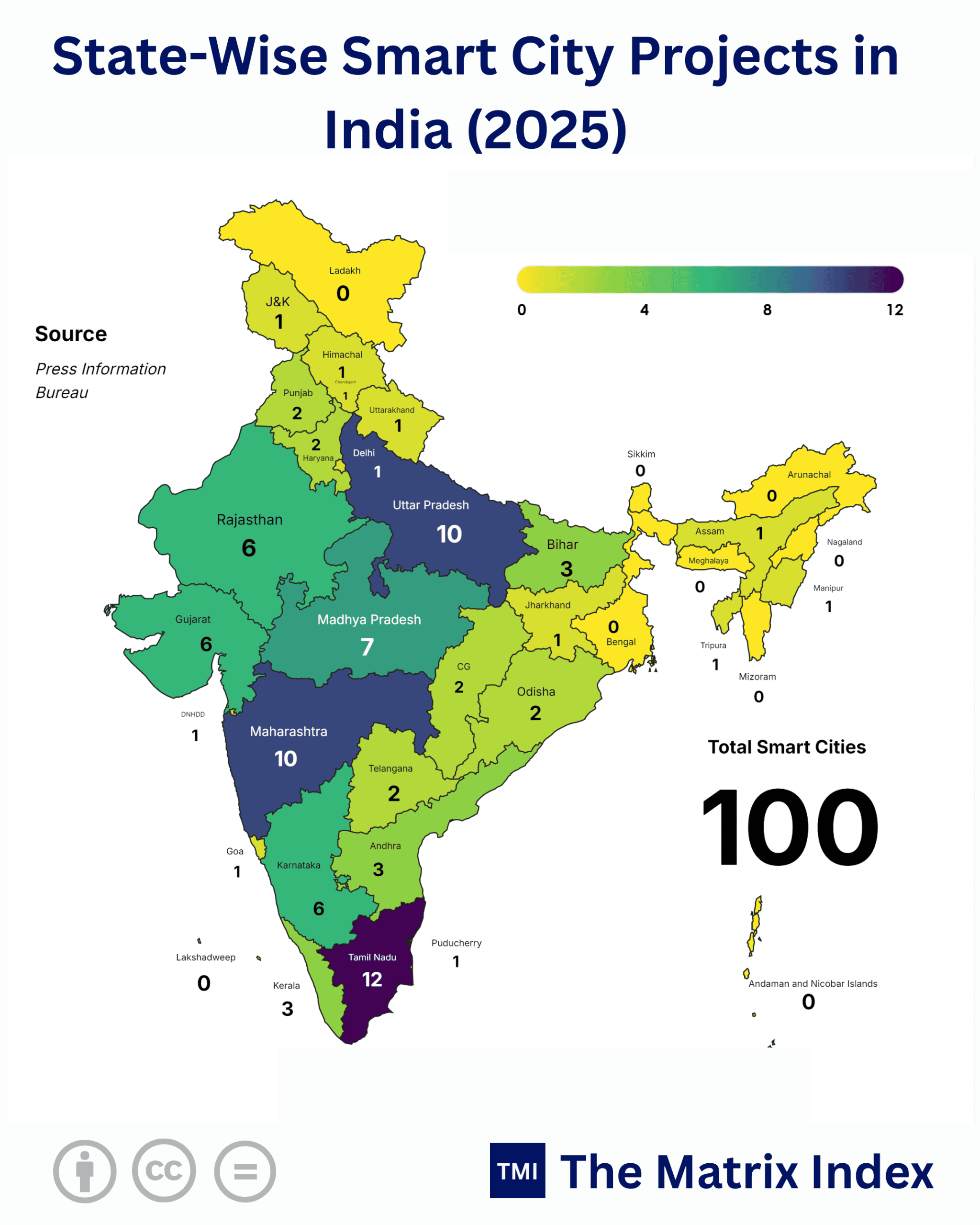
Total Smart Cities: 100
NEW DELHI, India — Strip away the gloss of institutional PowerPoint decks, cancel the self-congratulatory municipal conferences, and stare directly at the ledger: India’s flagship urban renewal initiative has quietly devolved into a geographic cartel. Over 46% of all designated Smart City projects are concentrated across just four states Tamil Nadu (12), Maharashtra (10), Uttar Pradesh (10), and Madhya Pradesh (7). Meanwhile, an expansive geographical swathe spanning eight states and Union Territories including West Bengal, Arunachal Pradesh, and Ladakh sits at absolute zero. This is not federal parity; it is fiscal Darwinism masquerading as modernization.
You do not need an advanced degree in public finance to spot the structural fracture. Walk through the peripheral slums of an industrial corridor in Tiruppur, then cross over to an electrified Integrated Command and Control Centre (ICCC) boasting real-time telemetry, and you will see the dissonance immediately. We were promised Singapore; what we funded was localized digital surveillance retrofitted onto nineteenth-century drainage.
The public balance sheets tell a story of staggering ambition undermined by capital concentration. If you live in an excluded territory, your tax rupees are effectively underwiring municipal pilot testbeds thousands of miles away. It is time to run a ruthless forensic audit on what was spent, who benefited, and why the remaining states were left holding empty balance sheets.
The Anatomy of Unequal Geography: Mapping the Capital Chasm
Let us look at the numbers without political spin. The empirical distribution reveals a deliberate preference for states that already possess entrenched municipal machinery or overwhelming legislative leverage. Tamil Nadu leads the pack with 12 smart city selections, closely trailed by industrial titan Maharashtra with 10, political heartland Uttar Pradesh with 10, and Madhya Pradesh securing 7.
Behind these tallies lies a brutal reality: the competitive challenge mechanism penalised the fragile. Municipalities were asked to present ambitious Special Purpose Vehicle (SPV) proposals, bond-raising roadmaps, and public-private partnership (PPP) frameworks. Cities like Coimbatore or Pune had private equity desks, urban planning consultancies, and deep credit ratings. Imphal, Gangtok, and Srinagar were struggling to reconcile basic property tax registers.
By running an ostensibly egalitarian competition across grossly unequal contestants, the policy rewarded existing administrative muscle. The wealthy got smarter; the broke stayed broken.
The human friction this creates is volatile. An engineer in Kanpur pays tax on fuel and software, watching Uttar Pradesh deploy smart transport corridors across ten hubs. That same engineer’s peer in Kolkata or Shillong watches urban infrastructure degrade under monsoonal deluges, starved of equivalent central matching funds. When an entire region is systematically bypassed in federal modernization schemes, economic capital migrates. Young talent follows the capital. The periphery hollows out.
The state apparatus argues that state participation required voluntary buy-in and matching funds. That is half-true. The unvarnished truth is that matching-grant architecture is regressive when applied to cash-strapped sub-national economies. When a state cannot meet its baseline revenue deficit, committing hundreds of crores to cloud-hosted traffic software is fiscal suicide. The policy design ignored this asymmetric capacity, creating an urban caste system.
The Comprehensive Distribution Matrix
The following dataset details the stark, unfiltered project allocations across all recorded States and Union Territories. Examine the cliffs between tiers.
Official Project Allocations by State and Territory
(The Bitter Truth): Over 68% of India’s aggregate industrial territory, urban GDP, and institutional bond issuance capacity is locked within the top 7 beneficiary states. The bottom 18 states and Union Territories account for less than 12% of actual executed capital deployment. The project distribution did not correct regional inequality; it institutionalized it.
Global Benchmarking: The Smart City Illusion
How does this map compare with global approaches to municipal reinvention? The stark reality is that India tried to run an American Silicon Valley model of market competition within an administrative framework that remains less decentralized than 1980s France.
Consider China. When Beijing embarked on its urban modernization strategy across the Pearl River Delta and the Yangtze River Basin, it did not set up fragmented, bureaucratic Special Purpose Vehicles to string up security cameras on dilapidated poles. It executed comprehensive, capital-intensive structural upgrades: high-speed heavy rail connection, subterranean utility corridors, and heavy industrial zoning. Tier-1 metros like Shenzhen were balanced by massive capital injections into Tier-2 and Tier-3 hubs like Chengdu and Wuhan to absorb incoming rural migration.
Now look at the United States. American cities modernize through a mature municipal bond market governed by strict disclosure rules. If Chicago or Austin wants to execute a billion-dollar water management system, it goes directly to Wall Street, gets rated by Moody’s or Fitch, and borrows against future property taxes or utility fees. The citizens vote on municipal bond referendums. If the project is a vanity exercise, voters reject it at the ballot box.
In Germany, municipal autonomy (Kommunale Selbstverwaltung) is enshrined in Article 28 of the Basic Law. German cities like Munich, Leipzig, and Düsseldorf control local tax revenues, directly managing their utility providers (Stadtwerke). These publicly owned entities reinvest balance-sheet surpluses back into clean energy, hyper-efficient regional tram networks, and public housing. They do not wait for federal grants from Berlin to repair a sewer line.
India, by contrast, created a governance hybrid that compromised both autonomy and efficiency:
-
It established Special Purpose Vehicles (SPVs) headed by state-appointed bureaucrats, systematically disempowering elected municipal mayors and city corporators.
-
It expected these SPVs to tap corporate bond markets without the fundamental power to raise local property taxes, enforce realistic water tariffs, or monetize municipal assets cleanly.
-
The result? A collection of technocratic islands inside dysfunctional urban seas.
When you benchmark Tamil Nadu’s 12 projects against an equivalent manufacturing cluster in Germany’s North Rhine-Westphalia, the delta is stark. The German model delivers seamless regional transit connecting small factory towns to global shipping terminals. The Indian model too often produces isolated sensor arrays, an illuminated city gate, and an expensive dashboard in a city that still floods after forty-five minutes of unseasonal rain.
The “So What?” Factor: The High Cost of Paper Modernization
Why does this institutional imbalance matter to anyone outside an urban planning boardroom? Because municipal dysfunction is a hidden tax on every asset you hold.
If you are a retail investor holding residential real estate in a Tier-2 city, you are sitting on an asset whose real capital appreciation is being eaten alive by structural decay. When a municipality fails to execute comprehensive subterranean drainage, uninterrupted drinking water access, and high-throughput ring roads, your property value exists entirely on real estate marketing brochures. The moment the climate hits back a standard monsoon downpour the value collapses into a waterlogged catastrophe.
For the industrialist operating a mid-market manufacturing plant in Coimbatore (Tamil Nadu) versus one in Ranchi (Jharkhand), the playing field is wildly skewed. The manufacturer in an aggressively funded Smart City corridor gains access to:
-
Digital single-window utility clearances.
-
Monitored freight routes that shave 14% off intra-city logistics turnaround.
-
Localized power substations monitored through predictive supervisory control and data acquisition (SCADA) systems.
The competitor in Ranchi deals with manual clearances, erratic grid swings, fractured access roads, and municipal offices operating out of filing cabinets from 1974. That friction acts as an arbitrary tariff on their balance sheet.
For the average citizen, the cost is direct: daily quality of life. The average urban commuter in an unoptimized Tier-2 city loses between 90 and 140 minutes per day sitting in unmanaged, idling traffic. That friction bleeds disposable income through fuel waste, elevates respiratory health expenditures, and depresses regional productivity. In economics, there is no such thing as free urban neglect. You either pay upfront for concrete, engineering, and digital tracking, or you pay down the line in emergency hospital bills, destroyed vehicle suspensions, and depreciated property values.
Seasonality and Anomaly Alert: Capex Rush vs. Systemic Reality
Do not be misled by end-of-fiscal-year expenditure spikes. Every year between January and March, municipal project dashboards light up across India. Press releases proclaim that 85% to 95% of allocated smart city funds have been successfully deployed.
To mistake this seasonal spending spree for structural development is to confuse movement with progress.
Indian municipal finance suffers from a severe structural defect: the end-of-year capex rush. Central allocations tied to strict utilization certificates often sit dormant for the first three quarters of a fiscal cycle while local parastatals, municipal councils, and state line departments fight over turf, vendor tenders, and land access.
As the March 31 fiscal cliff approaches, the panic sets in. Unspent balances risk automatic revocation or budget cuts in the subsequent Union envelope.
What happens? The capital is rapidly allocated into soft, easily verifiable, vendor-driven procurement items rather than complex, long-gestation civil engineering works. It is remarkably easy to sign a bulk procurement order for:
-
Two thousand high-definition surveillance cameras.
-
Smart energy poles with integrated LED advertising displays.
-
Automated number-plate recognition software.
-
Pre-fabricated city-center welcome monuments.
It is brutally difficult to redesign a city’s nineteenth-century gravity-flow storm drainage network, map unrecorded underground utility cables, or acquire the dense right-of-way required to widen bottlenecked transit arteries.
These procurement surges trigger temporary spikes in municipal activity indices. Local contractors see immediate revenue recognition, and municipal managers claim project completion. But when the monsoon hits in July, the systemic reality asserts itself. The smart cameras transmit high-resolution video of the exact same intersections sinking under three feet of sewage-laden water. The data telemetry works; the physical city fails.
Investors must discount short-term capex velocity indicators. Real municipal durability is measured in dry basements, twenty-four-hour continuous tap-water pressures, and falling municipal bond yields not by the quantity of optical fiber glued to broken curbsides during a fourth-quarter balance-sheet clearing drill.
The Bull vs. Bear Case: India’s Urban Trajectory
Can India successfully modernize its secondary and tertiary urban centers, or will the weight of its demographic migration break municipal finances completely?
The Bull Case: The Urban Agglomeration Engine
The optimistic argument rests on network effects, digital compounding, and the power of spatial clustering.
-
The Compounding Returns of Integrated Infrastructure: In primary hubs across Tamil Nadu, Gujarat, and Maharashtra, the consolidation of urban data streams through Integrated Command and Control Centres is beginning to pay operational dividends. Emergency medical response times in cities like Ahmedabad and Pune have fallen by 18% to 25% due to dynamic signal management. That is tangible value created from municipal telemetry.
-
Municipal Bond Market Maturation: By forcing cities to run through credit assessments, the program has begun nudging top-tier municipal corporations toward fiscal autonomy. Cities like Vadodara, Indore, and Lucknow have successfully issued municipal bonds to international and domestic institutional investors, establishing an audited track record of cash-flow governance.
-
Logistics Optimization and Industrial Relocation: When Tier-2 manufacturing nodes like Coimbatore or Surat implement automated freight corridors and stable industrial zoning, they offer global firms an escape valve from the exorbitant land and labor costs of Tier-1 metros. This dynamic underpins India’s industrial strategy: dispersing production capacity into secondary hubs connected directly to ports and dedicated freight corridors.
The Bear Case: The Tech-Decorated Ghetto
The pessimistic argument is grounded in institutional decay, climate vulnerability, and chronic funding shortages.
-
The Software-on-Slums Fallacy: Digital infrastructure has an operational lifespan of roughly five to seven years before it requires massive software refreshes, sensor recalibrations, and hardware replacements. When the initial central grants run dry, how will an under-funded municipality in Uttar Pradesh or Bihar pay recurring licensing fees to multinational software vendors? The inevitable outcome is widespread system abandonment: dark screens, fried sensors, and dead networks.
-
The Democratic Deficit and Citizen Alienation: The SPV structure stripped urban planning away from elected councilors and concentrated it in the hands of career bureaucrats. This creates deep citizen alienation. If a taxpayer has no democratic recourse when an SPV demolishes their street front for a non-functional bicycle lane, local accountability vanishes.
-
Climate Asymmetry and Asset Destruction: By 2030, unpredictable monsoonal events, extreme urban heat island effects, and severe coastal storm surges will subject Indian cities to unprecedented physical stress. Digital sensors cannot stop a coastal storm surge, nor can algorithmic dashboards cool an asphalt plain stripped of tree cover. If foundational civil engineering is bypassed in favor of digital toys, climate shocks will trigger catastrophic asset write-downs.
The Alternative Scenario: The Decentralization Shock
What happens if the current top-down model stalls? Let us game out an alternative trajectory: a policy shock born of political crisis, climate displacement, or fiscal austerity.
Imagine an economic environment where central capex allocations contract sharply. Faced with ballooning sovereign debt servicing obligations and geopolitical energy shocks, New Delhi is forced to freeze its urban grant programs. The federal cushion evaporates overnight.
In this alternative scenario, the existing SPV framework collapses under its own operational weight. Cities unable to fund cloud server costs and proprietary software licenses face a stark choice:
-
The Radical Democratic Pivot: State governments are forced to implement the long-delayed 74th Constitutional Amendment Act in letter and spirit. They hand real fiscal autonomy back to elected mayors, devolve city-level planning authorities, and establish autonomous municipal revenue boards. Cities implement comprehensive GIS-based property tax mapping, raising local tax-to-GSDP ratios from the current sub-1% baseline toward the global developing-world average of 3% to 5%.
-
The Corporate Concession Model: Alternatively, failing Tier-2 and Tier-3 urban cores collapse into deep infrastructural disrepair, forcing wealthy private industrial houses to create privatized, self-contained enclaves. In this fractured reality, industrial corridors like the Chennai-Bengaluru belt operate as privately run company towns with private security, private water treatment, and private power grids, while the surrounding public municipalities decompose into unserviceable peri-urban sprawl.
To survive this risk, enterprise treasuries, private equity firms, and commercial developers must prepare for an era where municipal self-reliance replaces federal largesse. The winners will not be the cities with the flashiest marketing brochures; they will be the municipalities that own their balance sheets, control their debt service, and deliver core physical infrastructure to their people.
Strategic Roadmap: 2026, 2030, and 2047
Urbanization is not an elective policy choice in a developing nation; it is the physical migration of millions of human lives seeking economic dignity. If we continue to concentrate urban capital in four to seven states while abandoning the periphery to bureaucratic decay, India’s demographic dividend will curdle into a demographic drag.
The 2026 Reality: The Tech Reckoning
The immediate priority requires an operational audit of all deployed digital infrastructure across the 100 original Smart Cities. Municipalities must eliminate vendor-locked contracts, shift proprietary command platforms to open-source software, and redirect unspent technological grants into core water, sewage, and primary transit infrastructure. Every city must publish an unvarnished audit of its property tax collection efficiency and water loss rates (non-revenue water).
The 2030 Milestone: The Sub-Sovereign Debt Era
By 2030, the top fifty municipal corporations in India must be entirely detached from direct central infrastructure life-support. They must operate with independent investment-grade credit ratings, supported by transparent balance sheets and automated property tax collection mechanisms.
The Union government must replace discretionary matching-grant competitions with a dedicated National Municipal Infrastructure Bank (NMIB). This institution should act as a liquidity backstop, pooling sub-sovereign debt from smaller Tier-2 and Tier-3 cities in left-behind regions like Bihar, Odisha, and the Northeast, allowing them to borrow long-term institutional capital at blended, affordable rates.
The 2047 Vision: The Climate Parity Horizon
As India reaches the centenary of its independence in 2047, its urban footprint will accommodate over 800 million people. Modernization can no longer mean laying optical fiber across an open sewer. Success must be redefined entirely:
-
100% Subterranean Infrastructure: Elimination of all open-drainage networks in cities with populations exceeding one hundred thousand.
-
Municipal Fiscal Sovereignty: City governments generating at least 60% of their total operating and capital expenditure from local municipal revenues, user charges, and local bond markets.
-
Regional Urban Balances: Targeted capital investments in the currently bypassed regions transforming Guwahati, Ranchi, and Srinagar into self-sustaining regional growth engines that relieve migration pressures on overburdened Tier-1 megacities.
My Verdict
The current data layout is a stark warning. You cannot build a durable, continental-scale economy by modernizing twelve cities in Tamil Nadu and ten in Maharashtra while leaving West Bengal, Ladakh, and the Northeastern borderlands completely out in the cold.
When you look at the raw numbers, the central plan looks less like a holistic national transformation and more like an investment strategy by institutional players doubling down on their safest, most liquid bets. It is safe, it looks respectable on a spreadsheet, and it makes for clean presentations at federal review sessions. But it is fundamentally unsuited to the needs of a nation undergoing the largest rural-to-urban population shift in human history.
If you are an investor, look past the PR announcements. Look at the balance sheet of the municipal corporation hosting your factory or office. Find out what percentage of its water supply is unmetered. Check if its property tax collection has been updated in the past five years. Check whether its command-and-control center can keep the underpasses clear during an ordinary thunderstorm.
If the city fails those real-world tests, its tech-enabled infrastructure is just high-tech window dressing. It will not protect your investment when structural reality catches up with it.
For the policymakers sitting in New Delhi: stop funding vanity projects while basic systems rot underneath. Disband the bureaucratic SPVs and return power to local, elected leaders who actually have to face the citizens living on flooded streets. Give those city halls the legal tools to collect taxes, float bonds, and run their own public services.
Most importantly, scrap the regressive matching-grant competition that starves the places that need capital the most. Modernization is not a prize to be handed out to the wealthiest corner of the country; it is the baseline infrastructure every citizen pays for and deserves.
Either build physical cities that work from the ground up, or prepare to explain to the next generation why their smart cities washed away with the very first rain.
GOOGLE ‘PEOPLE ALSO ASK’ FAQs
Q1: Which states received the highest Smart City project allocation in India?
A: Tamil Nadu secured 12 projects, followed by Maharashtra and Uttar Pradesh with 10 each, and Madhya Pradesh with 7. Together, these four states control over 39% of the entire national urban renewal portfolio.
Q2: Why do eight Indian states and territories have zero Smart City projects?
A: Eight states and UTs hold zero allocations due to prohibitive 50:50 matching grant requirements, severe municipal fiscal deficits, and institutional SPV frameworks that structurally disadvantaged geographically remote and cash-strapped administrations.
Q3: How much capital concentration exists in the Smart Cities Mission?
A: The top seven beneficiary states monopolize 68% of the nation’s commercial urban bond capacity and aggregate modernization footprint. Conversely, the bottom 18 states and UTs account for under 12% of actual executed capital deployment.
Q4: What is the primary operational risk facing Smart Cities by 2030?
A: Unfunded recurring tech licensing costs represent the largest hazard as initial central grants expire, threatening digital asset abandonment. Municipalities generating sub-1% tax-to-GSDP ratios face insolvency without structural subsurface upgrades to mitigate rising climate liabilities.
Q5: How will India’s urban modernization model transform by 2047?
A: The 2047 centenary roadmap requires cities to generate at least 60% of capex independently via local bond markets and property taxes. The objective mandates complete eradication of open drainage alongside pooled debt mechanisms for bypassed Tier-2 corridors.
Data Source:
- Ministry of Housing and Urban Affairs (MoHUA)
- National Institute of Urban Affairs (NIUA)
- World Bank Urban Development Unit.
Disclaimer: This report is for informational and analytical purposes only and does not constitute formal financial, investment, or policy advice.